Division of Hemato-Oncology, Center for Lung Cancer, Research Institute and Hospital, National Cancer Center, Gyeonggi-Do, Republic of Korea.
Department of Hematology and Oncology, Samsung Medical Center, Sungkyunkwan University School of Medicine, Seoul, Republic of Korea.
BMC Med. 2024 Oct 8;22(1):428. doi: 10.1186/s12916-024-03620-8.
Lazertinib is a potent, irreversible, third-generation epidermal growth factor receptor (EGFR) tyrosine kinase inhibitor (TKI) with significant efficacy in patients with EGFR T790M-mutated non-small cell lung cancer (NSCLC). This is the final overall survival (OS) report from the phase 1/2 LASER201 study in patients with advanced NSCLC with disease progression on or after prior EGFR TKI therapy.
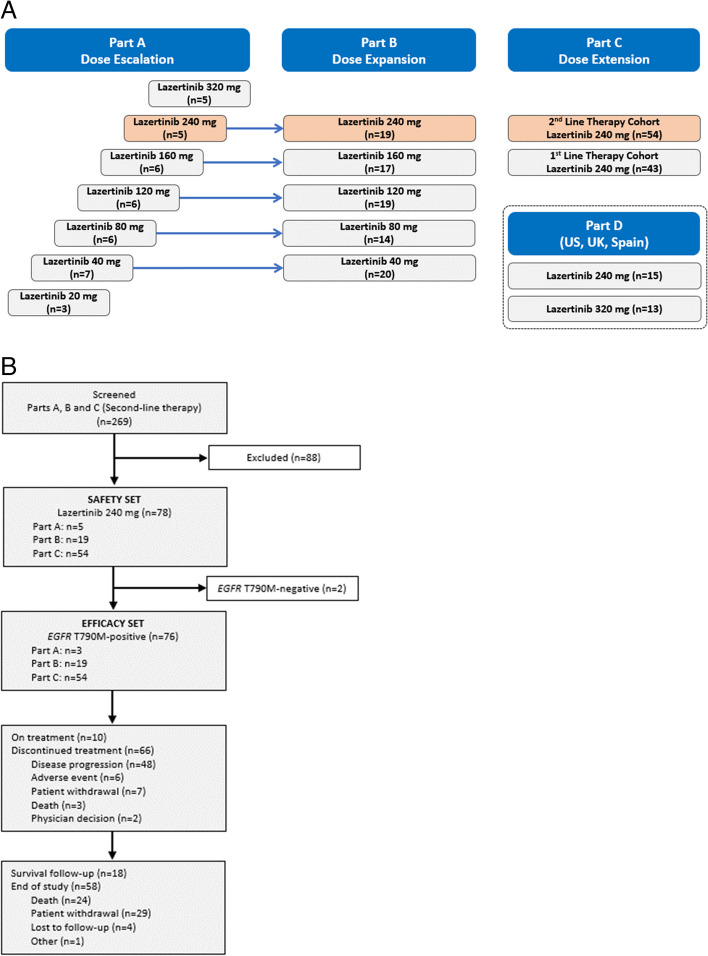
Eligible patients were aged ≥ 20 years, with advanced EGFR-mutated NSCLC and previous therapy with EGFR TKI. Patients in this integrated analysis received oral lazertinib 240 mg/day. Endpoints included efficacy and safety; exploratory analyses included associations between circulating EGFR-mutant tumor DNA (ctDNA) and efficacy parameters.
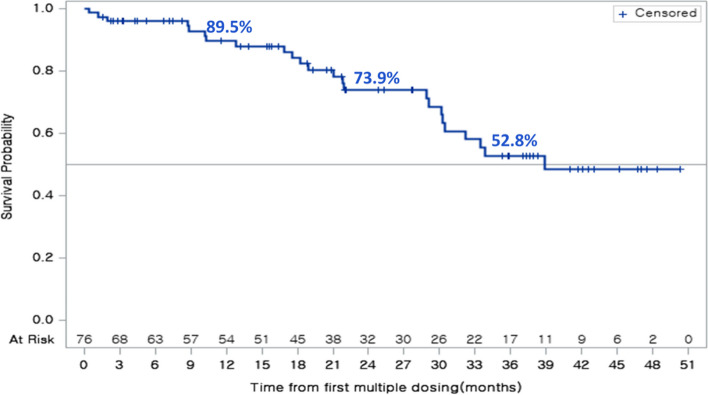
This integrated analysis included 78 patients in Korea who received second- or later-line lazertinib. The median OS was 38.9 months; estimated survival rates at 12, 24, and 36 months were 89.5%, 73.9%, and 52.8%, respectively. The cumulative 12-month incidence of central nervous system progression was 9.4%. EGFR-mutant ctDNA was detected in 46 patients (62.2%) at baseline. The presence of ctDNA at baseline significantly predicted progression-free survival (PFS), disease control rate (DCR), and OS. PFS, response rate, and DCR were significantly associated with EGFR-mutant ctDNA clearance at cycle 3; PFS and OS were significantly associated with ctDNA clearance at cycle 5. The safety profile of lazertinib 240 mg/day was consistent with previous findings.
Lazertinib is a promising treatment option for patients with EGFR T790M-positive NSCLC following disease progression on prior EGFR-directed TKIs. Patients in LASER201 experienced prolonged OS, regardless of their EGFR mutation, brain metastases, or prior brain radiation status. Clearance of plasma EGFR mutations after lazertinib was associated with patient outcomes.
ClinicalTrials.gov identifier NCT03046992.
拉泽替尼是一种强效、不可逆的第三代表皮生长因子受体(EGFR)酪氨酸激酶抑制剂(TKI),对 EGFR T790M 突变的非小细胞肺癌(NSCLC)患者具有显著疗效。这是在先前 EGFR TKI 治疗后疾病进展的晚期 NSCLC 患者中进行的 1/2 期 LASER201 研究的最终总生存(OS)报告。
符合条件的患者年龄≥20 岁,患有晚期 EGFR 突变 NSCLC,并在先前接受过 EGFR TKI 治疗。在这项综合分析中,患者接受了口服拉泽替尼 240mg/天。主要终点包括疗效和安全性;探索性分析包括循环 EGFR 突变肿瘤 DNA(ctDNA)与疗效参数之间的关系。
这项综合分析纳入了 78 名在韩国接受二线或二线以上拉泽替尼治疗的患者。中位 OS 为 38.9 个月;12、24 和 36 个月的估计生存率分别为 89.5%、73.9%和 52.8%。中枢神经系统进展的累积 12 个月发生率为 9.4%。基线时有 46 名患者(62.2%)检测到 EGFR 突变 ctDNA。基线时存在 ctDNA 显著预测无进展生存期(PFS)、疾病控制率(DCR)和 OS。PFS、反应率和 DCR 与第 3 周期时 EGFR 突变 ctDNA 清除率显著相关;PFS 和 OS 与第 5 周期时 ctDNA 清除率显著相关。拉泽替尼 240mg/天的安全性特征与之前的发现一致。
拉泽替尼是 EGFR T790M 阳性 NSCLC 患者在先前 EGFR 定向 TKI 治疗后疾病进展的一种有前途的治疗选择。LASER201 中的患者无论 EGFR 突变、脑转移或先前脑放疗状态如何,均经历了延长的 OS。拉泽替尼治疗后血浆 EGFR 突变的清除与患者结局相关。
ClinicalTrials.gov 标识符 NCT03046992。