Spezia Marie C, Dy Christopher J, Brogan David M
University of Missouri-Columbia School of Medicine, Columbia, MO.
The Institute of Clinical and Translational Sciences and Clinical Research Training Center, Washington University, St. Louis, MO.
J Hand Surg Glob Online. 2024 Mar 26;6(5):676-680. doi: 10.1016/j.jhsg.2024.01.017. eCollection 2024 Sep.
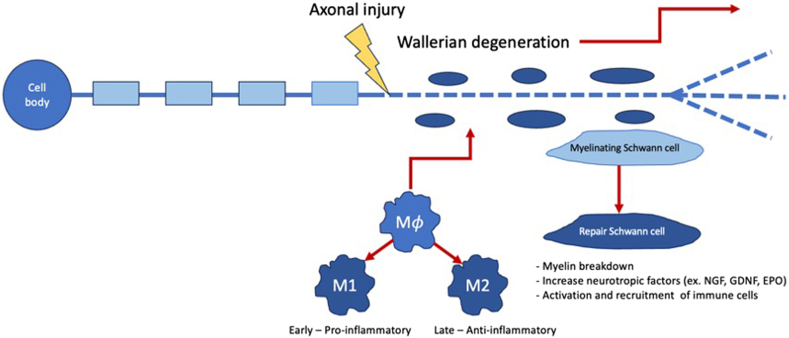
Peripheral nerve injuries affect a significant number of patients who experience trauma affecting the hand and upper extremity. Improving unsatisfactory outcomes from repair of these injuries remains a clinical challenge despite advancements in microsurgical repair. Imperfections of the nerve regeneration process, including imprecise reinnervation, distal axon degradation, and muscular atrophy, complicate the repair process. However, the capacity for peripheral nerves to regenerate offers an avenue for therapeutic advancement. Regeneration is a temporally and spatially dynamic process coordinated by Schwann cells and neurons among other cell types. Neurotrophic factors are a primary means of controlling cell growth and differentiation in the repair setting. Sustained axon survival and regrowth and consequently functional outcomes of nerve repair in animal models are improved by the administration of neurotrophic factors, including glial cell-derived neurotrophic factor, nerve growth factor, sterile alpha and TIR motif containing 1, and erythropoietin. Targeted and sustained delivery of neurotrophic factors through gelatin-based nerve conduits, multiluminal conduits, and hydrogels have been shown to enhance the innate roles of these factors to promote expedient and accurate peripheral nerve regeneration in animal models. These delivery methods may help address the practical limitations to clinical use of neurotrophic factors, including systemic side effects and the need for carefully timed, precisely localized release schedules. In addition, tacrolimus has also improved peripheral nerve regrowth in animal models and has recently shown promise in addressing human disease. Ultimately, this realm of adjunct pharmacotherapies provides ample promise to improve patient outcomes and advance the field of peripheral nerve repair.
周围神经损伤影响着大量因手部和上肢创伤而就医的患者。尽管显微外科修复技术有所进步,但改善这些损伤修复后不尽人意的结果仍是一项临床挑战。神经再生过程存在缺陷,包括神经再支配不精确、远端轴突退化和肌肉萎缩,使修复过程变得复杂。然而,周围神经的再生能力为治疗进展提供了一条途径。再生是一个由施万细胞和神经元等多种细胞类型协调的时空动态过程。神经营养因子是修复过程中控制细胞生长和分化的主要手段。在动物模型中,通过给予神经营养因子,包括胶质细胞源性神经营养因子、神经生长因子、含无菌α和TIR基序1以及促红细胞生成素,可提高轴突的持续存活和再生能力,从而改善神经修复的功能结果。通过基于明胶的神经导管、多腔导管和水凝胶靶向且持续地递送神经营养因子,已被证明可增强这些因子的固有作用,以促进动物模型中快速且准确的周围神经再生。这些递送方法可能有助于解决神经营养因子临床应用中的实际限制,包括全身副作用以及对精确计时、精确定位释放时间表的需求。此外,他克莫司也改善了动物模型中的周围神经再生,并且最近在治疗人类疾病方面显示出前景。最终,这一辅助药物治疗领域为改善患者预后和推动周围神经修复领域的发展提供了充足的希望。