Sconza Cristiano, Palloni Valentina, Lorusso Domenico, Guido Federico, Farì Giacomo, Tognolo Lucrezia, Lanza Ezio, Brindisino Fabrizio
IRCCS Humanitas Research Hospital, Rozzano, Milan, Italy.
Department of Physical Medicine and Rehabilitation, University of Milan, Milan, Italy -
Eur J Phys Rehabil Med. 2024 Dec;60(6):995-1008. doi: 10.23736/S1973-9087.24.08544-7. Epub 2024 Oct 9.
Ultrasound-guided lavage (UGL) is a minimally invasive percutaneous treatment for rotator cuff calcific tendinopathy (RCCT). It involves the use of a syringe containing saline and/or anesthetic solution injected directly into the calcification allowing aspiration of the fragmented calcific material. The aim of this systematic review is to investigate if UGL is effective in improving pain, function, quality of life, range of motion (ROM), and in promoting complete resorption of calcifications in patients with RCCT.
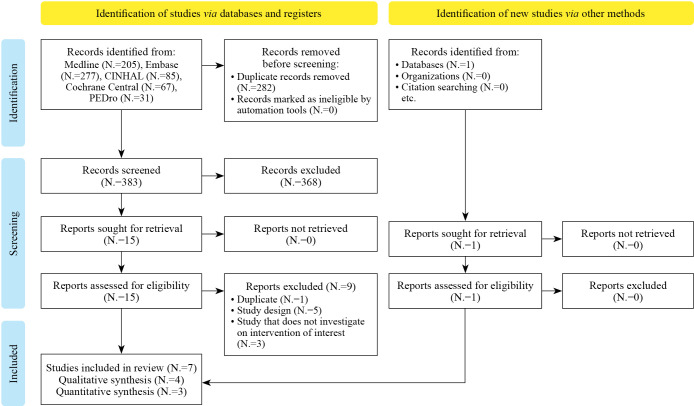
Only randomized controlled trials considering people diagnosed with RCCT, at any stage and at any time of the onset of symptoms treated with UGL, were included. Embase, CENTRAL, CINHAL, PEDro and MEDLINE were explored up until May 2024. Two independent authors selected randomized controlled trials by title and abstract; afterwards, the full text was thoroughly evaluated. The risk of bias (ROB) was assessed using the Cochrane risk of bias 2 (ROB2) tool and the certainty of evidence was evaluated through the GRADE approach.
Seven studies (709 subjects) were included. Overall, three studies were judged as low risk of bias. Pooled results showed non-significant differences between UGL and extracorporeal shock-wave therapy (ESWT) at 12 weeks (SMD=-0.52, 95% CI -1.57, 0.54, P=0.34, I=93%) and at 26 weeks (MD=-1.20, 95% CI -2.66, 0.27, P=0.11, I=82%), while a significant difference favoring UGL (SMD=-0.52, 95% CI -0.85, -0.19, P=0.002, I=38%) resulted at 52 weeks. In regard to function, pooled results showed non-significant difference between UGL and ESWT at 6 weeks (MD=3.34, 95% CI -11.45, 18.12, P=0.66, I=79%) and at 52 weeks (SMD=0.10, 95% CI -0.40, 0.60, P=0.69, I=30%). Considering the rate of resorption of calcifications between UGL combined with subacromial corticosteroid injection (SCI) versus injection alone, pooled results showed significant difference favoring UGL at <52 weeks (RR=1.63 95% CI 1.34, 1.98, P<0.00001, I=0%). Certainty of evidence ranged from low to very low.
UGL seems to be a reasonable and safe treatment for RCCT, however compared to other non/mini-invasive approaches, UGL showed doubtful results in controlling pain and increasing function and rate of calcifications resorption. These results should be interpreted with caution because certainty of evidence ranged from low to very low.
超声引导下灌洗(UGL)是一种用于治疗肩袖钙化性肌腱炎(RCCT)的微创经皮治疗方法。它包括使用装有生理盐水和/或麻醉溶液的注射器直接注入钙化部位,以便吸出破碎的钙化物质。本系统评价的目的是研究UGL是否能有效改善RCCT患者的疼痛、功能、生活质量、关节活动范围(ROM),并促进钙化的完全吸收。
仅纳入了考虑在任何阶段和症状发作的任何时间被诊断为RCCT且接受UGL治疗的人群的随机对照试验。截至2024年5月,对Embase、CENTRAL、CINHAL、PEDro和MEDLINE进行了检索。两名独立作者通过标题和摘要筛选随机对照试验;之后,对全文进行了全面评估。使用Cochrane偏倚风险2(ROB2)工具评估偏倚风险,并通过GRADE方法评估证据的确定性。
纳入了7项研究(709名受试者)。总体而言,3项研究被判定为低偏倚风险。汇总结果显示,UGL与体外冲击波疗法(ESWT)在12周时(标准化均数差=-0.52,95%置信区间-1.57,0.54,P=0.34,I²=93%)和26周时(平均差=-1.20,95%置信区间-2.66,0.27,P=0.11,I²=82%)无显著差异,而在52周时有利于UGL的显著差异出现(标准化均数差=-0.52,95%置信区间-0.85,-0.19,P=0.002,I²=38%)。关于功能,汇总结果显示UGL与ESWT在6周时(平均差=3.34,95%置信区间-11.45,18.12,P=0.66,I²=79%)和52周时(标准化均数差=0.10,95%置信区间-0.40,0.60,P=0.69,I²=30%)无显著差异。考虑UGL联合肩峰下皮质类固醇注射(SCI)与单独注射时钙化的吸收速率,汇总结果显示在<52周时有利于UGL的显著差异(相对危险度=1.63,95%置信区间1.34,1.98,P<0.00001,I²=0%)。证据的确定性范围从低到非常低。
UGL似乎是一种治疗RCCT的合理且安全的方法,然而与其他非/微创方法相比,UGL在控制疼痛、增加功能和钙化吸收速率方面的效果存疑。由于证据的确定性范围从低到非常低,这些结果应谨慎解读。