McCutchin Christina A, Edgar Kevin J, Chen Chun-Long, Dove Patricia M
Department of Chemistry, Virginia Tech, Blacksburg, Virginia 24061, United States.
Department of Sustainable Biomaterials, Virginia Tech, Blacksburg, Virginia 24061, United States.
Biomacromolecules. 2025 Jan 13;26(1):43-84. doi: 10.1021/acs.biomac.4c00674. Epub 2024 Oct 9.
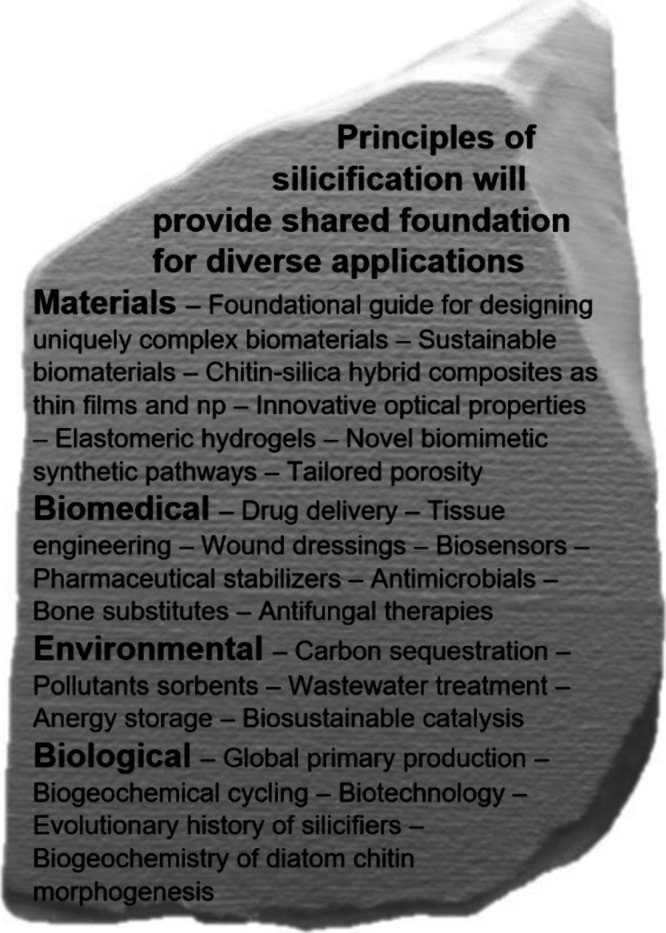
Silica-organic composites are receiving renewed attention for their versatility and environmentally benign compositions. Of particular interest is how macromolecules interact with aqueous silica to produce functional materials that confer remarkable physical properties to living organisms. This Review first examines silicification in organisms and the biomacromolecule properties proposed to modulate these reactions. We then highlight findings from silicification studies organized by major classes of biomacromolecules. Most investigations are qualitative, using disparate experimental and analytical methods and minimally characterized materials. Many findings are contradictory and, altogether, demonstrate that a consistent picture of biomacromolecule-Si interactions has not emerged. However, the collective evidence shows that functional groups, rather than molecular classes, are key to understanding macromolecule controls on mineralization. With recent advances in biopolymer chemistry, there are new opportunities for hypothesis-based studies that use quantitative experimental methods to decipher how macromolecule functional group chemistry and configuration influence thermodynamic and kinetic barriers to silicification. Harnessing the principles of silica-macromolecule interactions holds promise for biocomposites with specialized applications from biomedical and clean energy industries to other material-dependent industries.
硅石-有机复合材料因其多功能性和环境友好型组成而重新受到关注。特别令人感兴趣的是大分子如何与含水硅石相互作用,从而产生赋予生物体显著物理特性的功能材料。本综述首先考察生物体中的硅化作用以及被认为可调节这些反应的生物大分子特性。然后,我们着重介绍按主要生物大分子类别分类的硅化研究结果。大多数研究都是定性的,采用了不同的实验和分析方法,且材料表征最少。许多研究结果相互矛盾,总体而言,表明尚未形成生物大分子与硅相互作用的一致图景。然而,总体证据表明,官能团而非分子类别是理解大分子对矿化控制的关键。随着生物聚合物化学的最新进展,基于假设的研究有了新机会,这些研究使用定量实验方法来解读大分子官能团化学和构型如何影响硅化的热力学和动力学障碍。利用硅石-大分子相互作用的原理有望开发出具有特殊应用的生物复合材料,这些应用涵盖从生物医学和清洁能源行业到其他依赖材料的行业。