Yokohama City University Graduate School of Medicine, 4-57 Urafune, Minami-ku, Yokohama, 236-0004, Japan.
Japanese Foundation for Cancer Research, 3-8-31, Ariake, Koto-ku, Tokyo, 135-8500, Japan.
Int J Clin Oncol. 2024 Dec;29(12):1825-1839. doi: 10.1007/s10147-024-02632-x. Epub 2024 Oct 9.
Previously reported results from phase III KEYNOTE-048 demonstrated similar or improved overall survival (OS) with pembrolizumab or pembrolizumab-chemotherapy versus cetuximab-chemotherapy (EXTREME) in Japanese patients with recurrent/metastatic head and neck squamous cell carcinoma (R/M HNSCC). We report results in Japanese patients from KEYNOTE-048 after 5 years of follow-up.
Patients with R/M HNSCC of the oropharynx, oral cavity, hypopharynx, or larynx were randomly assigned 1:1:1 to pembrolizumab, pembrolizumab-chemotherapy, or EXTREME. Primary endpoints were OS and progression-free survival. Efficacy was evaluated in the programmed cell death ligand 1 (PD-L1) combined positive score (CPS) ≥ 20, PD-L1 CPS ≥ 1, and total Japanese populations.
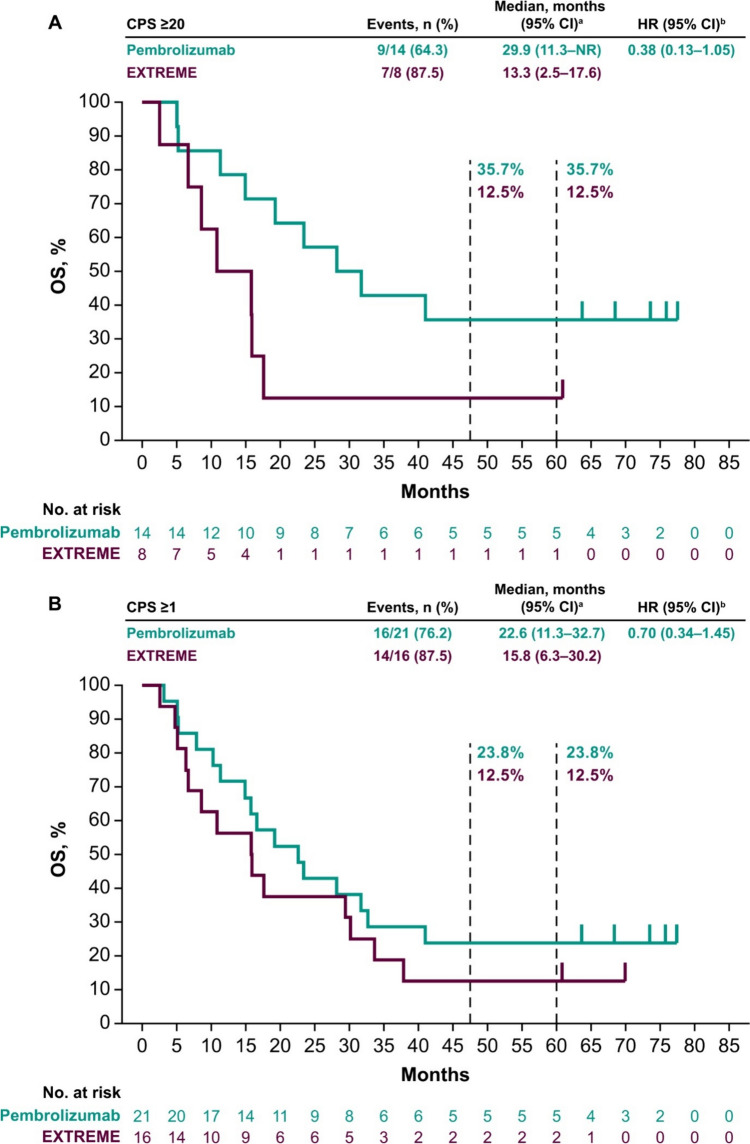
In Japan, 67 patients were enrolled (pembrolizumab, n = 23; pembrolizumab-chemotherapy, n = 25; EXTREME, n = 19). Median follow-up was 71.0 months (range, 61.2-81.5); data cutoff, February 21, 2022. 5-year OS rates with pembrolizumab versus EXTREME were 35.7% versus 12.5% (hazard ratio [HR] 0.38; 95% CI 0.13-1.05), 23.8% versus 12.5% (HR 0.70; 95% CI 0.34-1.45), and 30.4% versus 10.5% (HR 0.54; 95% CI 0.27-1.07) in the PD-L1 CPS ≥ 20, CPS ≥ 1, and total Japanese populations, respectively. 5-year OS rates with pembrolizumab-chemotherapy versus EXTREME were 20.0% versus 14.3% (HR 0.79; 95% CI 0.27-2.33), 10.5% versus 14.3% (HR 1.18; 95% CI 0.56-2.48), and 8.0% versus 12.5% (HR 1.11; 95% CI 0.57-2.16) in the PD-L1 CPS ≥ 20, CPS ≥ 1, and total Japanese populations, respectively.
After 5 years of follow-up, pembrolizumab and pembrolizumab-chemotherapy showed long-term clinical benefits; results further support these treatments as first-line options for Japanese patients with R/M HNSCC.
NCT02358031.
此前 III 期 KEYNOTE-048 研究结果显示,与西妥昔单抗联合化疗(EXTREME)相比,在复发/转移性头颈部鳞状细胞癌(R/M HNSCC)的日本患者中,帕博利珠单抗或帕博利珠单抗联合化疗在总生存期(OS)方面表现出相似或改善。我们报告了 KEYNOTE-048 中来自日本患者的 5 年随访结果。
接受过治疗的局部晚期或转移性口咽、口腔、下咽或喉鳞状细胞癌患者按 1:1:1 的比例随机分配至帕博利珠单抗、帕博利珠单抗联合化疗或 EXTREME 组。主要终点为 OS 和无进展生存期。在程序性死亡配体 1(PD-L1)联合阳性评分(CPS)≥20、PD-L1 CPS≥1 和全日本人群中评估疗效。
在日本,共纳入 67 例患者(帕博利珠单抗组 n=23;帕博利珠单抗联合化疗组 n=25;EXTREME 组 n=19)。中位随访时间为 71.0 个月(范围,61.2-81.5);数据截止日期为 2022 年 2 月 21 日。与 EXTREME 相比,帕博利珠单抗组的 5 年 OS 率为 35.7%比 12.5%(风险比 [HR] 0.38;95%置信区间 [CI] 0.13-1.05)、23.8%比 12.5%(HR 0.70;95% CI 0.34-1.45)和 30.4%比 10.5%(HR 0.54;95% CI 0.27-1.07),在 PD-L1 CPS≥20、CPS≥1 和全日本人群中分别为。与 EXTREME 相比,帕博利珠单抗联合化疗组的 5 年 OS 率为 20.0%比 14.3%(HR 0.79;95% CI 0.27-2.33)、10.5%比 14.3%(HR 1.18;95% CI 0.56-2.48)和 8.0%比 12.5%(HR 1.11;95% CI 0.57-2.16),在 PD-L1 CPS≥20、CPS≥1 和全日本人群中分别为。
在 5 年随访后,帕博利珠单抗和帕博利珠单抗联合化疗显示出长期临床获益;这些结果进一步支持这些治疗方案作为日本复发/转移性头颈部鳞状细胞癌患者的一线选择。
NCT02358031。