U.S. Geological Survey, Western Ecological Research Center, San Diego, California, United States of America.
Department of Biology, Eastern Oregon University, One University Boulevard, La Grande, Oregon, United States of America.
PLoS One. 2024 Oct 9;19(10):e0310812. doi: 10.1371/journal.pone.0310812. eCollection 2024.
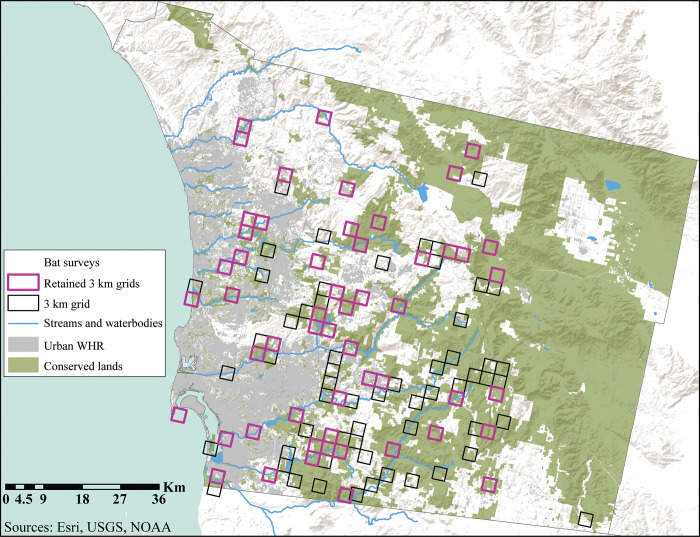
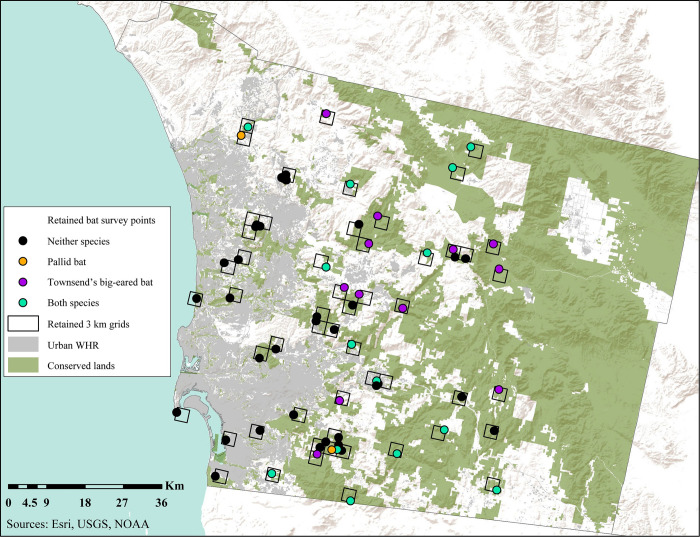
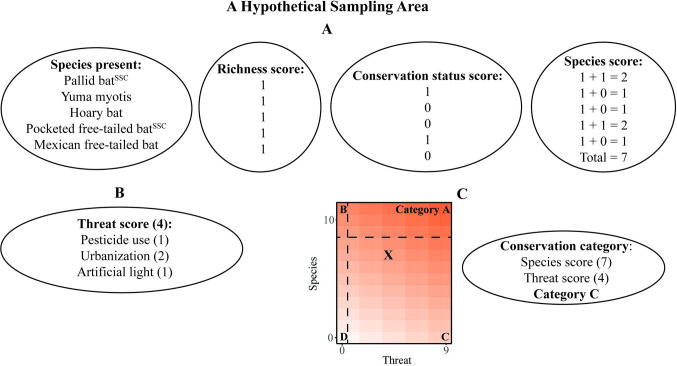
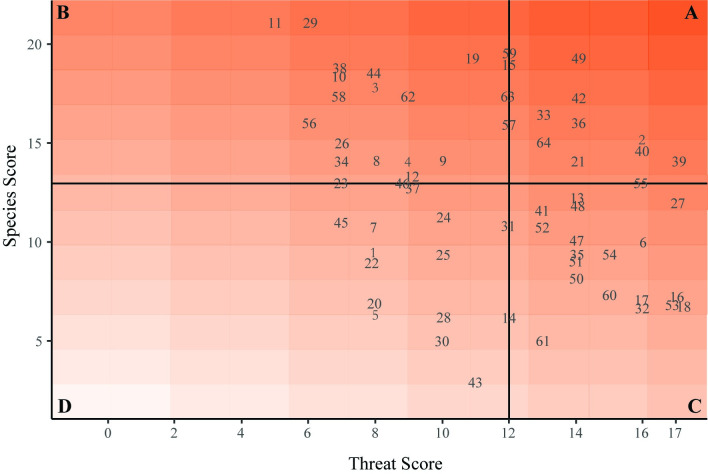
In a rapidly changing world, where species conservation needs vary by local habitat, concentrated conservation efforts at small spatial scales can be critical. Bats provide an array of value to the ecosystems they inhabit; many bat species are also of conservation concern. San Diego County, California, contains 22 of the 41 bat species that occur in the United States, 16 of which are on conservation watchlists. Thus, management of bat communities in San Diego County is a pressing need. Because bats exploit vast areas of the landscape and historical sampling strategies have shifted over time, a standardized way of prioritizing areas of the landscape for management would provide an integral asset to bat conservation. We leveraged long-term bat community survey data from sampling areas across San Diego County to prioritize areas with the most management need. We calculated two types of scores: species scores and threat scores. Species scores incorporated richness and conservation status, and threat scores included landscape level threats that bats could encounter. We found that urbanization, the presence of artificial lights, and areas sampled on unconserved land were all significantly associated with decreases in species richness. Further, using species and threat scores, each sampling area was placed into one of four conservation categories, in order from greatest to least conservation need, ranging from highest priority (high species score, high threat score) to lowest (low species score, low threat score). Additionally, we focused on sampling areas in which Townsend's big-eared bat (Corynorhinus townsendii) and/or pallid bat (Antrozous pallidus) occurred. These two species are of exceptional conservation concern in San Diego County and across the western United States. We identified urbanization, the presence of artificial lights, and areas sampled on unconserved land as threats that were all significantly associated with the absence of Townsend's big-eared bat, but not pallid bat. The strategy, methodology, and solutions proposed in our study should assist bat conservation and management efforts wherever bats occur, and can be extended to other species that require conservation attention.
在一个瞬息万变的世界中,由于物种保护需求因当地栖息地而异,因此在小空间尺度上集中进行保护工作可能至关重要。蝙蝠为它们栖息的生态系统提供了多种价值;许多蝙蝠物种也受到保护关注。加利福尼亚州圣地亚哥县包含在美国出现的 41 种蝙蝠中的 22 种,其中 16 种被列入保护观察名单。因此,管理圣地亚哥县的蝙蝠群落是当务之急。由于蝙蝠在景观中利用了广阔的区域,并且历史采样策略随着时间的推移而发生了变化,因此,优先考虑景观管理区域的标准化方法将为蝙蝠保护提供重要资产。我们利用来自圣地亚哥县各地采样区的长期蝙蝠群落调查数据,对最需要管理的区域进行优先级排序。我们计算了两种类型的分数:物种分数和威胁分数。物种分数纳入了丰富度和保护状况,而威胁分数则包括蝙蝠可能遇到的景观水平威胁。我们发现,城市化、人工灯光的存在以及在未受保护土地上采样的区域都与物种丰富度的降低显著相关。此外,使用物种和威胁分数,每个采样区域都被归入四个保护类别之一,从最需要保护的区域(物种分数高、威胁分数高)到最不需要保护的区域(物种分数低、威胁分数低)。此外,我们专注于采样区域,其中包括汤森氏大耳蝠(Corynorhinus townsendii)和/或苍白蝙蝠(Antrozous pallidus)。这两个物种在圣地亚哥县和整个美国西部都受到特别关注。我们确定了城市化、人工灯光的存在以及在未受保护土地上采样的区域是与汤森氏大耳蝠不存在显著相关的威胁,但与苍白蝙蝠无关。我们研究中提出的策略、方法和解决方案应该有助于蝙蝠保护和管理工作,无论蝙蝠在何处出现,并且可以扩展到需要保护关注的其他物种。