Froidevaux J S P, Boughey K L, Hawkins C L, Jones G, Collins J
School of Biological Sciences University of Bristol Bristol UK.
Université de Toulouse, INRAE, UMR DYNAFOR Castanet-Tolosan France.
Anim Conserv. 2020 Oct;23(5):597-606. doi: 10.1111/acv.12574. Epub 2020 Apr 2.
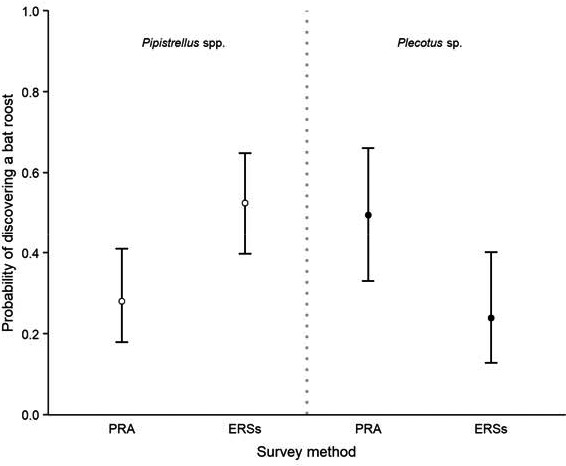
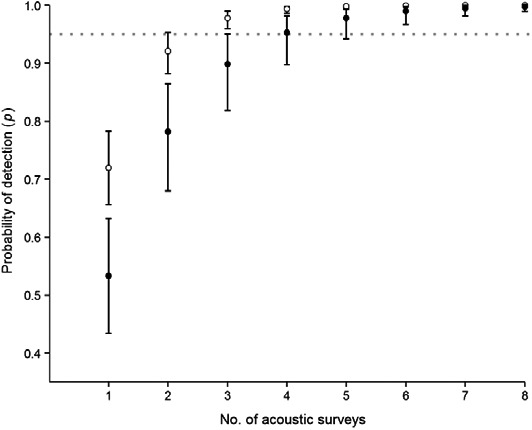
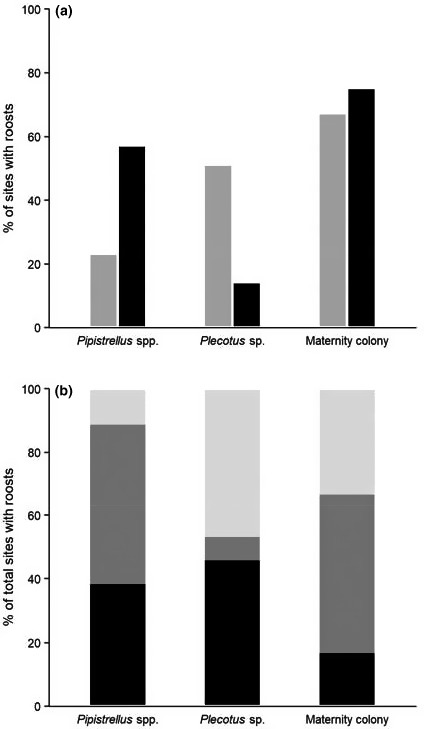
The disturbance, damage and destruction of roosts are key drivers of bat population declines worldwide. In countries where bats are protected by law, bat roost surveys are often required to inform ecological impact assessments. Yet, evidence-based information on survey methodology to detect bat roosts is crucially lacking, and failing to detect a roost can lead to serious errors during decision-making processes. Here, we assess the efficacy of bat roost surveys in buildings as implemented in the UK. These consist of a daytime inspection of buildings, followed by a series of acoustic surveys at dusk/dawn if during the daytime inspection evidence of bats is found, or if the absence of bats cannot be verified. We reviewed 155 ecological consultants' reports to (1) compare survey outcome between daytime inspection and acoustic surveys and (2) determine the minimum sampling effort required during acoustic surveys to be confident that no bats are roosting within a building. We focused on two genera of bats most frequently found in buildings in Europe - (crevice roosting species with high-intensity echolocation calls that can be easily detected by ultrasound detectors) and (species that roost in open spaces and which emit faint echolocation calls that are difficult to detect). Daytime inspections were efficient in detecting open-roosting species such as species but were likely to miss the presence of crevice-dwelling ones (here species) which may lead to erroneous conclusions if no acoustic surveys are subsequently prescribed to confirm their absence. A minimum of three and four acoustic surveys are required to be 95% confident that a building does not host a roost of species and species, respectively, thus exceeding current recommendations. Overall, we demonstrated that reports submitted as part of an ecological impact assessment provide suitable data to test and improve survey methods.
栖息地的干扰、破坏和损毁是全球蝙蝠种群数量下降的关键驱动因素。在蝙蝠受到法律保护的国家,通常需要进行蝙蝠栖息地调查,以为生态影响评估提供依据。然而,至关重要的是,目前缺乏关于检测蝙蝠栖息地的调查方法的循证信息,而且未能检测到栖息地可能会在决策过程中导致严重错误。在此,我们评估了英国实施的建筑物内蝙蝠栖息地调查的效果。这些调查包括对建筑物进行日间检查,如果在日间检查中发现蝙蝠迹象,或者无法确认没有蝙蝠,则在黄昏/黎明时分进行一系列声学调查。我们查阅了155份生态顾问的报告,以(1)比较日间检查和声学调查的结果,以及(2)确定声学调查期间所需的最小采样工作量,以确保有信心认为建筑物内没有蝙蝠栖息。我们重点关注了欧洲建筑物中最常见的两类蝙蝠——(具有高强度回声定位叫声、可被超声波探测器轻松检测到的缝隙栖息物种)和 (栖息在开阔空间、发出微弱回声定位叫声且难以检测到的物种)。日间检查在检测诸如 物种等开阔栖息物种方面很有效,但很可能会遗漏缝隙栖息物种(此处为 物种)的存在,如果随后没有规定进行声学调查以确认其不存在,可能会导致错误结论。分别需要至少进行三次和四次声学调查,才能有95%的信心认为建筑物内没有 物种和 物种的栖息地,因此超出了当前的建议。总体而言,我们证明,作为生态影响评估一部分提交的报告提供了合适的数据来测试和改进调查方法。