Department of Biology, University of York, York, UK.
Centre for Novel Agricultural Products (CNAP), Department of Biology, University of York, York, UK.
Nat Plants. 2024 Nov;10(11):1801-1813. doi: 10.1038/s41477-024-01812-x. Epub 2024 Oct 9.
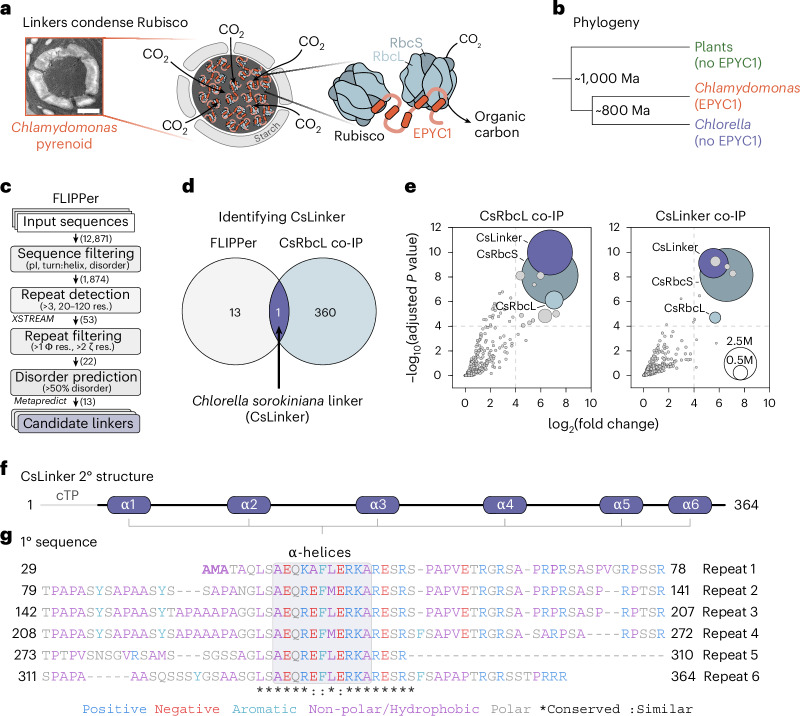
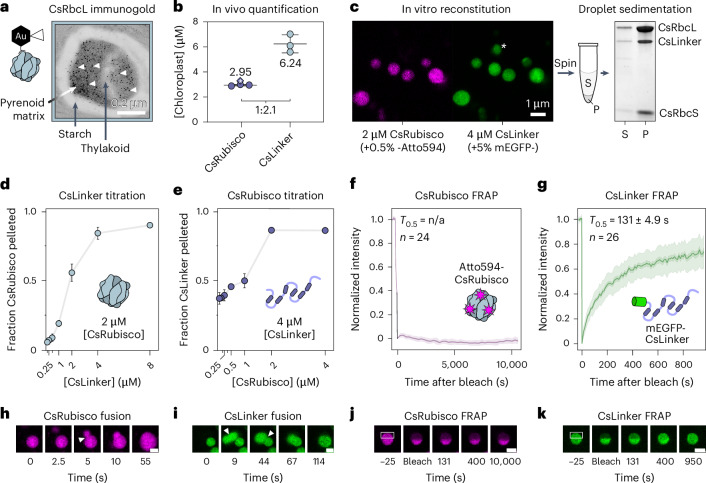
CO fixation is commonly limited by inefficiency of the CO-fixing enzyme Rubisco. Eukaryotic algae concentrate and fix CO in phase-separated condensates called pyrenoids, which complete up to one-third of global CO fixation. Condensation of Rubisco in pyrenoids is dependent on interaction with disordered linker proteins that show little conservation between species. We developed a sequence-independent bioinformatic pipeline to identify linker proteins in green algae. We report the linker from Chlorella and demonstrate that it binds a conserved site on the Rubisco large subunit. We show that the Chlorella linker phase separates Chlamydomonas Rubisco and that despite their separation by ~800 million years of evolution, the Chlorella linker can support the formation of a functional pyrenoid in Chlamydomonas. This cross-species reactivity extends to plants, with the Chlorella linker able to drive condensation of some native plant Rubiscos in vitro and in planta. Our results represent an exciting frontier for pyrenoid engineering in plants, which is modelled to increase crop yields.
CO 固定通常受到 CO 固定酶 Rubisco 效率低下的限制。真核藻类在称为淀粉核的相分离凝聚物中浓缩和固定 CO,这些凝聚物完成了全球三分之一的 CO 固定。Rubisco 在淀粉核中的凝聚取决于与无序连接蛋白的相互作用,这些蛋白在物种之间几乎没有保守性。我们开发了一种序列无关的生物信息学管道来识别绿藻中的连接蛋白。我们报告了来自衣藻的连接蛋白,并证明它与 Rubisco 大亚基上的保守位点结合。我们表明,衣藻连接蛋白使衣藻 Rubisco 相分离,尽管它们在 8 亿年的进化中分离,但衣藻连接蛋白可以支持在衣藻中形成功能性淀粉核。这种种间反应性扩展到植物,衣藻连接蛋白能够驱动一些天然植物 Rubisco 在体外和体内的凝聚。我们的结果代表了植物淀粉核工程的一个令人兴奋的前沿领域,该领域的模型旨在提高作物产量。