Department of Molecular Biology, Princeton University, Princeton, NJ, USA.
Lewis-Sigler Institute for Integrative Genomics, Princeton University, Princeton, NJ, USA.
Nat Plants. 2022 May;8(5):583-595. doi: 10.1038/s41477-022-01153-7. Epub 2022 May 19.
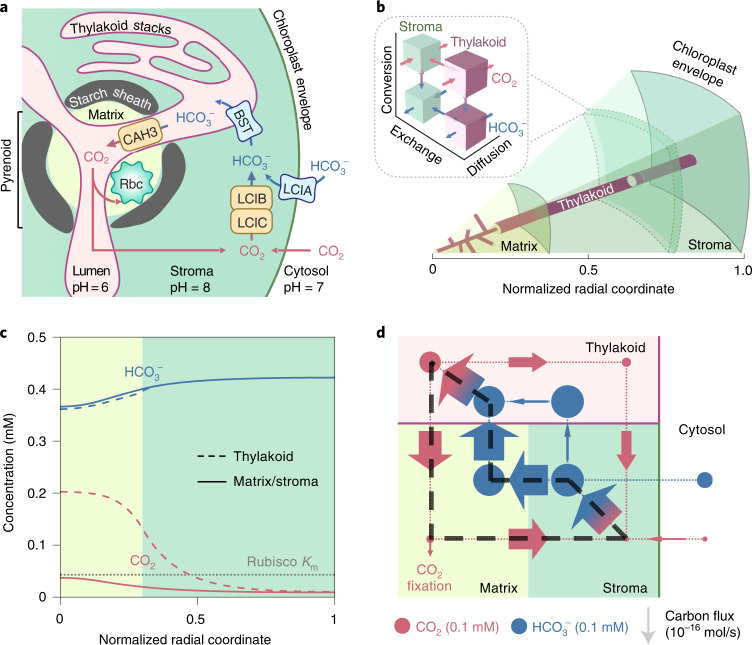
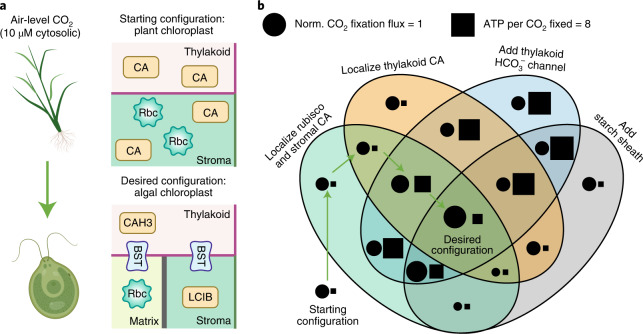
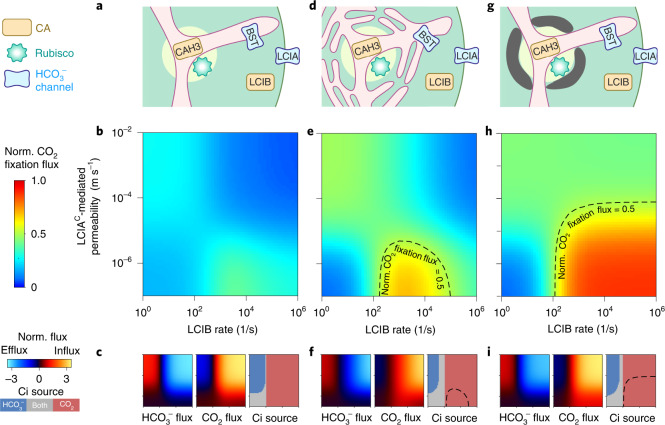
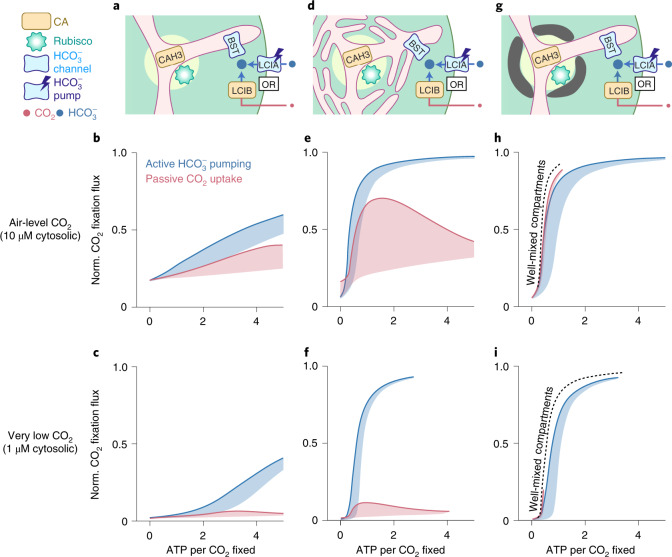
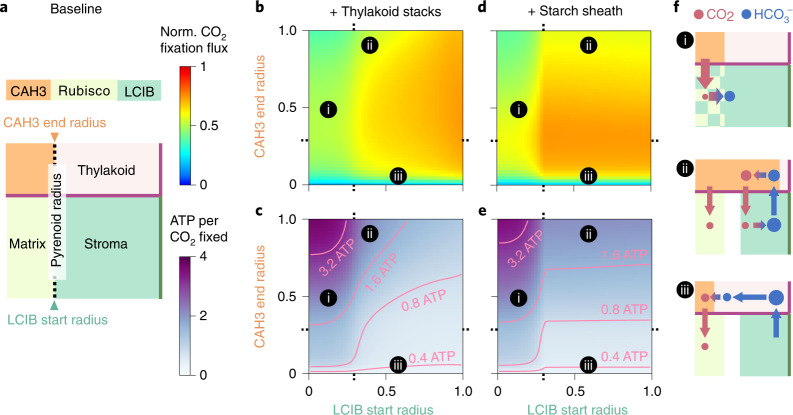
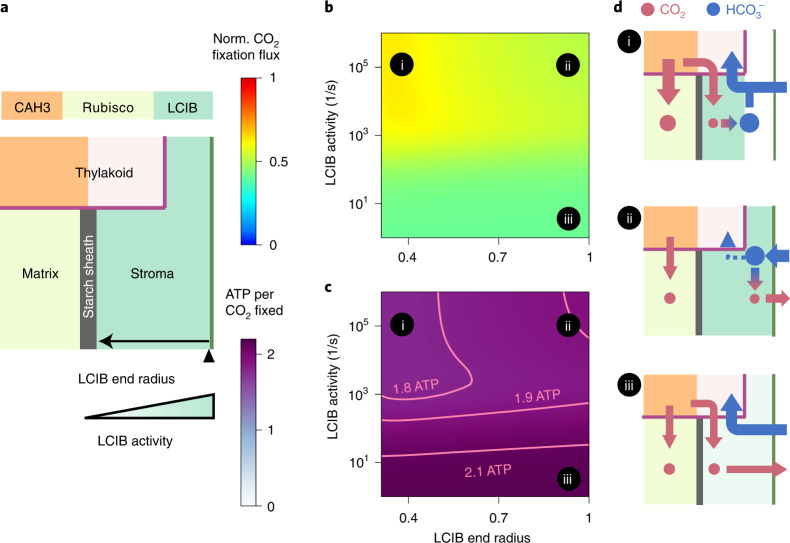
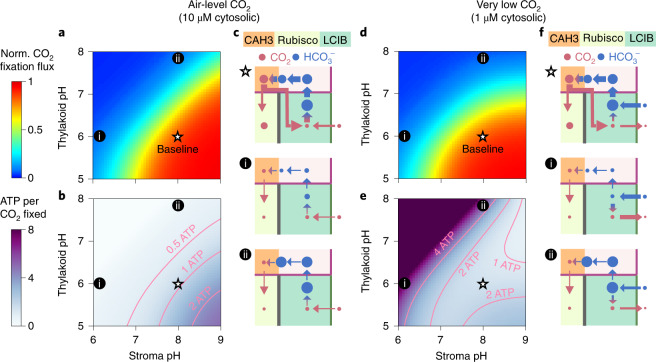
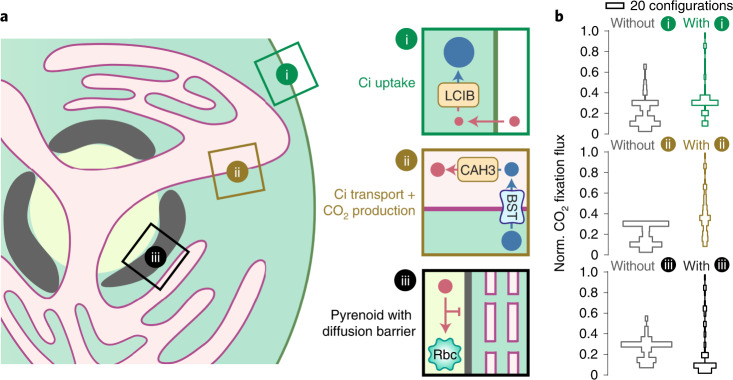
Many eukaryotic photosynthetic organisms enhance their carbon uptake by supplying concentrated CO to the CO-fixing enzyme Rubisco in an organelle called the pyrenoid. Ongoing efforts seek to engineer this pyrenoid-based CO-concentrating mechanism (PCCM) into crops to increase yields. Here we develop a computational model for a PCCM on the basis of the postulated mechanism in the green alga Chlamydomonas reinhardtii. Our model recapitulates all Chlamydomonas PCCM-deficient mutant phenotypes and yields general biophysical principles underlying the PCCM. We show that an effective and energetically efficient PCCM requires a physical barrier to reduce pyrenoid CO leakage, as well as proper enzyme localization to reduce futile cycling between CO and HCO. Importantly, our model demonstrates the feasibility of a purely passive CO uptake strategy at air-level CO, while active HCO uptake proves advantageous at lower CO levels. We propose a four-step engineering path to increase the rate of CO fixation in the plant chloroplast up to threefold at a theoretical cost of only 1.3 ATP per CO fixed, thereby offering a framework to guide the engineering of a PCCM into land plants.
许多真核光合生物通过在被称为淀粉核的细胞器中将浓缩的 CO 供应给 CO 固定酶 Rubisco 来增强其碳吸收能力。目前正在努力将这种基于淀粉核的 CO 浓缩机制 (PCCM) 工程化到作物中以提高产量。在这里,我们基于绿藻莱茵衣藻中的假定机制为 PCCM 开发了一个计算模型。我们的模型再现了所有 Chlamydomonas PCCM 缺陷突变体的表型,并得出了 PCCM 所依据的一般生物物理原理。我们表明,有效的和节能的 PCCM 需要物理屏障来减少淀粉核 CO 泄漏,以及适当的酶定位来减少 CO 和 HCO 之间的无效循环。重要的是,我们的模型证明了在空气水平的 CO 下采用纯被动 CO 摄取策略的可行性,而主动 HCO 摄取在较低的 CO 水平下证明是有利的。我们提出了一个四步工程途径,以将植物叶绿体中 CO 的固定速率提高到理论上的三倍,每固定 1 个 CO 只需消耗 1.3 个 ATP,从而为将 PCCM 工程化到陆地植物中提供了一个框架。