Ranzau Brodie L, Robinson Tiffany D, Scully Jack M, Kapelczack Edmund D, Dean Teagan S, TeSlaa Tara, Schmitt Danielle L
Department of Chemistry and Biochemistry, University of California, Los Angeles, Los Angeles, CA, USA.
These authors contributed equally.
bioRxiv. 2024 Sep 28:2024.09.27.615526. doi: 10.1101/2024.09.27.615526.
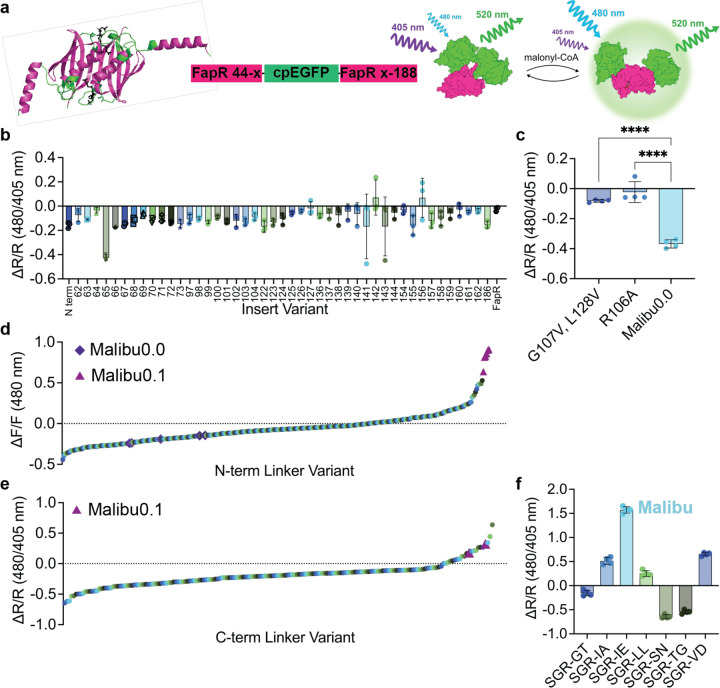
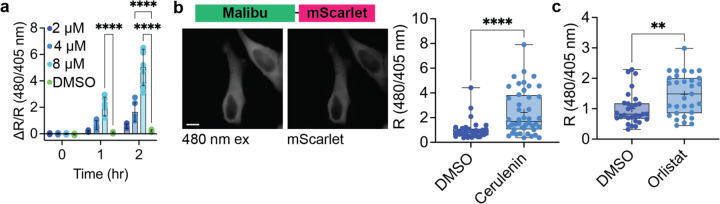
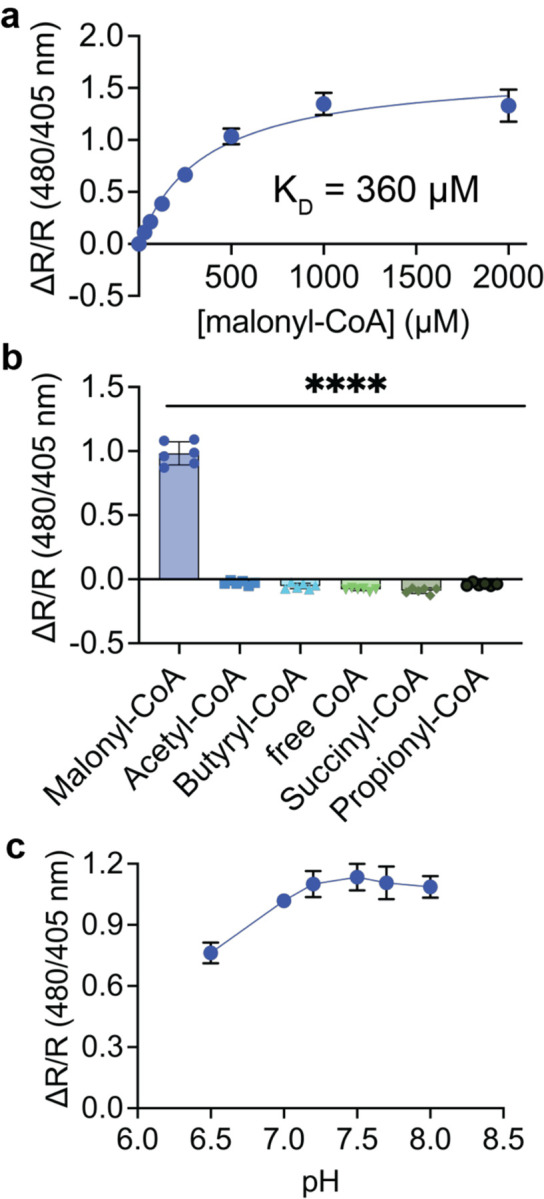
Malonyl-CoA is the essential building block of fatty acids and regulates cell function through protein malonylation and allosteric regulation of signaling networks. Accordingly, the production and use of malonyl-CoA is finely tuned by the cellular energy status. Most studies of malonyl-CoA dynamics rely on bulk approaches that take only a snapshot of the average metabolic state of a population of cells, missing out on dynamic changes in malonyl-CoA and fatty acid biosynthesis that could be occurring within a single cell. To overcome this limitation, we have developed a genetically encoded fluorescent protein-based biosensor for malonyl-CoA that can be used to capture malonyl-CoA dynamics in single cells. This biosensor, termed Malibu (onyl-CoA ntracellular iosensor to nderstand dynamics), exhibits an excitation-ratiometric change in response to malonyl-CoA binding. We first used Malibu to monitor malonyl-CoA dynamics during inhibition of fatty acid biosynthesis using cerulenin in , observing an increase in Malibu response in a time- and dose-dependent manner. In HeLa cells, we used Malibu to monitor the impact of fatty acid biosynthesis inhibition on malonyl-CoA dynamics in single cells, finding that two inhibitors of fatty acid biosynthesis, cerulenin and orlistat, which inhibit different steps of fatty acid biosynthesis, increase malonyl-CoA levels. Altogether, we have developed a new genetically encoded biosensor for malonyl-CoA, which can be used to sensitively study malonyl-CoA dynamics in single cells, providing an unparalleled view into fatty acid biosynthesis.
丙二酰辅酶A是脂肪酸的重要组成部分,并通过蛋白质丙二酰化和信号网络的变构调节来调控细胞功能。因此,丙二酰辅酶A的产生和利用受到细胞能量状态的精细调节。大多数关于丙二酰辅酶A动态变化的研究依赖于整体方法,这些方法仅对一群细胞的平均代谢状态进行快照,从而忽略了单个细胞内可能发生的丙二酰辅酶A和脂肪酸生物合成的动态变化。为了克服这一限制,我们开发了一种基于基因编码荧光蛋白的丙二酰辅酶A生物传感器,可用于捕获单个细胞中的丙二酰辅酶A动态变化。这种生物传感器被称为Malibu(用于理解动态变化的细胞内丙二酰辅酶A传感器),在结合丙二酰辅酶A时表现出激发比率变化。我们首先使用Malibu监测在使用浅蓝菌素抑制脂肪酸生物合成过程中的丙二酰辅酶A动态变化,观察到Malibu反应以时间和剂量依赖性方式增加。在HeLa细胞中,我们使用Malibu监测脂肪酸生物合成抑制对单个细胞中丙二酰辅酶A动态变化的影响,发现两种脂肪酸生物合成抑制剂浅蓝菌素和奥利司他,它们抑制脂肪酸生物合成的不同步骤,会增加丙二酰辅酶A水平。总之,我们开发了一种用于丙二酰辅酶A的新型基因编码生物传感器,可用于灵敏地研究单个细胞中的丙二酰辅酶A动态变化,为脂肪酸生物合成提供了无与伦比的视角。