Autio Joonas A, Uematsu Akiko, Ikeda Takuro, Ose Takayuki, Hou Yujie, Magrou Loïc, Kimura Ikko, Ohno Masahiro, Murata Katsutoshi, Coalson Tim, Kennedy Henry, Glasser Matthew F, Van Essen David C, Hayashi Takuya
Laboratory for Brain Connectomics Imaging, RIKEN Center for Biosystems Dynamics Research, Kobe, Japan.
Université Lyon, Université Claude Bernard Lyon 1, Inserm, Stem Cell and Brain Research Institute U1208, 69500, Bron, France.
bioRxiv. 2024 Nov 13:2024.09.27.615294. doi: 10.1101/2024.09.27.615294.
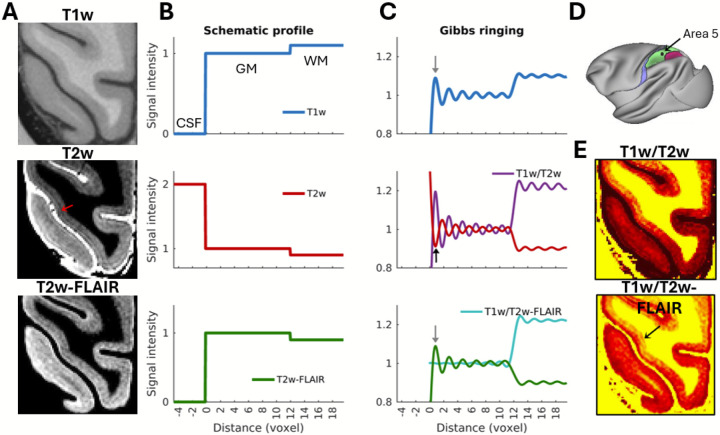
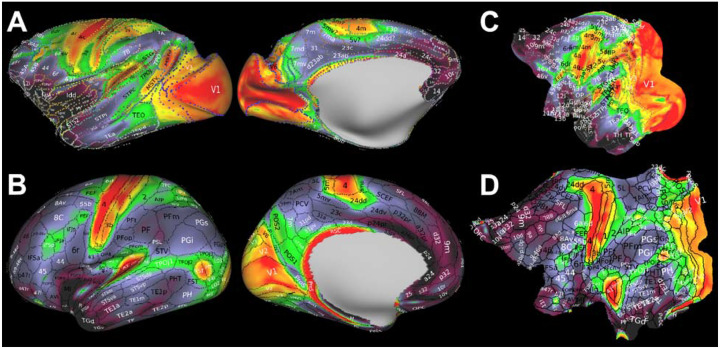
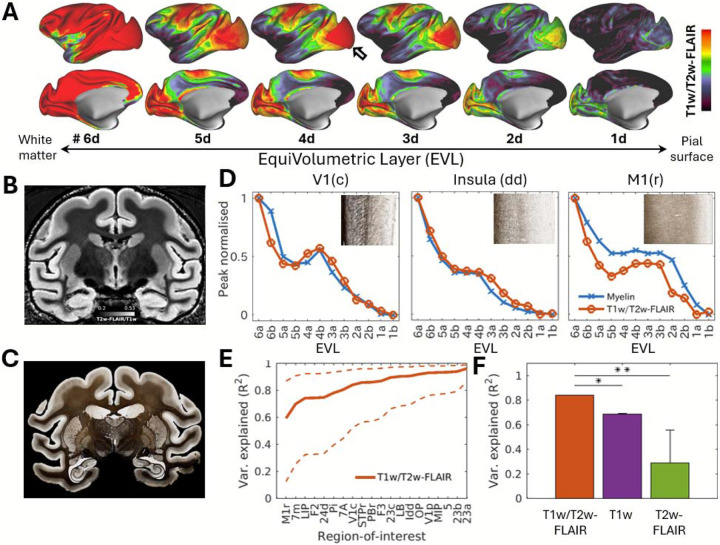
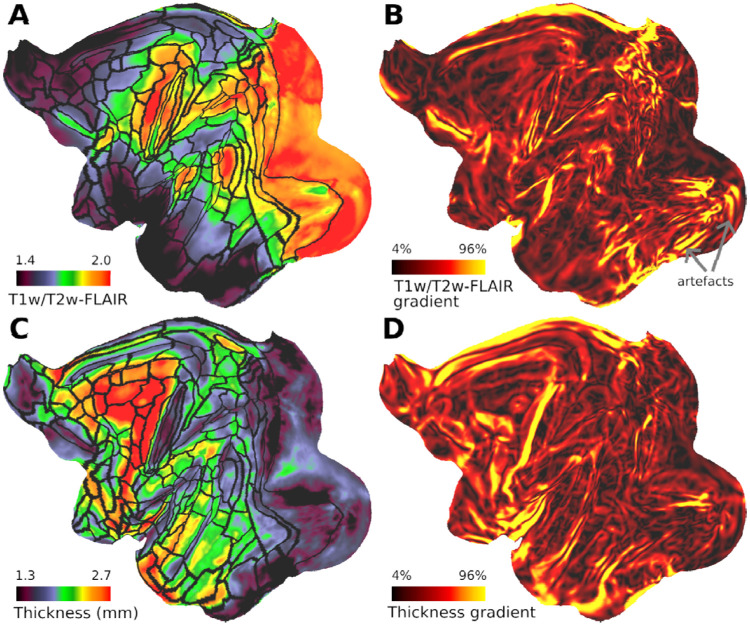
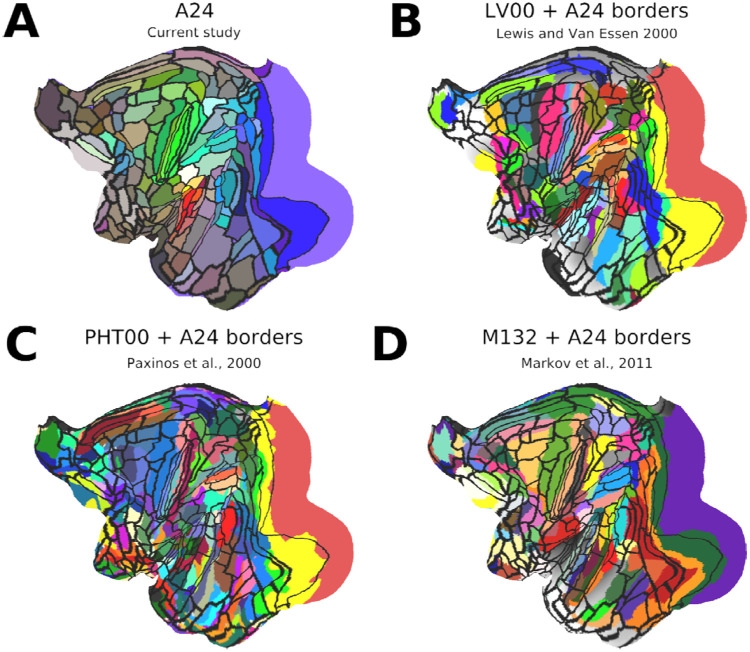
Cortical areas have traditionally been defined by their distinctive layer cyto- and/or myelo- architecture using postmortem histology. Recent studies have delineated many areas by measuring overall cortical myelin content and its spatial gradients using the T1w/T2w ratio MRI in living primates, including humans. While T1w/T2w studies of areal transitions might benefit from using the layer profile of this myelin-related contrast, a significant confound is Gibbs' ringing artefact, which produces signal fluctuations resembling cortical layers. Here, we address these issues with a novel approach using cortical layer thickness-adjusted T1w/T2w-FLAIR imaging, which effectively cancels out Gibbs' ringing artefacts while enhancing intra-cortical myelin contrast. Whole-brain MRI measures were mapped onto twelve equivolumetric layers, and layer-specific sharp myeloarchitectonic transitions were identified using spatial gradients resulting in a putative 182 area/subarea partition of the macaque cerebral cortex. The myelin maps exhibit notably high homology with those in humans, suggesting cortical myelin shares a similar developmental program across species. Comparison with histological Gallyas myelin stains explains over 80% of the variance in the laminar T1w/T2w-FLAIR profiles, substantiating the validity of the method. Altogether, our approach provides a novel, noninvasive means for precision mapping layer myeloarchitecture in the primate cerebral cortex, advancing the pioneering work of classical neuroanatomists.
传统上,皮质区域是通过死后组织学,依据其独特的层状细胞结构和/或髓鞘结构来定义的。最近的研究通过在包括人类在内的活体灵长类动物中使用T1w/T2w比率MRI测量整体皮质髓鞘含量及其空间梯度,描绘出了许多区域。虽然关于区域过渡的T1w/T2w研究可能会受益于使用这种与髓鞘相关对比度的层状轮廓,但一个重大的混淆因素是吉布斯振铃伪影,它会产生类似于皮质层的信号波动。在这里,我们采用一种新颖的方法,即使用皮质层厚度调整后的T1w/T2w-FLAIR成像来解决这些问题,这种方法在增强皮质内髓鞘对比度的同时,有效地消除了吉布斯振铃伪影。全脑MRI测量结果被映射到十二个等体积层上,并使用空间梯度识别出特定层的尖锐髓鞘结构过渡,从而得出猕猴大脑皮质的一个假定的182个区域/子区域划分。髓鞘图谱与人类的图谱显示出显著的高度同源性,表明皮质髓鞘在不同物种间共享相似的发育程序。与组织学Gallyas髓鞘染色的比较解释了层状T1w/T2w-FLAIR图谱中超过80%的差异,证实了该方法的有效性。总之,我们的方法为精确绘制灵长类动物大脑皮质的层状髓鞘结构提供了一种新颖的非侵入性手段,推进了经典神经解剖学家的开创性工作。