Savva Christina, Vlassakev Ivan, Bunney Blynn G, Bunney William E, Massier Lucas, Seldin Marcus, Sassone-Corsi Paolo, Petrus Paul, Sato Shogo
Department of Medicine (H7), Karolinska Institutet, Stockholm, Sweden.
Department of Psychiatry and Human Behavior, School of Medicine, University of California, Irvine, Irvine, California.
Biol Psychiatry Glob Open Sci. 2024 Aug 23;4(6):100385. doi: 10.1016/j.bpsgos.2024.100385. eCollection 2024 Nov.
Chronic stress has a profound impact on circadian regulation of physiology. In turn, disruption of circadian rhythms increases the risk of developing both psychiatric and metabolic disorders. To explore the role of chronic stress in modulating the links between neural and metabolic rhythms, we characterized the circadian transcriptional regulation across different brain regions and the liver as well as serum metabolomics in mice exposed to chronic social defeat stress, a validated model for studying depressive-like behaviors.
Male C57BL/6J mice underwent chronic social defeat stress, and subsequent social interaction screening identified distinct behavioral phenotypes associated with stress resilience and susceptibility. Stressed mice and their control littermates were sacrificed every 4 hours over the circadian cycle for comprehensive analyses of the circadian transcriptome in the hypothalamus, hippocampus, prefrontal cortex, and liver together with assessments of the circadian circulatory metabolome.
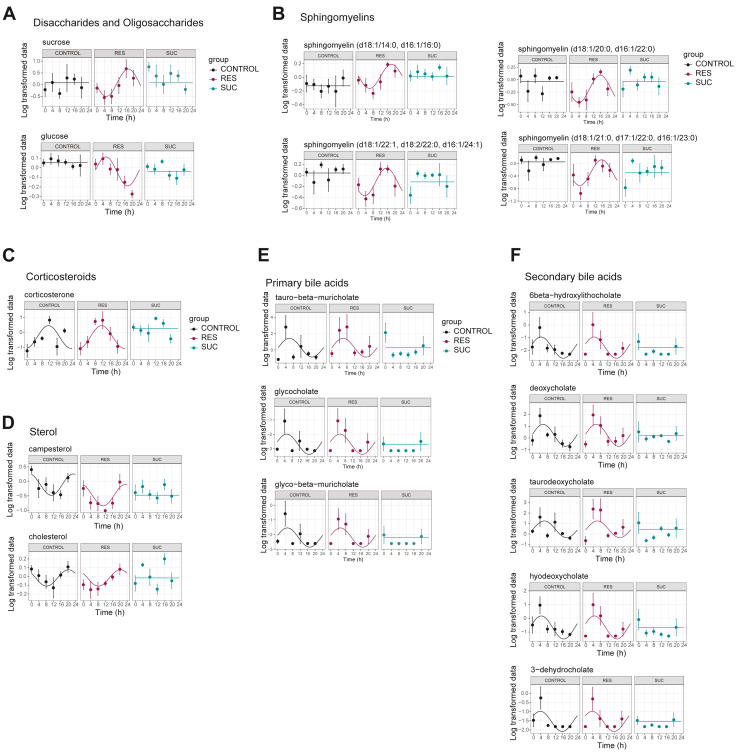
Our data demonstrate that stress adaptation was characterized by reprogramming of the brain as well as the hepatic circadian transcriptome. Stress resiliency was associated with an increase in cyclic transcription in the hypothalamus, hippocampus, and liver. Furthermore, cross-tissue analyses revealed that resilient mice had enhanced transcriptional coordination of circadian pathways between the brain and liver. Conversely, susceptibility to social stress resulted in a loss of cross-tissue coordination. Circadian serum metabolomic profiles corroborated the transcriptome data, highlighting that stress-resilient mice gained circadian rhythmicity of circulating metabolites, including bile acids and sphingomyelins.
This study reveals that resilience to stress is characterized by enhanced metabolic rhythms and circadian brain-liver transcriptional coordination.
慢性应激对生理的昼夜节律调节有深远影响。反过来,昼夜节律的破坏会增加患精神疾病和代谢紊乱的风险。为了探究慢性应激在调节神经节律和代谢节律之间联系中的作用,我们对暴露于慢性社会挫败应激的小鼠的不同脑区、肝脏以及血清代谢组学进行了昼夜转录调控特征分析,慢性社会挫败应激是一种用于研究抑郁样行为的有效模型。
雄性C57BL/6J小鼠经历慢性社会挫败应激,随后的社会互动筛选确定了与应激恢复力和易感性相关的不同行为表型。在昼夜周期中每4小时处死应激小鼠及其对照同窝小鼠,以全面分析下丘脑、海马体、前额叶皮质和肝脏中的昼夜转录组,并评估昼夜循环代谢组。
我们的数据表明,应激适应的特征是大脑以及肝脏昼夜转录组的重新编程。应激恢复力与下丘脑、海马体和肝脏中循环转录的增加有关。此外,跨组织分析表明,有恢复力的小鼠在大脑和肝脏之间的昼夜节律途径的转录协调增强。相反,对社会应激的易感性导致跨组织协调的丧失。昼夜血清代谢组学图谱证实了转录组数据,突出表明有应激恢复力的小鼠获得了循环代谢物的昼夜节律,包括胆汁酸和鞘磷脂。
本研究表明,对应激的恢复力的特征是代谢节律增强以及昼夜脑-肝转录协调。