Wantania Letha Louisiana, Koppetsch Thore, Möhring Jan, Miesen Friedrich W, Wowor Daisy, Boneka Farnis, Herder Fabian
Sektion Ichthyologie, Museum Koenig, Leibniz Institute for the Analysis of Biodiversity Change, Germany.
Natural History Museum, University of Oslo, Oslo, Norway.
J Fish Biol. 2025 Feb;106(2):358-375. doi: 10.1111/jfb.15944. Epub 2024 Oct 10.
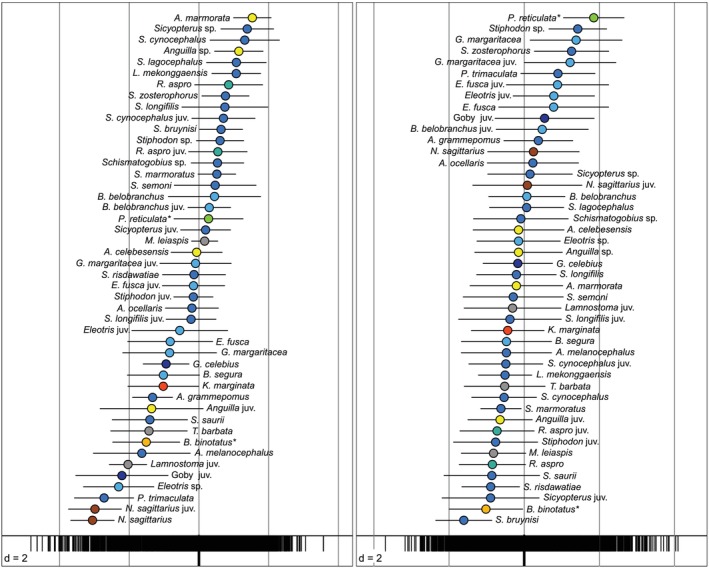
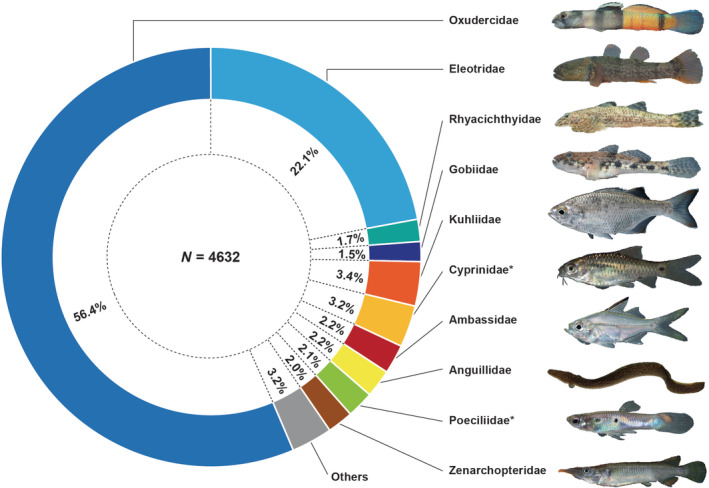
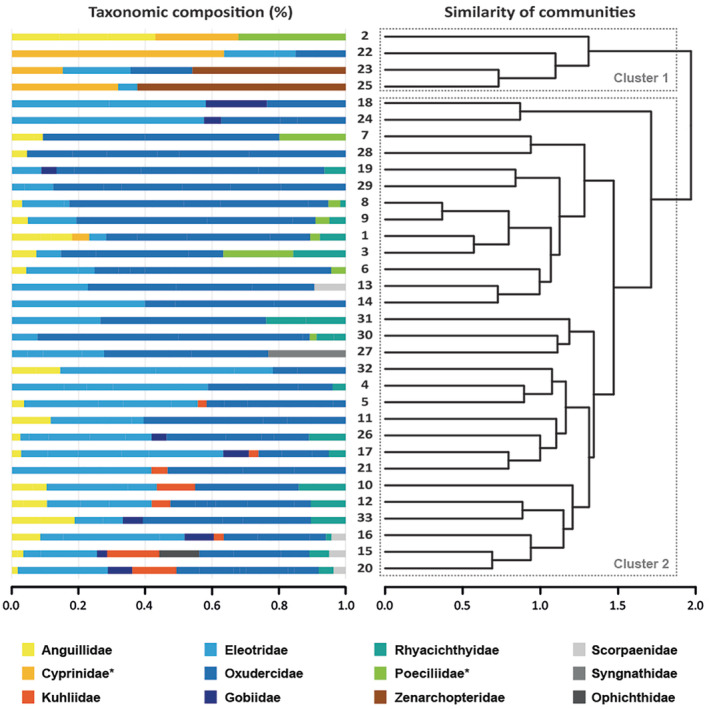
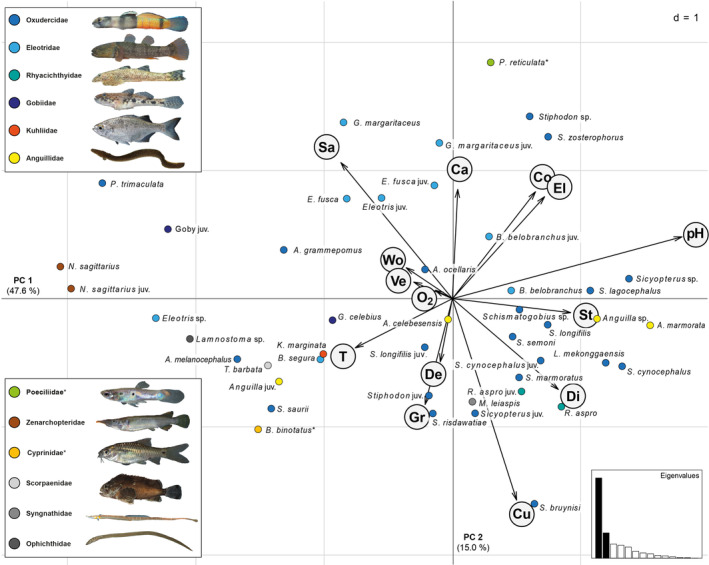
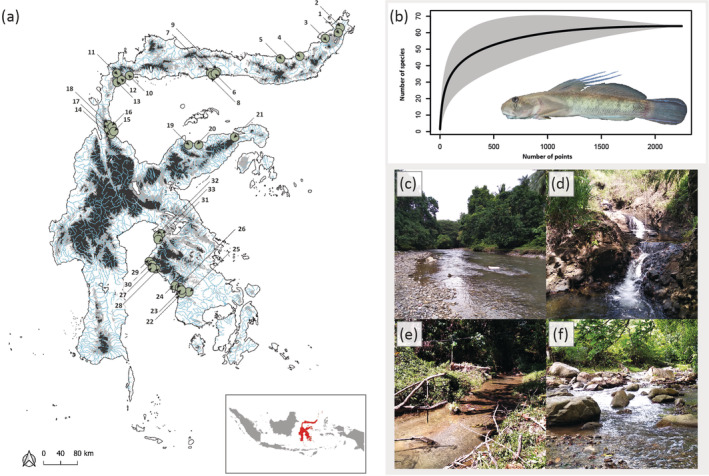
Streams provide an array of habitat niches that may act as environmental filters for fish communities. The tropical island of Sulawesi in Indonesia is located in the Wallacea, a region isolated by marine barriers from the Asian and Australian faunas. Primary freshwater fishes are naturally absent in the Wallacea, including Sulawesi's numerous coastal streams. Diadromous species are in contrast species-rich in the area. The knowledge available on stream fishes in the Wallacea is largely restricted to taxonomic work and studies targeting single species groups, whereas baseline data on fish ecology remain extremely scarce. Such data and a deeper understanding of stream fish ecology are, however, urgently required for purposes such as informed management. We assumed that the stream fish assemblages are dominated by recruitment from the sea and are structured by macro- and microhabitat diversity. To test this hypothesis, we quantified the occurrence of individual fishes by point abundance electrofishing at 33 streams across Sulawesi. The 4632 fishes obtained represent 58 species out of 24 families. The native fishes recorded are mainly amphidromous (34 species), euryhaline (five species), and catadromous (five species). Gobiiformes make up the vast majority of records, dominated by Oxudercidae (22 species) and Eleotridae (five species). Only two of the species recorded are endemic to Sulawesi, including a single species strictly confined to freshwaters. Ten species, making up 6% of the fishes caught, are not native to Sulawesi. The outlying mean index (OMI) and BIOENV analyses suggest that effects on the scale of macro- and microhabitat shape fish assemblage composition, ranging from pH, conductivity, and temperature to current velocity, substrate, canopy cover, and elevation. Habitat niche use of species along the first two OMI axes is complementary and fine-scaled, covering a wide range of the available habitat space. Juvenile and adult conspecifics share similar habitat niches in most of the cases. Niche breadths overlap, but niche specialization is significant in most of the species. Non-native fishes link into the assemblages at the margins of habitat space, with substantial niche overlaps to native species. The present findings show that the native fish communities in coastal streams of Sulawesi are largely composed of species depending on access to the sea, highlighting the importance of connectivity down to the estuaries and sea. The ichthyofauna shows a rich diversity in habitat use, and the availability of alternative habitats along the altitudinal gradient provides plausible filters for species establishment. Non-native fishes are locally abundant, pose substantial potential for changing communities, but are still stocked intentionally. We stress the need for incorporating the need for connectivity and maintained habitat quality into management decisions, and a critical evaluation of stocking activities.
溪流提供了一系列栖息地生态位,这些生态位可能对鱼类群落起到环境过滤的作用。印度尼西亚的热带岛屿苏拉威西岛位于华莱士区,该地区被海洋屏障与亚洲和澳大利亚动物区系隔离开来。华莱士区自然没有原生淡水鱼,包括苏拉威西众多的沿海溪流。相比之下,溯河洄游性物种在该地区种类丰富。目前关于华莱士区溪流鱼类的知识主要局限于分类学工作以及针对单一物种组的研究,而鱼类生态学的基线数据仍然极其匮乏。然而,出于明智管理等目的,迫切需要此类数据以及对溪流鱼类生态学更深入的理解。我们假设溪流鱼类群落主要由来自海洋的补充群体主导,并由宏观和微观栖息地的多样性构成。为了验证这一假设,我们通过点样丰度电捕鱼法对苏拉威西岛33条溪流中的个体鱼类出现情况进行了量化。捕获的4632条鱼代表了24个科中的58个物种。记录到的本地鱼类主要是溯河洄游性的(34种)、广盐性的(5种)和降河洄游性的(5种)。虾虎鱼目占记录的绝大多数,以背眼虾虎鱼科(22种)和塘鳢科(5种)为主。记录到的物种中只有两种是苏拉威西岛特有的,其中一种严格局限于淡水环境。10个物种占捕获鱼类的6%,并非苏拉威西岛本地物种。外围平均指数(OMI)和BIOENV分析表明,从pH值、电导率、温度到流速、底物、树冠覆盖率和海拔高度等宏观和微观栖息地尺度的因素会影响鱼类群落组成。沿着前两个OMI轴,物种的栖息地生态位利用是互补且精细的,涵盖了广泛的可用栖息地空间。在大多数情况下,幼鱼和成鱼共享相似的栖息地生态位。生态位宽度有重叠,但大多数物种的生态位特化很显著。非本地鱼类在栖息地空间边缘融入群落,与本地物种有大量生态位重叠。目前的研究结果表明,苏拉威西岛沿海溪流中的本地鱼类群落主要由依赖进入海洋的物种组成,突出了连接到河口和海洋的重要性。鱼类区系在栖息地利用方面表现出丰富的多样性,沿海拔梯度的替代栖息地的可用性为物种建立提供了合理的筛选条件。非本地鱼类在当地数量众多,有改变群落的巨大潜力,但仍被有意投放。我们强调需要将连通性需求和维持栖息地质量纳入管理决策,并对投放活动进行严格评估。