Center for Geospatial Analytics, North Carolina State University, Raleigh, North Carolina, United States of America.
Division of Public Health, North Carolina Department of Health and Human Services, Raleigh, North Carolina, United States of America.
PLoS One. 2024 Oct 10;19(10):e0311516. doi: 10.1371/journal.pone.0311516. eCollection 2024.
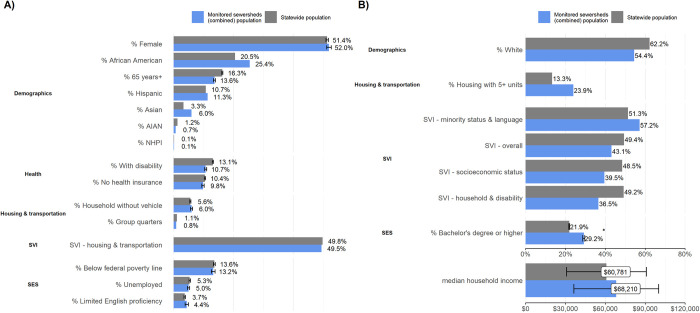
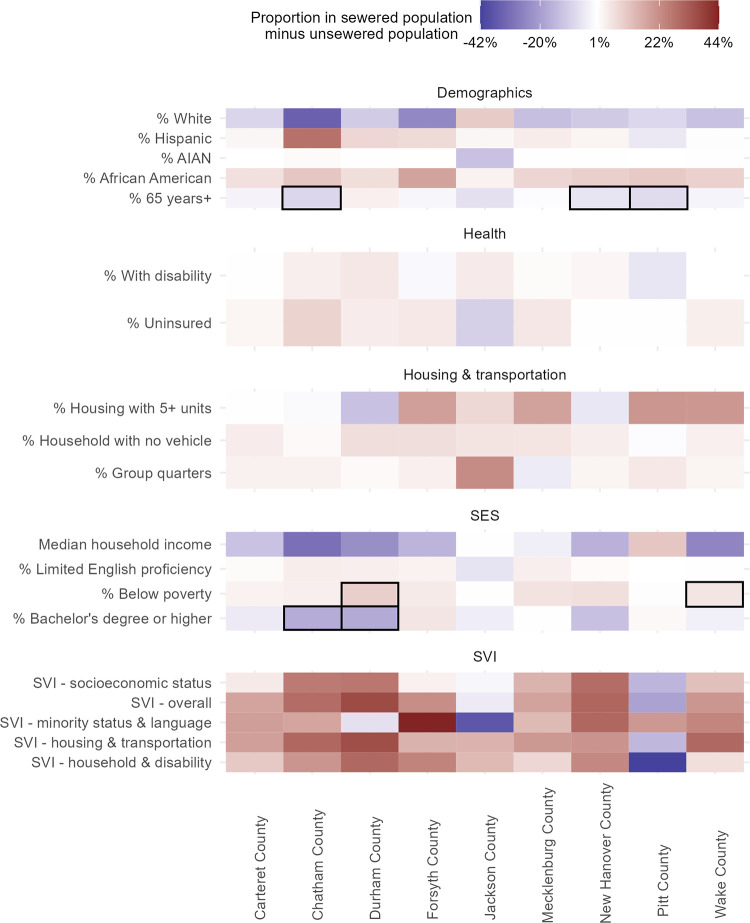
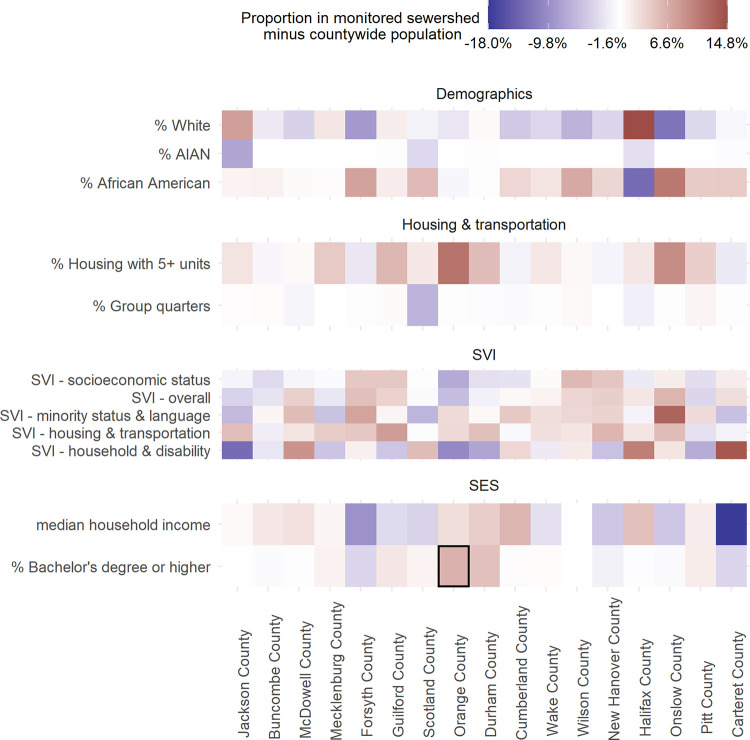
Wastewater monitoring is a valuable public health tool that can track a variety of health markers. The strong correlations between trends in wastewater viral concentrations and county-level COVID-19 case counts point to the ability of wastewater data to represent changes in a community's disease burden. However, studies are lacking on whether the populations sampled through wastewater monitoring represent the characteristics of the broader community and the implications on health equity. We conducted a geospatial analysis to examine the extent to which populations contributing to wastewater collected through the North Carolina Wastewater Monitoring Network as of June 2022 represent the broader countywide and statewide populations. After intersecting sewershed boundary polygons for 38 wastewater treatment plants across 18 counties with census block and tract polygons, we compared the demographics and social vulnerability of (1) people residing in monitored sewersheds with countywide and statewide populations, and (2) sewered residents, regardless of inclusion in wastewater monitoring, with unsewered residents. We flagged as meaningful any differences greater than +/- 5 percentage points or 5 percent (for categorical and continuous variables, respectively) and noted statistically significant differences (p < 0.05). We found that residents within monitored sewersheds largely resembled the broader community on most variables analyzed, with only a few exceptions. We also observed that when multiple sewersheds were monitored within a county, their combined service populations resembled the county population, although individual sewershed and county populations sometimes differed. When we contrasted sewered and unsewered populations within a given county, we found that sewered populations were more vulnerable than unsewered populations, suggesting that wastewater monitoring may fill in the data gaps needed to improve health equity. The approach we present here can be used to characterize sewershed populations nationwide to ensure that wastewater monitoring is implemented in a manner that informs equitable public health decision-making.
污水监测是一种有价值的公共卫生工具,可以追踪多种健康指标。污水中病毒浓度的变化趋势与县一级 COVID-19 病例数量之间的强相关性表明,污水数据能够反映社区疾病负担的变化。然而,关于通过污水监测采样的人群是否代表更广泛社区的特征以及对健康公平的影响,相关研究还很缺乏。我们进行了一项地理空间分析,以检验截至 2022 年 6 月通过北卡罗来纳州污水监测网络收集的污水所涉及的人群在多大程度上代表了更广泛的全县和全州人口。在将 18 个县的 38 个污水处理厂的污水流域边界多边形与普查区和流域多边形相交后,我们比较了(1)居住在监测污水流域的人群与全县和全州人口的人口统计学和社会脆弱性,以及(2)无论是否纳入污水监测,污水区居民与非污水区居民的人口统计学和社会脆弱性。我们将差异大于 +/- 5 个百分点或 5%(分别为分类和连续变量)标记为有意义,并指出了统计学上的显著差异(p < 0.05)。我们发现,在大多数分析的变量中,监测污水流域内的居民与更广泛的社区基本相似,只有少数例外。我们还观察到,在一个县内监测多个污水流域时,它们的综合服务人口与县人口相似,尽管个别污水流域和县人口有时不同。当我们在一个给定的县内对比污水区和非污水区的人口时,我们发现污水区人口比非污水区人口更脆弱,这表明污水监测可能填补了改善健康公平所需的数据空白。我们在这里提出的方法可以用于描述全国范围内的污水流域人口,以确保污水监测以告知公平的公共卫生决策的方式实施。