Department of Behavioral Science, School of Public Health and Social Sciences, Muhimbili University of Health and Allied Sciences, P. O. Box 65015, Dar es Salaam, Tanzania.
Department of Environmental and Occupational Health, School of Public Health and Social Sciences, Muhimbili University of Health and Allied Sciences, P. O. Box 65015, Dar es Salaam, Tanzania.
BMC Public Health. 2024 Oct 10;24(1):2766. doi: 10.1186/s12889-024-20305-2.
Tanzania faces ever-rising concerns due to the recurrence of the Ebola Virus Disease (EVD) in neighbouring Democratic Republic of Congo (DRC) and Uganda. This necessitates a better understanding of the community perspectives in high-risk regions for effective risk communication and preparedness.
This rapid ethnographic assessment study used explorative qualitative methods to collect data. People from diverse backgrounds participated in 59 in-depth interviews, 57 Key Informant interviews, and 35 focus group discussions. Data was analysed using a thematic analysis approach.
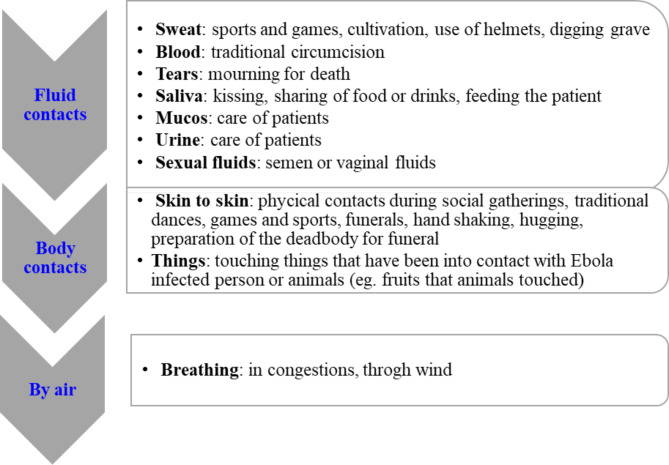
The study revealed existence of awareness of EVD and its symptoms, with radio and television being the main sources of information. However, there were varied perceptions of EVD's cause and transmission, some attributed it to bats, monkeys, and wild animal meat, while others associated it with high fever, a dirty environment, changing dietary patterns, and the COVID-19 virus. Physical contact with an infected person's body fluids and eating meat from infected animals were perceived as EVD transmission routes. Women, school children, boda-boda (motorcycle) riders, and fishermen were considered the most susceptible to EVD infections due to their daily activities. Preventive measures included avoiding physical contact, touching fluids, and refraining from eating wild animal meat. Prompt reporting of suspected cases to health facilities was deemed crucial for earlier outbreak identification and containment.
The high-risk regions of Tanzania had a high level of awareness and perceived susceptibility to EVD, coupled with varying degrees of misperception about the etiology and its transmission. To improve community perspectives and preparedness in the case of an outbreak, there is a need for ongoing risk communication and participation in EVD prevention and responses.
坦桑尼亚因邻国刚果民主共和国(DRC)和乌干达再次爆发埃博拉病毒病(EVD)而面临日益严重的问题。这就需要更好地了解高危地区的社区观点,以便进行有效的风险沟通和准备。
本快速人种学评估研究采用探索性定性方法收集数据。来自不同背景的人参与了 59 次深入访谈、57 次关键信息提供者访谈和 35 次焦点小组讨论。使用主题分析方法对数据进行分析。
研究表明,人们对 EVD 及其症状有一定的认识,广播和电视是主要的信息来源。然而,人们对 EVD 的病因和传播有不同的看法,一些人认为它是由蝙蝠、猴子和野生动物肉引起的,而另一些人则认为它是由高烧、肮脏的环境、饮食模式的改变和 COVID-19 病毒引起的。与感染者的体液接触和食用受感染动物的肉被认为是 EVD 的传播途径。妇女、学童、摩托车手和渔民由于日常活动,被认为最容易感染 EVD。预防措施包括避免身体接触、触摸体液和避免食用野生动物肉。及时向医疗机构报告疑似病例被认为对早期发现和控制疫情至关重要。
坦桑尼亚的高危地区对 EVD 有很高的认识和感知易感性,同时对病因及其传播也存在不同程度的误解。为了改善社区的观点和应对疫情的准备,需要持续进行风险沟通,并参与 EVD 的预防和应对。