Division of Physiological Sciences, Sports Science Institute of South Africa, Department of Human Biology, Faculty of Health Sciences, Health through Physical Activity, Lifestyle and Sport Research Centre (HPALS), University of Cape Town, Boundary Road, Newlands, Cape Town, 7700, South Africa.
Steno Diabetes Center Copenhagen, Capital Region, Borgmester Ib Juuls Vej 83, Herlev, 2730, Denmark.
BMC Public Health. 2024 Oct 10;24(1):2768. doi: 10.1186/s12889-024-20228-y.
Human Immunodeficiency Virus (HIV) and type 2 diabetes (T2D) are amongst the leading causes of death in South Africa. The preferred first-line anti-retroviral treatment contains dolutegravir (DTG), shown to increase body weight, may compound the already high rates of obesity and associated risk for T2D. South Africa has widespread food insecurity, making traditional dietary strategies difficult to implement. Time-restricted eating (TRE) may be an appropriate intervention in resource-limited communities.
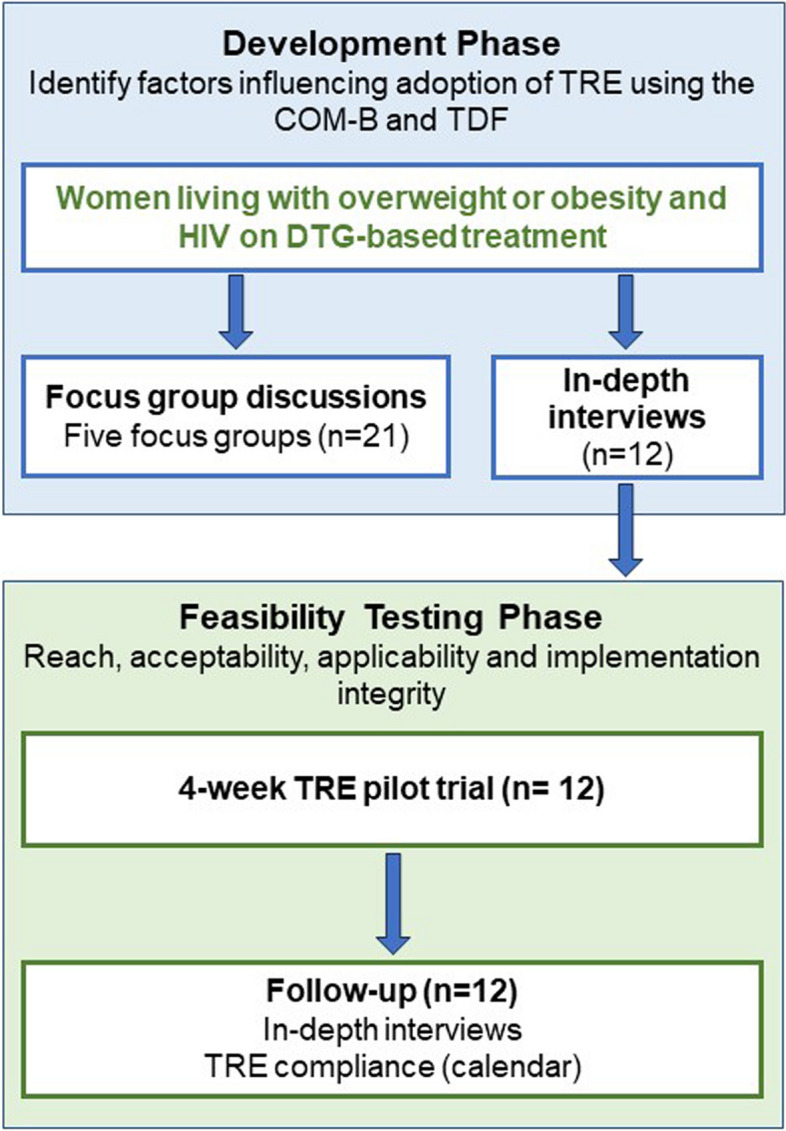
This article outlines the development and feasibility testing of a TRE intervention to inform the design of a TRE randomised controlled trial in women (20-45 years old) living with overweight/obesity and HIV, receiving DTG-based treatment from a resource-limited community in Cape Town, South Africa. Factors influencing TRE adoption were identified using the Capability, Opportunity, Motivation - Behaviour model and the Theoretical Domains Framework, combining in-depth interviews (IDIs) and focus group discussions. Participants from the IDIs went on to participate in a single arm 4-week TRE pilot trial where feasibility was explored in terms of reach, acceptability, applicability, and implementation integrity. An iterative, thematic analysis approach was employed to analyse the qualitative data.
Participants included 33 isiXhosa-speaking women (mean age 37.1 years, mean BMI 35.9 kg/m). Thematic analysis identified psychological capability (knowledge of fasting), social influences (cultural preferences, family support), and reflective motivation (awareness of weight, health impact, motivation for TRE) as key factors influencing adoption of TRE for weight management. In a 4-week TRE pilot trial (n = 12), retention was 100%. Positive outcomes perceived included improved energy, appetite control and weight loss. TRE was perceived as acceptable, easy, and enjoyable. Family support facilitated adherence, while habitual and social eating and drinking practices were barriers. Compliance was high, aided by self-selected eating times, reminders, and weekly calls. Recommendations included the incorporation of dietary education sessions and text messages to provide additional support and reminders.
This study indicates that TRE is a feasible weight management strategy in women living with overweight/obesity and HIV, receiving DTG-based treatment in a resource-limited community. These findings will ensure that the forthcoming TRE randomised controlled trial is adapted and optimised to the local South African context.
人类免疫缺陷病毒(HIV)和 2 型糖尿病(T2D)是南非主要的死亡原因之一。首选的一线抗逆转录病毒治疗包含多拉韦林(DTG),已证明其会增加体重,可能会使肥胖率和与 T2D 相关的风险已经很高的情况更加恶化。南非普遍存在粮食不安全问题,使得传统的饮食策略难以实施。限时进食(TRE)可能是资源有限社区的一种合适的干预措施。
本文概述了 TRE 干预措施的制定和可行性测试,以为在南非开普敦一个资源有限的社区接受 DTG 治疗的超重/肥胖和 HIV 感染者的女性(20-45 岁)中开展 TRE 随机对照试验提供信息。使用能力、机会、动机-行为模型和理论领域框架确定了影响 TRE 采用的因素,将深入访谈(IDIs)和焦点小组讨论结合起来。IDIs 的参与者随后参加了一项为期 4 周的 TRE 初步试验,以探索可及性、可接受性、适用性和实施完整性方面的可行性。采用迭代、主题分析方法对定性数据进行分析。
参与者包括 33 名说 isiXhosa 的女性(平均年龄 37.1 岁,平均 BMI 为 35.9kg/m²)。主题分析确定了心理能力(禁食知识)、社会影响(文化偏好、家庭支持)和反思动机(对体重、健康影响、TRE 动机的认识)是影响 TRE 用于体重管理的关键因素。在为期 4 周的 TRE 初步试验(n=12)中,保留率为 100%。被认为是积极的结果包括改善能量、食欲控制和体重减轻。TRE 被认为是可接受的、简单的和愉快的。家庭支持促进了依从性,而习惯性和社交饮食行为则是障碍。高依从性得益于自我选择的进食时间、提醒和每周电话。建议包括纳入饮食教育课程和短信,以提供额外的支持和提醒。
这项研究表明,在资源有限的社区中接受 DTG 治疗的超重/肥胖和 HIV 感染者中,TRE 是一种可行的体重管理策略。这些发现将确保即将开展的 TRE 随机对照试验适应和优化南非当地的情况。