Department of Population and Family Health, Institute of Health, Jimma University, Jimma, Ethiopia.
Department of Public Health, College of Health Sciences, Assosa University, Assosa, Ethiopia.
BMC Pregnancy Childbirth. 2024 Oct 10;24(1):661. doi: 10.1186/s12884-024-06872-7.
Approximately 80% of people in Ethiopia live in rural areas, where poor access to maternity services, accounts for the majority of maternal and perinatal deaths. Maternity waiting homes are residential facilities for women who come from remote areas to stay and wait before giving birth at health facilities, particularly in hospitals and health centers. It is a new initiative and one of the strategies that increase skilled care utilization at birth. However, there is no evidence on the status of maternity waiting home utilization in the study area. Therefore, this study aimed to generate evidence on the status of maternity waiting home utilization and its associated factors.
A community-based cross-sectional household survey was conducted from June 5-30, 2022. The sample size was calculated using the single population proportion formula, which resulted in 354 participants. The study population included mothers who gave birth within 12 months before the survey were selected by using a systematic sampling method. The data were coded, edited, cleaned, and entered into Epi Data version 3.1. The data were subsequently exported to SPSS version 25 for analysis. Descriptive, bivariable, and multivariable binary logistic regression analyses were performed. The results are presented in the text, figures, and tables. Finally, variables with a p value < 0.05 in the multivariable analysis were reported as significantly associated with the independent variables and outcome variable.
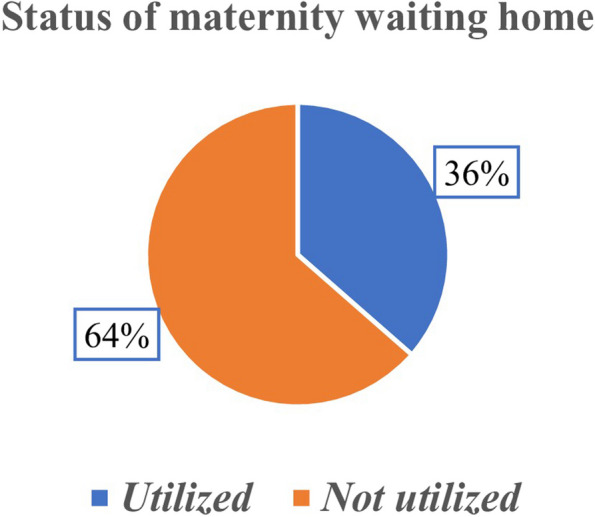
The magnitude of maternity waiting home utilization was 36.4% (95% CI = 31.4, 41.8). Being knowledgeable about the presence of maternity waiting home (AOR = 3.9; 95% CI: 1.0-15.2), being able to afford transportation (AOR = 2.4; 95% CI: 1.01-5.9), being home delivery (AOR = 0.007; 95% CI: 0.002-0.031) and being acess to transportation services (AOR = 3.0; 95% CI: 1.2-7.5) were significantly associated with maternity waiting home utilization.
The magnitude of maternity waiting home utilization in the study area was found to be low. Access to and affordability of transportation services, being knowledgeable and being home delivery were associated factors for the use of maternity waiting homes. Therefore, increasing maternal knowledge, economically empowering women and respecting care while waiting at maternity homes are important for improving the utilization of maternity waiting homes.
在埃塞俄比亚,约 80%的人口居住在农村地区,那里的产妇服务获取机会有限,导致大部分孕产妇和围产期死亡。母婴等候之家是为那些从偏远地区前来分娩的妇女提供的住宿设施,让她们在卫生设施(特别是医院和保健中心)分娩前有地方等待。这是一项新举措,也是增加分娩时熟练护理利用的策略之一。然而,在研究地区,没有关于母婴等候之家利用情况的证据。因此,本研究旨在提供母婴等候之家利用情况及其相关因素的证据。
本研究采用基于社区的横断面家庭调查方法,于 2022 年 6 月 5 日至 30 日进行。使用单一人口比例公式计算样本量,得出 354 名参与者。研究人群包括在调查前 12 个月内分娩的母亲,通过系统抽样方法选择。使用 EpiData 版本 3.1 对数据进行编码、编辑、清理和输入。随后将数据导出到 SPSS 版本 25 进行分析。进行描述性、双变量和多变量二元逻辑回归分析。结果以文本、图表和表格的形式呈现。最后,多变量分析中 p 值<0.05 的变量被报告为与自变量和因变量显著相关。
母婴等候之家的利用程度为 36.4%(95%CI=31.4,41.8)。了解母婴等候之家的存在(AOR=3.9;95%CI:1.0-15.2)、有能力支付交通费用(AOR=2.4;95%CI:1.01-5.9)、在家分娩(AOR=0.007;95%CI:0.002-0.031)和获得交通服务(AOR=3.0;95%CI:1.2-7.5)与母婴等候之家的利用显著相关。
研究地区母婴等候之家的利用程度较低。获得和负担得起交通服务、了解情况和在家分娩是使用母婴等候之家的相关因素。因此,增加产妇的知识、增强妇女的经济权能以及尊重在母婴等候之家等待时的护理,对于提高母婴等候之家的利用至关重要。