Division of Applied Life Science (Brain Korea 21 Four), Research Institute of Life Sciences, Gyeongsang National University, Jinju, 52828, Korea.
Environmental Disease Research Center, Korea Research Institute of Bioscience and Biotechnology, Daejeon, 34141, Korea.
Mol Cancer. 2024 Oct 11;23(1):227. doi: 10.1186/s12943-024-02138-0.
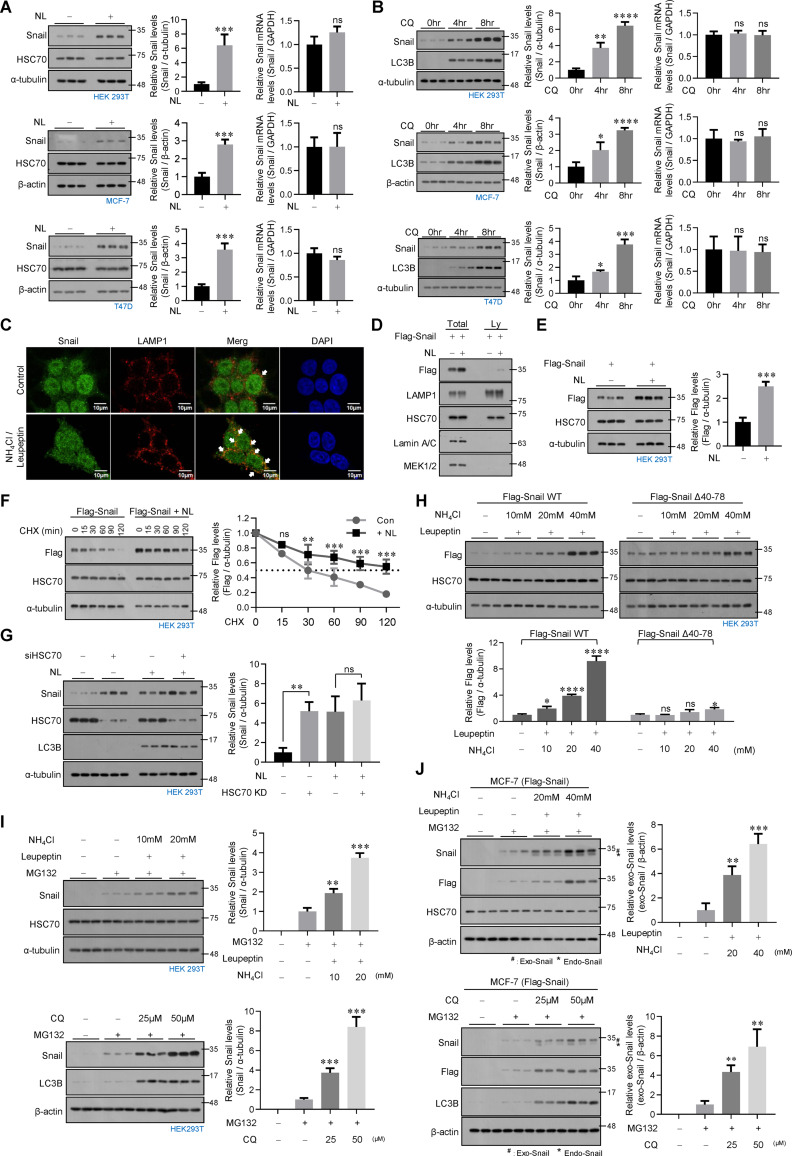
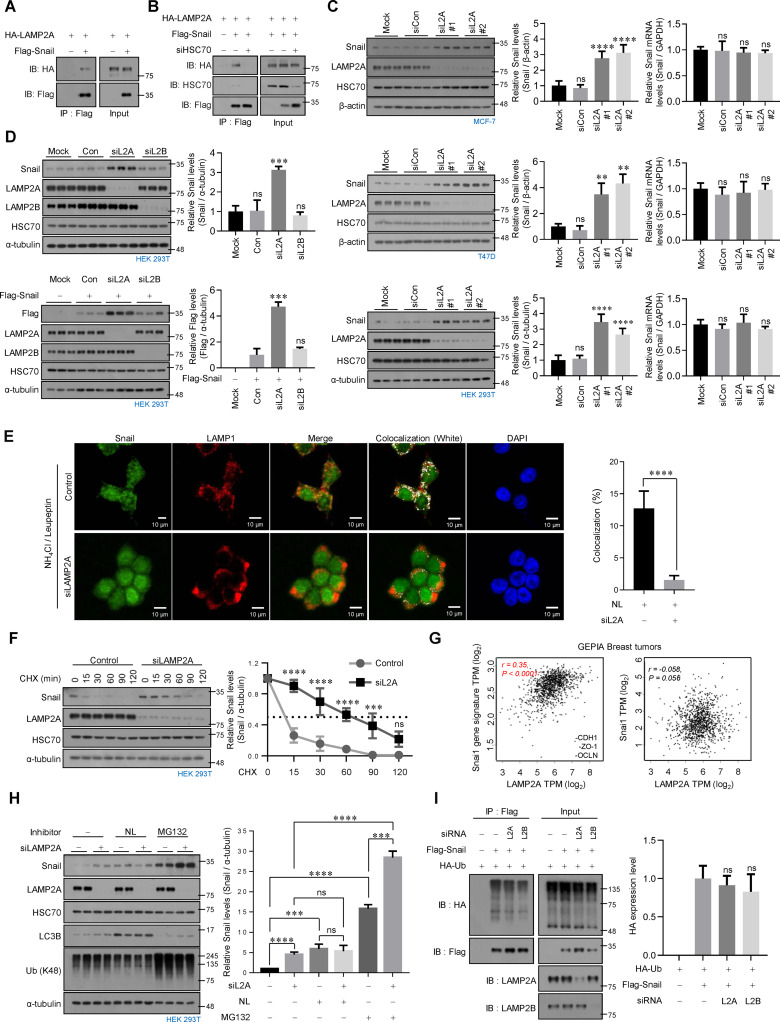
Breast cancer remains a significant health concern, with triple-negative breast cancer (TNBC) being an aggressive subtype with poor prognosis. Epithelial-mesenchymal transition (EMT) is important in early-stage tumor to invasive malignancy progression. Snail, a central EMT component, is tightly regulated and may be subjected to proteasomal degradation. We report a novel proteasomal independent pathway involving chaperone-mediated autophagy (CMA) in Snail degradation, mediated via its cytosolic interaction with HSC70 and lysosomal targeting, which prevented its accumulation in luminal-type breast cancer cells. Conversely, Snail predominantly localized to the nucleus, thus evading CMA-mediated degradation in TNBC cells. Starvation-induced CMA activation downregulated Snail in TNBC cells by promoting cytoplasmic translocation. Evasion of CMA-mediated Snail degradation induced EMT, and enhanced metastatic potential of luminal-type breast cancer cells. Our findings elucidate a previously unrecognized role of CMA in Snail regulation, highlight its significance in breast cancer, and provide a potential therapeutic target for clinical interventions.
乳腺癌仍然是一个重大的健康问题,三阴性乳腺癌(TNBC)是一种侵袭性亚型,预后较差。上皮-间充质转化(EMT)在早期肿瘤向侵袭性恶性肿瘤进展中很重要。Snail 是 EMT 的重要组成部分,受到严格调控,可能会受到蛋白酶体降解。我们报告了一种涉及伴侣介导的自噬(CMA)的新型蛋白酶体非依赖性途径,该途径通过其与细胞质中的 HSC70 的相互作用和溶酶体靶向介导 Snail 降解,从而防止其在腔型乳腺癌细胞中积累。相反,Snail 主要定位于细胞核,从而避免了在 TNBC 细胞中 CMA 介导的降解。饥饿诱导的 CMA 激活通过促进细胞质易位,下调了 TNBC 细胞中的 Snail。逃避 CMA 介导的 Snail 降解诱导 EMT,并增强腔型乳腺癌细胞的转移潜力。我们的研究结果阐明了 CMA 在 Snail 调节中的一个以前未被认识的作用,强调了它在乳腺癌中的重要性,并为临床干预提供了一个潜在的治疗靶点。