Department of Pharmacology, Sungkyunkwan University School of Medicine, Suwon, 16419, Republic of Korea.
Samsung Medical Center (SMC), Sungkyunkwan University School of Medicine, Samsung Biomedical Research Institute, Suwon, 16419, Republic of Korea.
J Transl Med. 2024 Oct 10;22(1):919. doi: 10.1186/s12967-024-05666-x.
Propagation of neuronal α-synuclein aggregate pathology to the cortex and hippocampus correlates with cognitive impairment in Parkinson's disease (PD) dementia and dementia with Lewy body disease. Previously, we showed accumulation of the parkin substrate aminoacyl-tRNA synthetase interacting multifunctional protein-2 (AIMP2) in the temporal lobe of postmortem brains of patients with advanced PD. However, the potential pathological role of AIMP2 accumulation in the cognitive dysfunction of patients with PD remains unknown.
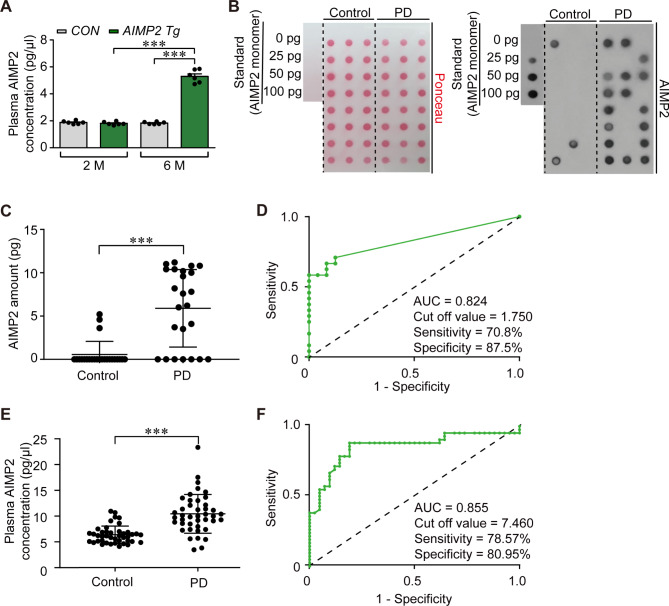
We performed immunofluorescence imaging to examine cellular distribution and accumulation of AIMP2 in brains of conditional AIMP2 transgenic mice and postmortem PD patients. The pathological role of AIMP2 was investigated in the AIMP2 transgenic mice by assessing Nissl-stained neuron counting in the hippocampal area and Barnes maze to determine cognitive functions. Potential secretion and cellular uptake of AIMP2 was monitored by dot blot analysis and immunofluorescence. The utility of AIMP2 as a new PD biomarker was evaluated by dot blot and ELISA measurement of plasma AIMP2 collected from PD patients and healthy control followed by ROC curve analysis.
We demonstrated that AIMP2 is toxic to the dentate gyrus neurons of the hippocampus and that conditional AIMP2 transgenic mice develop progressive cognitive impairment. Moreover, we found that neuronal AIMP2 expression levels correlated with the brain endothelial expression of AIMP2 in both AIMP2 transgenic mice and in the postmortem brains of patients with PD. AIMP2, when accumulated, was released from the neuronal cell line SH-SY5Y cells. Secreted AIMP2 was taken up by human umbilical vein endothelial cells. Consistent with the fact that AIMP2 can be released into the extracellular space, we showed that AIMP2 transgenic mice have higher levels of plasma AIMP2. Finally, ELISA-based assessment of AIMP2 in plasma samples from patients with PD and controls, and subsequent ROC curve analysis proved that high plasma AIMP2 expression could serve as a reliable molecular biomarker for PD diagnosis.
The pathological role in the hippocampus and the cell-to-cell transmissibility of AIMP2 provide new therapeutic avenues for PD treatment, and plasma AIMP2 combined with α-synuclein may improve the accuracy of PD diagnosis in the early stages.
神经元α-突触核蛋白聚集病理的传播到皮层和海马与帕金森病(PD)痴呆和路易体痴呆患者的认知障碍相关。此前,我们发现帕金森病患者晚期死后大脑颞叶中积累了 parkin 底物氨酰-tRNA 合成酶相互作用多功能蛋白-2(AIMP2)。然而,AIMP2 积累在 PD 患者认知功能障碍中的潜在病理作用尚不清楚。
我们通过免疫荧光成像检查条件性 AIMP2 转基因小鼠和 PD 患者死后大脑中 AIMP2 的细胞分布和积累。通过评估海马区尼氏染色神经元计数和 Barnes 迷宫来确定认知功能,研究 AIMP2 转基因小鼠中的 AIMP2 病理作用。通过点印迹分析和免疫荧光监测 AIMP2 的潜在分泌和细胞摄取。通过点印迹和 ELISA 测量从 PD 患者和健康对照中收集的血浆 AIMP2,并进行 ROC 曲线分析,评估 AIMP2 作为新的 PD 生物标志物的效用。
我们证明 AIMP2 对海马齿状回神经元有毒性,并且条件性 AIMP2 转基因小鼠会出现进行性认知障碍。此外,我们发现 AIMP2 转基因小鼠和 PD 患者死后大脑中神经元 AIMP2 表达水平与脑内皮细胞 AIMP2 的表达相关。积累的 AIMP2 从神经元细胞系 SH-SY5Y 细胞中释放出来。分泌的 AIMP2 被人脐静脉内皮细胞摄取。与 AIMP2 可以释放到细胞外空间的事实一致,我们发现 AIMP2 转基因小鼠具有更高水平的血浆 AIMP2。最后,基于 ELISA 的 PD 患者和对照组血浆样本中 AIMP2 的评估,以及随后的 ROC 曲线分析证明,高血浆 AIMP2 表达可作为 PD 诊断的可靠分子生物标志物。
AIMP2 在海马中的病理作用和细胞间的可传递性为 PD 治疗提供了新的治疗途径,而血浆 AIMP2 与α-突触核蛋白结合可能提高早期 PD 诊断的准确性。