
自我控制与网络游戏障碍及社交网站使用问题之间的关系:网络使用动机的中介作用。
The relationship between self-control and internet gaming disorder and problematic social networking site use: the mediation effects of internet use motives.
作者信息
Zhou Ruoyu, Morita Nobuaki, Zhu Chunmu, Ogai Yasukazu, Saito Tamaki, Yang Wenjie, Ogawa Mitsue, Zhang Hong
机构信息
Doctoral Program in Human Care Science, Graduate School of Comprehensive Human Sciences, University of Tsukuba, Tsukuba, Japan.
Department of Social Psychiatry and Mental Health, University of Tsukuba, School of Medicine and Medical Sciences, Tsukuba, Japan.
出版信息
Front Psychiatry. 2024 Sep 26;15:1369973. doi: 10.3389/fpsyt.2024.1369973. eCollection 2024.
INTRODUCTION
This study aimed to explore the relationships between problematic social networking site use (PSNSU), Internet Gaming Disorder (IGD), internet use motives, and self-control among university students in China and Japan. Specifically, it investigated the indirect effects of self-control on IGD and PSNSU through various internet use motives, considering gender differences.
METHODS
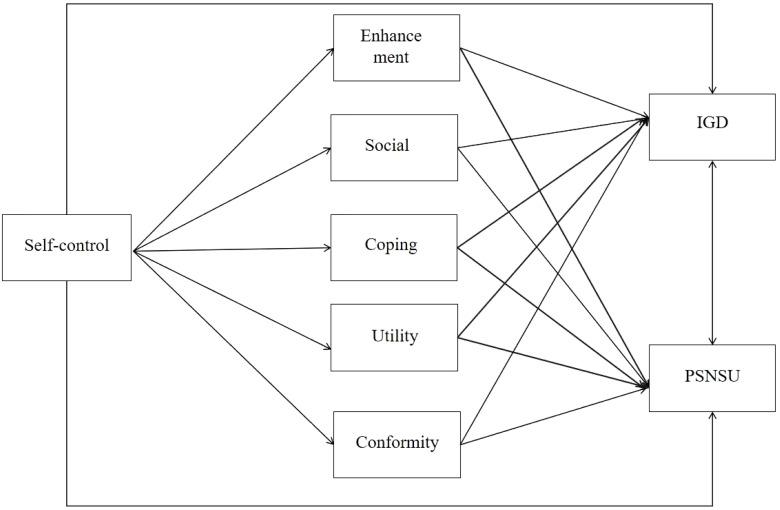
A sample of 697 university students (465 females; 397 Chinese) was surveyed. Path analysis was conducted separately for male and female users to examine the relationships between self-control, internet use motives, IGD, and PSNSU.
RESULTS
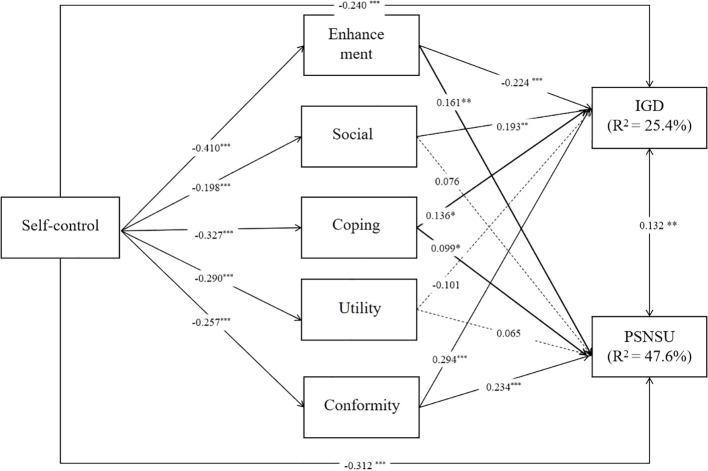
The results indicated that self-control had significant indirect effects on IGD through enhancement (β = 0.096**, p = 0.005), social (β = -0.090**, p = 0.007), and conformity (β = -0.117**, p = 0.001) motives, but these effects were observed only in the male group. Self-control also exhibited indirect effects on PSNSU through enhancement, social, coping, and conformity motives, with a greater impact observed on PSNSU than on IGD. Gender differences in mediating effects were identified, with males and females showing distinct patterns.
DISCUSSION
The findings highlight the importance of understanding gender differences and motivational factors in problematic internet use. These insights contribute to a better understanding of how internet use motives influence IGD and PSNSU in different contexts.
引言
本研究旨在探讨中国和日本大学生中存在问题的社交网站使用(PSNSU)、网络游戏障碍(IGD)、互联网使用动机和自我控制之间的关系。具体而言,研究考虑了性别差异,通过各种互联网使用动机调查了自我控制对IGD和PSNSU的间接影响。
方法
对697名大学生(465名女性;397名中国学生)进行了抽样调查。对男性和女性用户分别进行路径分析,以检验自我控制、互联网使用动机、IGD和PSNSU之间的关系。
结果
结果表明,自我控制通过增强(β = 0.096**,p = 0.005)、社交(β = -0.090**,p = 0.007)和从众(β = -0.117**,p = 0.001)动机对IGD有显著的间接影响,但这些影响仅在男性组中观察到。自我控制还通过增强、社交、应对和从众动机对PSNSU表现出间接影响,对PSNSU的影响比对IGD的影响更大。确定了中介效应的性别差异,男性和女性表现出不同的模式。
讨论
研究结果强调了理解问题性互联网使用中的性别差异和动机因素的重要性。这些见解有助于更好地理解互联网使用动机在不同背景下如何影响IGD和PSNSU。

 Zotero 插件