Király Orsolya, Urbán Róbert, Griffiths Mark D, Ágoston Csilla, Nagygyörgy Katalin, Kökönyei Gyöngyi, Demetrovics Zsolt
Institute of Psychology, Eötvös Loránd University, Budapest, Hungary.
J Med Internet Res. 2015 Apr 7;17(4):e88. doi: 10.2196/jmir.3515.
The rapid expansion of online video gaming as a leisure time activity has led to the appearance of problematic online gaming (POG). According to the literature, POG is associated with different psychiatric symptoms (eg, depression, anxiety) and with specific gaming motives (ie, escape, achievement). Based on studies of alcohol use that suggest a mediator role of drinking motives between distal influences (eg, trauma symptoms) and drinking problems, this study examined the assumption that there is an indirect link between psychiatric distress and POG via the mediation of gaming motives. Furthermore, it was also assumed that there was a moderator effect of gender and game type preference based on the important role gender plays in POG and the structural differences between different game types.
This study had two aims. The first aim was to test the mediating role of online gaming motives between psychiatric symptoms and problematic use of online games. The second aim was to test the moderator effect of gender and game type preference in this mediation model.
An online survey was conducted on a sample of online gamers (N=3186; age: mean 21.1, SD 5.9 years; male: 2859/3186, 89.74%). The Brief Symptom Inventory (BSI), the Motives for Online Gaming Questionnaire (MOGQ), and the Problematic Online Gaming Questionnaire (POGQ) were administered to assess general psychiatric distress, online gaming motives, and problematic online game use, respectively. Structural regression analyses within structural equation modeling were used to test the proposed mediation models and multigroup analyses were used to test gender and game type differences to determine possible moderating effects.
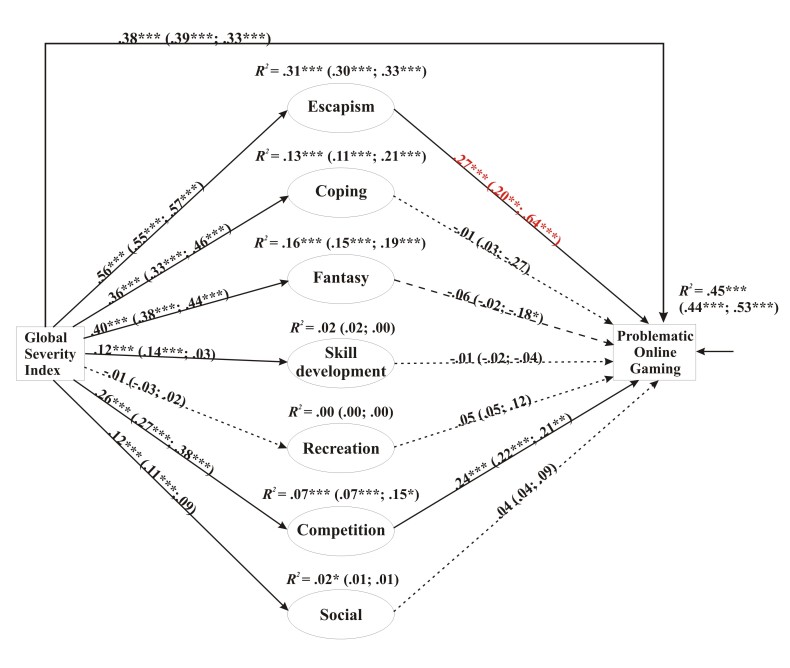
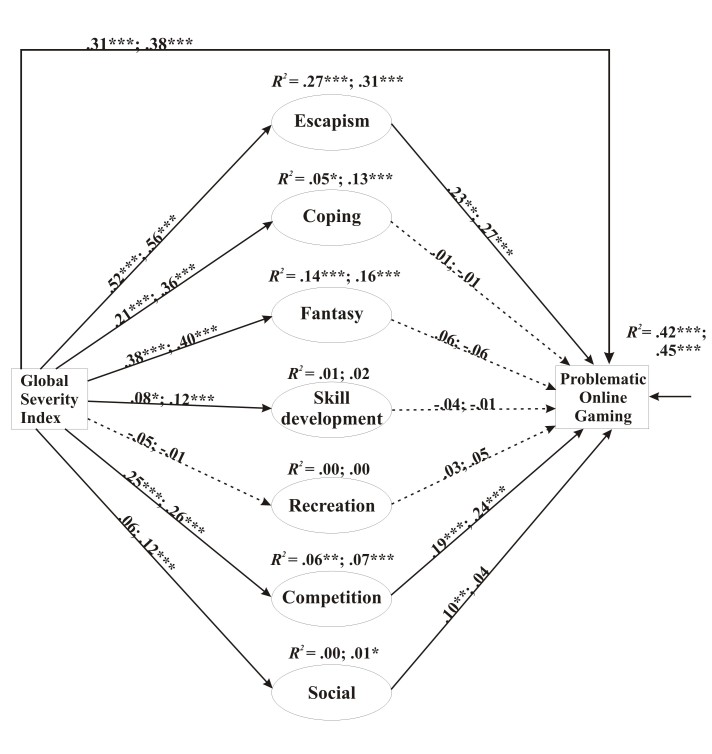
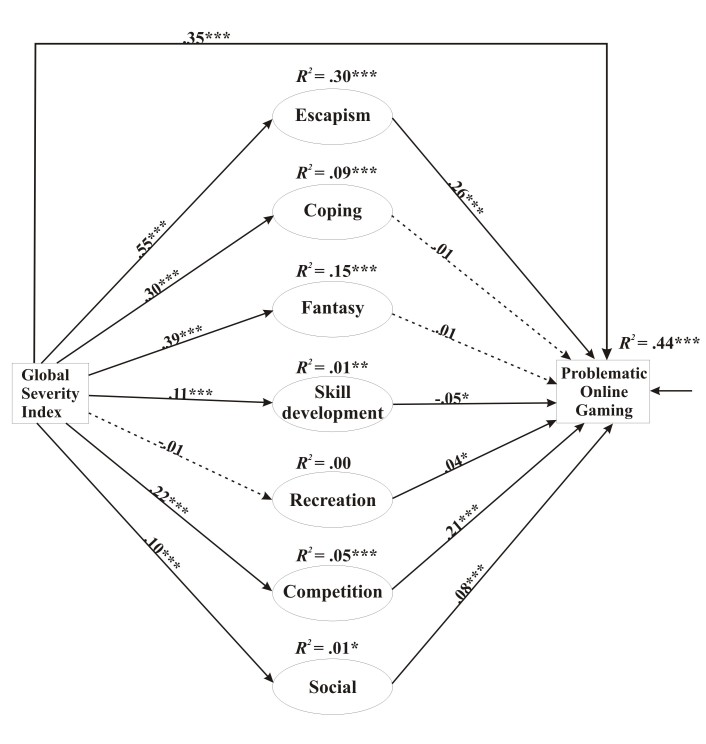
The mediation models fitted the data adequately. The Global Severity Index (GSI) of the BSI indicated that the level of psychiatric distress had a significant positive direct effect (standardized effect=.35, P<.001) and a significant indirect (mediating) effect on POG (standardized effect=.194, P<.001) via 2 gaming motives: escape (standardized effect=.139, P<.001) and competition (standardized effect=.046, P<.001). The comparison of the 2 main gamer types showed no significant differences in the model. However, when comparing male and female players it was found that women had (1) slightly higher escape scores (on a 5-point Likert scale: mean 2.28, SD 1.14) than men (mean 1.87, SD 0.97) and (2) a stronger association between the escape motive and problematic online gaming (standardized effect size=.64, P<.001) than men (standardized effect size=.20, P=.001).
The results suggest that psychiatric distress is both directly and indirectly (via escape and competition motives) negatively associated with POG. Therefore, the exploration of psychiatric symptoms and gaming motives of POG can be helpful in the preparation of prevention and treatment programs.
在线视频游戏作为一种休闲活动迅速扩张,导致了问题性在线游戏(POG)的出现。根据文献,POG与不同的精神症状(如抑郁、焦虑)以及特定的游戏动机(即逃避、成就)相关。基于对酒精使用的研究表明饮酒动机在远端影响(如创伤症状)和饮酒问题之间起中介作用,本研究检验了这样一种假设,即精神痛苦与POG之间通过游戏动机的中介存在间接联系。此外,基于性别在POG中所起的重要作用以及不同游戏类型之间的结构差异,还假设存在性别和游戏类型偏好的调节作用。
本研究有两个目的。第一个目的是检验在线游戏动机在精神症状与问题性在线游戏使用之间的中介作用。第二个目的是检验性别和游戏类型偏好在该中介模型中的调节作用。
对在线游戏玩家样本(N = 3186;年龄:平均21.1岁,标准差5.9岁;男性:2859/3186,89.74%)进行了在线调查。分别使用简明症状量表(BSI)、在线游戏动机问卷(MOGQ)和问题性在线游戏问卷(POGQ)来评估一般精神痛苦、在线游戏动机和问题性在线游戏使用。结构方程模型中的结构回归分析用于检验所提出的中介模型,多组分析用于检验性别和游戏类型差异以确定可能的调节作用。
中介模型对数据拟合良好。BSI 的全球严重指数(GSI)表明,精神痛苦水平对POG有显著的正向直接效应(标准化效应 = 0.35,P <.001)和显著的间接(中介)效应(标准化效应 = 0.194,P <.001),通过两种游戏动机:逃避(标准化效应 = 0.139,P <.001)和竞争(标准化效应 = 0.046,P <.001)。两种主要游戏玩家类型的比较在模型中未显示出显著差异。然而,在比较男性和女性玩家时发现,女性(1)逃避得分(5点李克特量表)略高于男性(平均2.28,标准差1.14)(平均1.87,标准差 = 0.97),并且(2)逃避动机与问题性在线游戏之间的关联比男性更强(标准化效应大小 = 0.64,P <.001)(标准化效应大小 = 0.20,P = 0.001)。
结果表明,精神痛苦与POG呈负相关,既有直接关联,也有通过逃避和竞争动机产生的间接关联。因此,探索POG的精神症状和游戏动机有助于制定预防和治疗方案。