Carolina Population Center, University of North Carolina at Chapel Hill, Chapel Hill, North Carolina, United States of America.
Institute of Health and Environment, Seoul National University, Seoul, Republic of Korea.
PLoS Negl Trop Dis. 2024 Oct 11;18(10):e0012574. doi: 10.1371/journal.pntd.0012574. eCollection 2024 Oct.
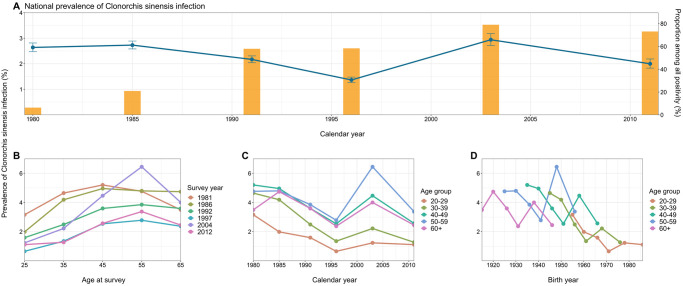
With decades of containment efforts, the prevalence of C. sinensis infection in Korea has shown a declining trend. However, well-tailored intervention assessments remain challenging, particularly when considering the potential impacts of cohort variations in raw freshwater fish consumption behavior, a major transmission route to humans, on this observed decline.
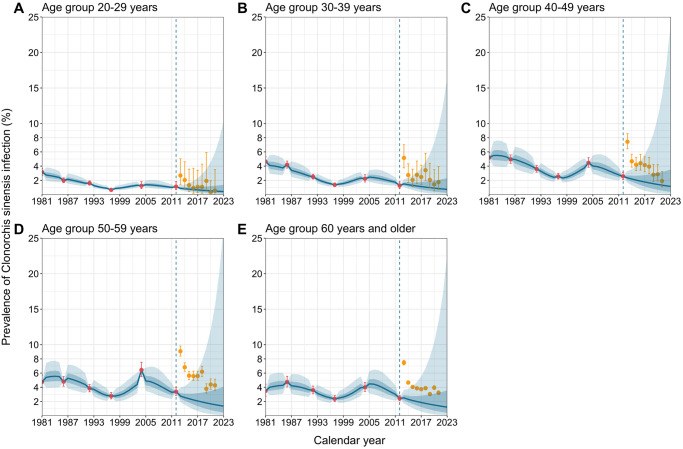
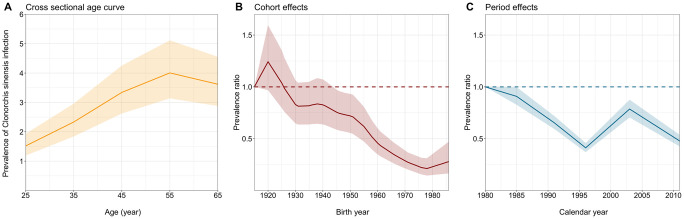
We applied an age-period-cohort modeling approach to nationally representative C. sinensis infection prevalence data from 1981-2012 in Korea to assess age, period, and cohort effects on its secular trend and to project the age-stratified prevalence up to 2023.
Our analysis suggests that both cohort and period effects have substantially contributed to the declining prevalence of C. sinensis infection in Korea. Age-stratified projections up to 2023 suggest a decline in prevalence across all age groups, while those aged over 40 are anticipated to maintain prevalences above the elimination threshold of 1%.
Our study highlights the importance of incorporating cohort effects into intervention assessments aimed at controlling C. sinensis infection. The effectiveness of interventions remains evident in Korea despite adjusting for the cohort effect. This approach, applicable to other endemic countries, would provide valuable insights for intervention assessments and inform future public health planning to eliminate C. sinensis infection.
经过几十年的防控努力,韩国华支睾吸虫感染的流行率呈下降趋势。然而,精心设计的干预评估仍然具有挑战性,特别是在考虑到人类主要传播途径之一的生淡水鱼消费行为的队列变化对这种观察到的下降的潜在影响时。
我们应用年龄-时期-队列模型方法,对韩国 1981 年至 2012 年期间具有代表性的华支睾吸虫感染流行率数据进行分析,以评估年龄、时期和队列对其流行趋势的影响,并预测 2023 年华支睾吸虫感染的年龄分层流行率。
我们的分析表明,队列和时期效应对韩国华支睾吸虫感染流行率的下降都有很大的贡献。到 2023 年的年龄分层预测表明,所有年龄组的流行率都在下降,而 40 岁以上的人群预计仍将保持在 1%以上的消除阈值。
本研究强调了在针对华支睾吸虫感染的干预评估中纳入队列效应的重要性。尽管考虑了队列效应,韩国的干预措施仍然有效。这种方法适用于其他流行地区,为干预评估提供了有价值的见解,并为消除华支睾吸虫感染的未来公共卫生规划提供了信息。