Bastos-Moreira Yuri, Argaw Alemayehu, Di Palma Giulianmichela, Dailey-Chwalibóg Trenton, El-Hafi Jasmin, Ouédraogo Lionel Olivier, Toe Laeticia Celine, De Saeger Sarah, Lachat Carl, De Boevre Marthe
Center of Excellence in Mycotoxicology and Public Health, MYTOX-SOUTH® Coordination Unit, Faculty of Pharmaceutical Sciences, Ghent University, Ghent, Belgium; Department of Food Technology, Safety and Health, Faculty of Bioscience Engineering, Ghent University, Ghent, Belgium.
Department of Food Technology, Safety and Health, Faculty of Bioscience Engineering, Ghent University, Ghent, Belgium.
J Nutr. 2025 Jan;155(1):260-269. doi: 10.1016/j.tjnut.2024.10.015. Epub 2024 Oct 10.
Mycotoxin exposure during pregnancy has been associated with adverse birth outcomes and poor infant growth. We assessed multiple biomarkers and metabolites of exposure to mycotoxins at birth and their associations with birth outcomes and infant growth in 274 newborns in rural Burkina Faso.
Whole-blood microsamples were analyzed for mycotoxin concentrations in newborns in the Biospecimen substudy nested in the MIcronutriments pour la SAnté de la Mère et de l'Enfant-III trial using ultra-performance liquid chromatography coupled with tandem mass spectrometry. Unadjusted and adjusted associations between mycotoxin exposure, and birth outcomes and infant growth at 6 mo were estimated using linear regression models for continuous outcomes and linear probability models with robust variance estimation for binary outcomes. Infant growth trajectories from birth to 6 mo were compared by exposure status using mixed-effects models with a random intercept for the individual infant and a random slope for the infant's age.
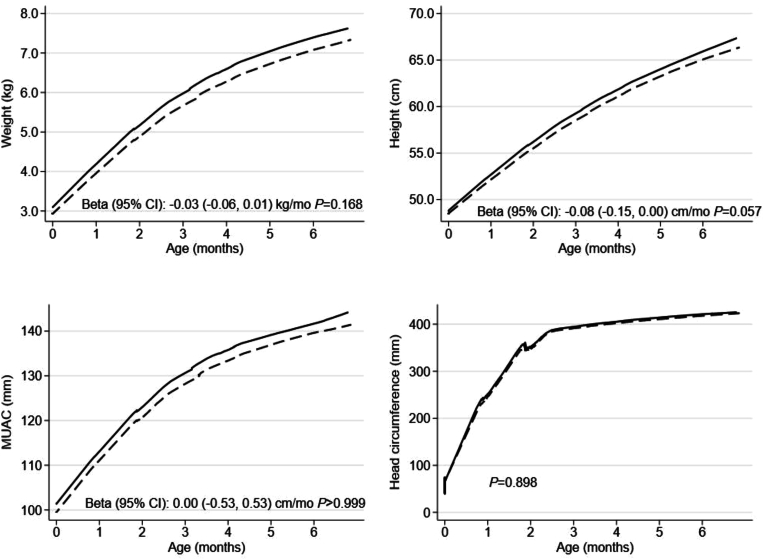
Ochratoxin A (OTA) exposure was detected in 38.3% of newborns, with other mycotoxins being detected in the range of 0.36% and 4.01%. OTA exposure was significantly associated with adverse birth outcomes, such as lower birth weight [β (95% CI): -0.11 kg (-0.21, 0.00); P = 0.042] and ponderal index [β (95% CI): -0.62 gm/cm (-1.19, -0.05); P = 0.034], and a marginally significant lower length growth trajectories during the first 6 mo [β (95% CI): -0.08 cm/mo (-0.15, 0.0); P = 0.057].
OTA exposure was prevalent among newborns and also associated with lower growth at birth and during the first 6 mo. The results emphasize the importance of nutrition-sensitive strategies to mitigate dietary OTA, as well as adopting food safety measures in Burkina Faso during the fetal period of development.
孕期接触霉菌毒素与不良出生结局及婴儿生长发育不良有关。我们评估了布基纳法索农村地区274名新生儿出生时接触霉菌毒素的多种生物标志物和代谢物,以及它们与出生结局和婴儿生长发育的关联。
在“母婴营养健康Ⅲ期试验”的生物样本子研究中,采用超高效液相色谱-串联质谱法分析新生儿全血微量样本中的霉菌毒素浓度。使用线性回归模型评估连续变量结局,以及带有稳健方差估计的线性概率模型评估二元变量结局,来估计霉菌毒素暴露与出生结局及6个月时婴儿生长发育之间未校正和校正后的关联。通过混合效应模型比较不同暴露状态下从出生到6个月的婴儿生长轨迹,模型中个体婴儿采用随机截距,婴儿年龄采用随机斜率。
38.3%的新生儿检测出赭曲霉毒素A(OTA)暴露,其他霉菌毒素的检出率在0.36%至4.01%之间。OTA暴露与不良出生结局显著相关,如出生体重较低[β(95%可信区间):-0.11千克(-0.21,0.00);P = 0.042]和 ponderal指数[β(95%可信区间):-0.62克/厘米(-1.19,-0.05);P = 0.034],并且在前6个月期间长度生长轨迹略显著降低[β(95%可信区间):-0.08厘米/月(-0.15,0.0);P = 0.057]。
OTA暴露在新生儿中普遍存在,并且与出生时及前6个月的生长发育较低有关。结果强调了营养敏感策略对于减轻膳食OTA的重要性,以及在布基纳法索胎儿发育期间采取食品安全措施的重要性。