Department of Food Technology, Safety and Health, Faculty of Bioscience Engineering, Ghent University, Ghent, Belgium.
Unité Nutrition et Maladies Métaboliques, Institut de Recherche en Sciences de la Santé (IRSS), Bobo-Dioulasso, Burkina Faso.
PLoS Med. 2023 Jul 24;20(7):e1004242. doi: 10.1371/journal.pmed.1004242. eCollection 2023 Jul.
Micronutrient-fortified balanced energy-protein (BEP) supplements are promising interventions to prevent intrauterine growth retardation in low- and middle-income countries. On the other hand, one concern with blanket prenatal supplementation programs using energy-dense supplements is that they could lead to more maternal and/or infant overweight. However, evidence is lacking on the potential effect of BEP on maternal and offspring body composition. This study evaluates the effects of micronutrient-fortified BEP supplementation during pregnancy on body composition of mothers and their newborns in rural Burkina Faso.
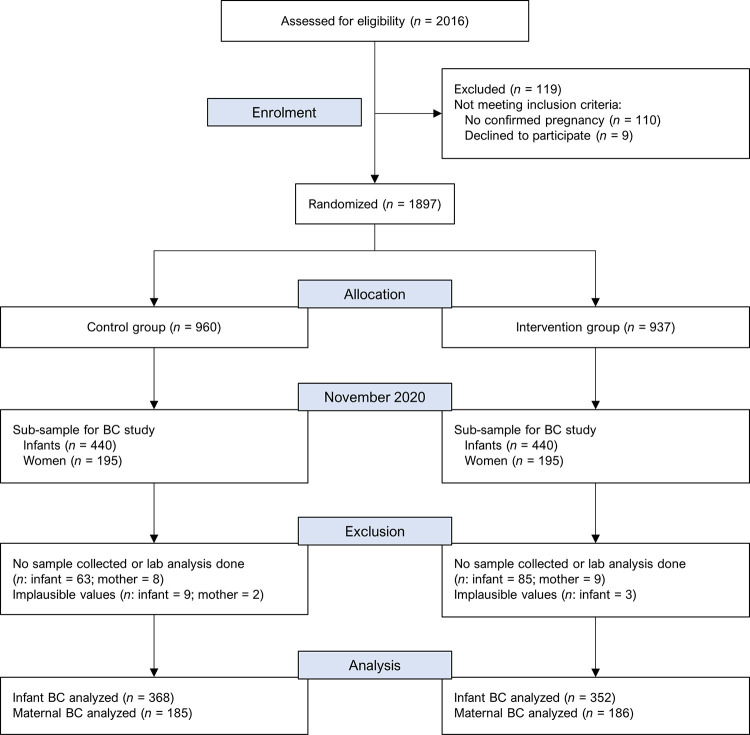
The MISAME-III study is an open label individually randomized controlled trial where pregnant women (n = 1,897) of gestational age <21 weeks received either a combination of micronutrient-fortified BEP and iron-folic acid (IFA) tablets (i.e., intervention) or IFA alone (i.e., control). The prenatal phase of the MISAME-III study was conducted between the first enrollment in October 2019 and the last delivery in August 2021. In a sub-study nested under the MISAME-III trial, we evaluated anthropometry and body composition in newborns who were born starting from 17 November 2020 (n: control = 368 and intervention = 352) and their mothers (n: control = 185 and intervention = 186). Primary study outcomes were newborn and maternal fat-free mass (FFMI) and fat-mass (FMI) indices. We used the deuterium dilution method to determine FFMI and FMI and %FFM and %FM of total body weight within 1 month postpartum. Our main analysis followed a modified intention-to-treat approach by analyzing all subjects with body composition data available. Univariable and multivariable linear regression models were fitted to compare the intervention and control arms, with adjusted models included baseline maternal age, height, arm fat index, hemoglobin concentration and primiparity, household size, wealth and food security indices, and newborn age (days). At study enrollment, the mean ± SD maternal age was 24.8 ± 6.13 years and body mass index (BMI) was 22.1 ± 3.02 kg/m2 with 7.05% of the mothers were underweight and 11.5% were overweight. Prenatal micronutrient-fortified BEP supplementation resulted in a significantly higher FFMI in mothers (MD (mean difference): 0.45; 95% CI (confidence interval): 0.05, 0.84; P = 0.026) and newborns (MD: 0.28; 95% CI: 0.06, 0.50; P = 0.012), whereas no statistically significant effects were found on FMI. The effect of micronutrient-fortified BEP on maternal FFMI was greater among mothers from food secure households and among those with a better nutritional status (BMI ≥21.0 kg/m2 or mid-upper arm circumference (MUAC) ≥23 cm). Key limitations of the study are the relatively high degree of missing data (approximately 18%), the lack of baseline maternal body composition values, and the lack of follow-up body composition measurements to evaluate any long-term effects.
Micronutrient-fortified BEP supplementation during pregnancy can increase maternal and newborn FFMI, without significant effects on FMI.
ClinicalTrials.gov with identifier NCT03533712.
在中低收入国家,强化微量营养素的均衡能量-蛋白质(BEP)补充剂是预防宫内生长迟缓的有前景的干预措施。另一方面,使用高热量补充剂的产前补充计划的一个担忧是,它们可能会导致更多的母亲和/或婴儿超重。然而,缺乏关于 BEP 对母婴身体成分潜在影响的证据。本研究评估了在布基纳法索农村地区怀孕期间补充强化微量营养素的 BEP 对母亲及其新生儿身体成分的影响。
MISAME-III 研究是一项开放标签个体随机对照试验,其中妊娠<21 周的孕妇(n=1897)接受了强化微量营养素的 BEP 与铁叶酸(IFA)片剂的组合(即干预组)或 IFA 单独(即对照组)。MISAME-III 研究的产前阶段于 2019 年 10 月首次入组至 2021 年 8 月最后一次分娩期间进行。在 MISAME-III 试验的嵌套子研究中,我们评估了从 2020 年 11 月 17 日开始出生的新生儿(n:对照组=368,干预组=352)及其母亲(n:对照组=185,干预组=186)的人体测量学和身体成分。主要研究结果是新生儿和产妇去脂体重指数(FFMI)和脂肪质量指数(FMI)。我们使用氘稀释法在产后 1 个月内确定总体重的 FFMI 和 FMI 以及%FFM 和%FM。我们的主要分析遵循修改后的意向治疗方法,通过分析所有有身体成分数据的受试者进行。单变量和多变量线性回归模型用于比较干预组和对照组,调整模型包括基线时母亲的年龄、身高、臂脂指数、血红蛋白浓度和初产妇、家庭规模、财富和粮食安全指数以及新生儿年龄(天)。在研究入组时,产妇的平均年龄为 24.8±6.13 岁,体重指数(BMI)为 22.1±3.02kg/m2,7.05%的母亲体重不足,11.5%的母亲超重。产前强化微量营养素的 BEP 补充剂可显著提高母亲(MD(平均差异):0.45;95%CI(置信区间):0.05,0.84;P=0.026)和新生儿(MD:0.28;95%CI:0.06,0.50;P=0.012)的 FFMI,而对 FMI 则没有统计学意义的影响。强化微量营养素的 BEP 对来自粮食安全家庭的母亲和营养状况较好的母亲(BMI≥21.0kg/m2或中上臂围(MUAC)≥23cm)的母亲 FFMI 影响更大。研究的主要局限性是数据缺失程度较高(约 18%)、缺乏基线时母亲的身体成分值以及缺乏后续的身体成分测量来评估任何长期影响。
怀孕期间强化微量营养素的 BEP 补充剂可以增加产妇和新生儿的 FFMI,而对 FMI 没有显著影响。
ClinicalTrials.gov,标识符为 NCT03533712。