Botany Department, Faculty of Science, Mansoura University, Mansoura, 35516, Egypt.
Department Genebank, Resources Genetics and Reproduction, Leibniz Institute of Plant Genetics and Crop Plant Research (IPK), Corrensstr. 3, OT Gatersleben D, Stadt Seeland, 06466, Germany.
BMC Plant Biol. 2024 Oct 11;24(1):948. doi: 10.1186/s12870-024-05620-5.
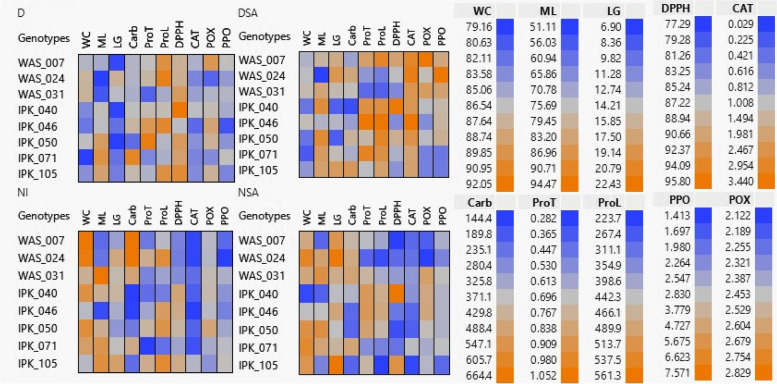
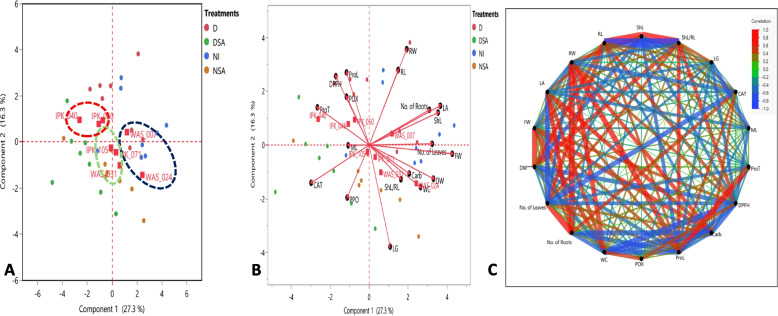
Climate change-related droughts that recur frequently are one of the biggest obstacles to wheat (Triticum aestivum L.) productivity. Worldwide, attempts are being done to establish drought-resistant cultivars. However, progress is slow since drought tolerance is a complex trait controlled by numerous genes, and its expression is influenced by the environment. Phenotypic, biochemical physiological, and genotyping approaches are highlighted as critical research components for leveraging genetic variation in eight wheat genotypes. Treatments included eight spring wheat genotypes (IPK_040, IPK_046, IPK_050, IPK_071, IPK_105, WAS_007, WAS_024 and WAS_031), normal irrigation (NI), drought stress (D) (30% field capacity (FC)), normal irrigation with 0.5 mM SA (NSA), and drought treated with SA (DSA). The results revealed that there was a reduction in relative water content, an increase membrane leakage, and leaf chlorophyll content under drought stress. SA induced the defense responses against drought by increasing the osmolytes and the antioxidative enzymes activities. Compared to the NI group, the DSA treatment improved the water regulation, antioxidant capacity, and drought stress resistance. SA significantly reduced the deleterious effects of water stress on phenotyping more in WAS_ 024 and IPK_ 105 genotypes. The most responsive genotypes to salicylic acid were IPK_ 046 among the IPK genotypes, whereas WAS_031 genotype was amongst WAS genotypes based on the morpho-physiological traits. The findings of this study give a solid foundation for assessing drought resistance in T. aestivum and developing cultivation-specific water management methods.
气候变化相关的频繁干旱是影响小麦(Triticum aestivum L.)生产力的最大障碍之一。全球范围内,人们正在努力培育抗旱品种。然而,进展缓慢,因为耐旱性是一个由众多基因控制的复杂性状,其表达受环境影响。表型、生化生理和基因分型方法被强调为利用八种小麦基因型遗传变异的关键研究组成部分。处理包括八个春小麦基因型(IPK_040、IPK_046、IPK_050、IPK_071、IPK_105、WAS_007、WAS_024 和 WAS_031)、正常灌溉(NI)、干旱胁迫(D)(30%田间持水量(FC))、用 0.5mM SA 的正常灌溉(NSA)和用 SA 处理的干旱胁迫(DSA)。结果表明,在干旱胁迫下,相对水含量降低,膜渗漏增加,叶片叶绿素含量降低。SA 通过增加渗透物和抗氧化酶活性诱导对干旱的防御反应。与 NI 组相比,DSA 处理改善了水调节、抗氧化能力和抗旱性。与 NI 组相比,SA 处理显著减轻了水胁迫对表型的不利影响,WAS_024 和 IPK_105 基因型的效果更为明显。在 IPK 基因型中,IPK_046 是对水杨酸反应最敏感的基因型,而 WAS_031 基因型是 WAS 基因型中对水杨酸反应最敏感的基因型。本研究的结果为评估小麦抗旱性和开发特定于栽培的水分管理方法提供了坚实的基础。