Department of Psychology, University of Regina, 3737 Wascana Parkway, Regina, SK, S4S 0A2, Canada.
Department of Psychology, University of Calgary, 2500 University Drive Northwest, Calgary, AB, T2N 1N4, Canada.
Trials. 2024 Oct 11;25(1):671. doi: 10.1186/s13063-024-08527-6.
Atrial fibrillation (AF) represents a global epidemic. Although international AF practice guidelines indicate weight loss for patients with AF and comorbid obesity (BMI ≥ 30 kg/m) to alleviate symptom burden and improve prognosis, few cardiac rehabilitation (CR) programs include targeted weight loss treatment.
This RCT protocol will evaluate the efficacy of a "Small Changes" behavioral weight loss treatment (BWLT) to produce clinically relevant (≥ 10%) weight loss among patients with AF and obesity undergoing CR, relative to CR alone. Secondary aims are to establish efficacy of CR + BWLT for improving AF symptoms, AF risk factors, and health-related quality of life.
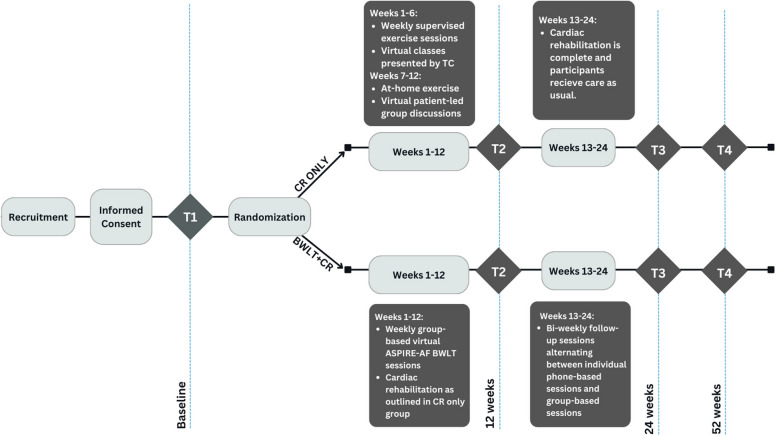
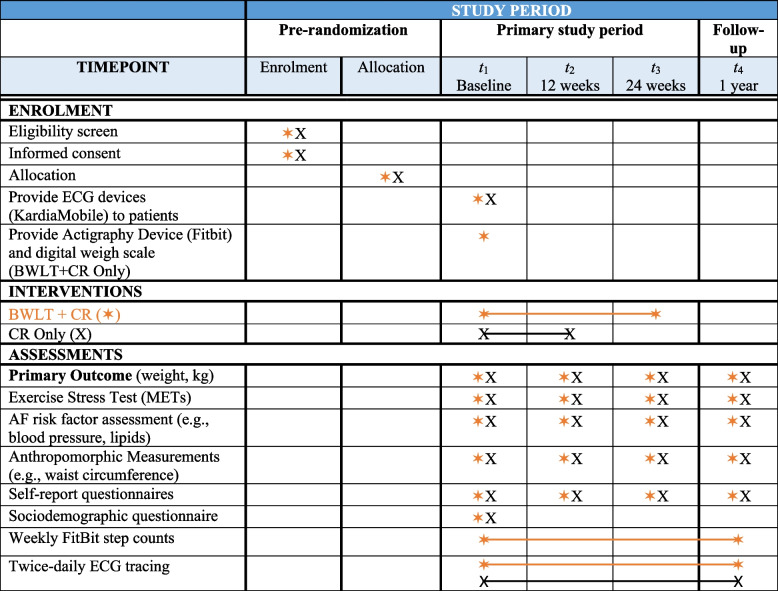
Adults (18 +) with AF and obesity will be recruited and randomized to receive CR + BWLT (intervention) or CR-only (control). Controls will receive CR consisting of supervised exercise and risk factor self-management for 12 weeks. The intervention group will receive CR plus BWLT (12 weekly, group-based virtual sessions, followed by 12 weeks of follow-up support). Weight and AF-risk factors will be assessed at pre-randomization, 12 weeks, 24 weeks, and 52 weeks. AF burden will be assessed using 30-s ECGs recorded bidaily and with AF symptoms. The primary endpoint of weight loss will be calculated from baseline to 52 weeks as a percentage of starting weight. Intention-to-treat analyses will compare the proportion in each group achieving ≥ 10% weight loss. Assuming success rates of 5% and 30% among controls and intervention groups, respectively, and a 30% loss to follow-up, 120 patients (60 per group) will provide 80% power to detect a difference using a two-sided independent test of proportions (alpha = 5%).
This clinical trial will be the first to demonstrate that adding BWLT to CR promotes clinically meaningful weight loss among patients with AF and comorbid obesity. Findings will inform design and execution of a large efficacy trial of long-term (e.g., 5-year) clinical endpoints (e.g., AF severity, mortality). Implementing weight control interventions designed to target the AF substrate in CR could dramatically reduce morbidity and enhance quality of life among patients living with AF in Canada.
ClinicalTrials.gov registration number: NCT05600829. Registered October 31, 2022.
心房颤动(AF)是一种全球性疾病。尽管国际 AF 实践指南表明,对于合并肥胖症(BMI≥30kg/m)的 AF 患者,减轻体重可减轻症状负担并改善预后,但很少有心脏康复(CR)计划包括针对体重减轻的治疗。
本 RCT 方案将评估“小改变”行为体重减轻治疗(BWLT)在接受 CR 的 AF 和肥胖患者中产生临床相关(≥10%)体重减轻的效果,与单独接受 CR 相比。次要目的是确定 CR+BWLT 是否可以改善 AF 症状、AF 危险因素和与健康相关的生活质量。
将招募年龄在 18 岁及以上的 AF 和肥胖症患者,并将其随机分为接受 CR+BWLT(干预组)或仅接受 CR(对照组)。对照组将接受为期 12 周的监督运动和危险因素自我管理的 CR。干预组将接受 CR 加 BWLT(12 周的每周一次、基于小组的虚拟课程,随后进行 12 周的随访支持)。在基线、12 周、24 周和 52 周时评估体重和 AF 危险因素。使用每天记录两次的 30 秒心电图和 AF 症状评估 AF 负担。体重减轻的主要终点将从基线到 52 周计算,以起始体重的百分比表示。意向治疗分析将比较每组中达到≥10%体重减轻的比例。假设对照组和干预组的成功率分别为 5%和 30%,随访损失率为 30%,则需要 120 名患者(每组 60 名)才能使用双侧独立比例检验(α=5%)以 80%的效能检测差异。
本临床试验将是第一个证明在 CR 中添加 BWLT 可促进 AF 合并肥胖患者体重显著减轻的临床试验。研究结果将为设计和执行针对长期(例如 5 年)临床终点(例如 AF 严重程度、死亡率)的大型疗效试验提供信息。在 CR 中实施旨在针对 AF 基质的体重控制干预措施,可能会大大降低加拿大 AF 患者的发病率并提高生活质量。
ClinicalTrials.gov 注册号:NCT05600829。于 2022 年 10 月 31 日注册。