School of Public Health, University of California, Berkeley, Berkeley, CA, USA.
West Coast Metabolomics Center, University of California, Davis, Davis, CA, USA.
BMC Med. 2024 Oct 11;22(1):449. doi: 10.1186/s12916-024-03606-6.
Pre-diagnostic disturbances in the microbiome-derived metabolome have been associated with an increased risk of diabetes in non-pregnant populations. However, the roles of microbiome-derived metabolites, the end-products of microbial metabolism, in gestational diabetes (GDM) remain understudied. We examined the prospective association of microbiome-derived metabolites in early to mid-pregnancy with GDM risk in a diverse population.
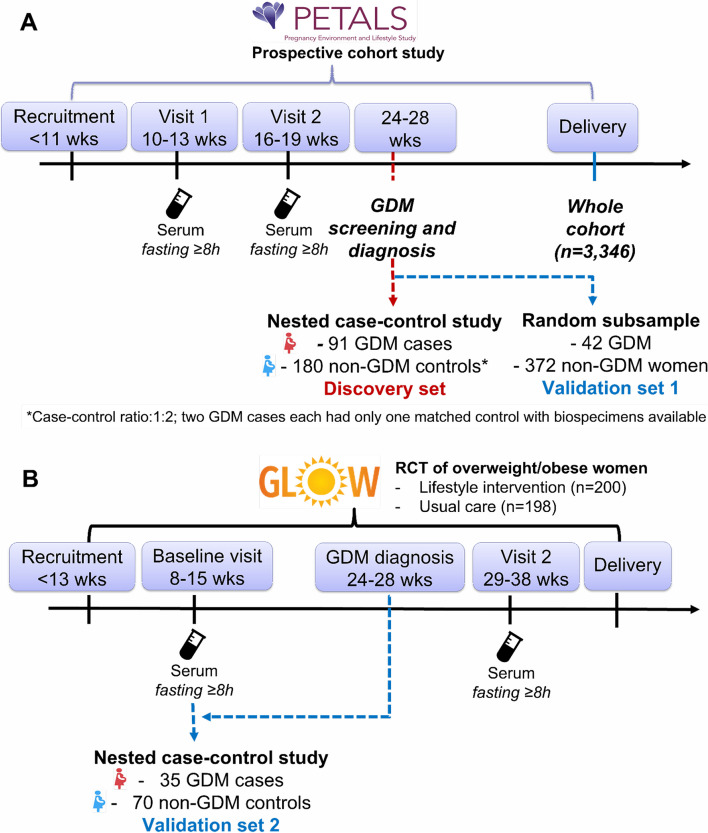
We conducted a prospective discovery and validation study, including a case-control sample of 91 GDM and 180 non-GDM individuals within the multi-racial/ethnic The Pregnancy Environment and Lifestyle Study (PETALS) as the discovery set, a random sample from the PETALS (42 GDM, 372 non-GDM) as validation set 1, and a case-control sample (35 GDM, 70 non-GDM) from the Gestational Weight Gain and Optimal Wellness randomized controlled trial as validation set 2. We measured untargeted fasting serum metabolomics at gestational weeks (GW) 10-13 and 16-19 by gas chromatography/time-of-flight mass spectrometry (TOF-MS), liquid chromatography (LC)/quadrupole TOF-MS, and hydrophilic interaction LC/quadrupole TOF-MS. GDM was diagnosed using the 3-h, 100-g oral glucose tolerance test according to the Carpenter-Coustan criteria around GW 24-28.
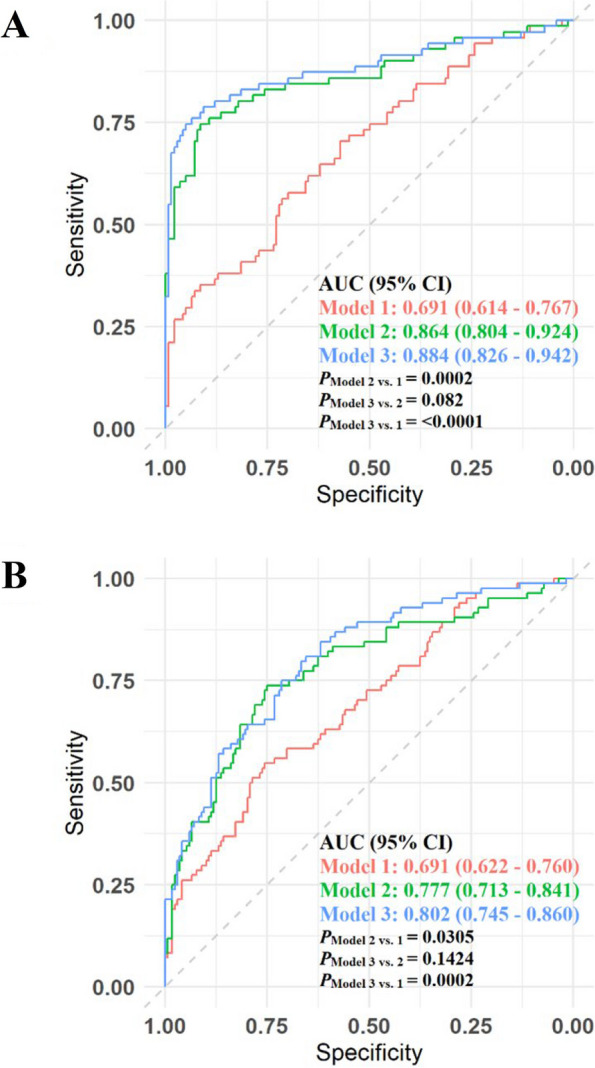
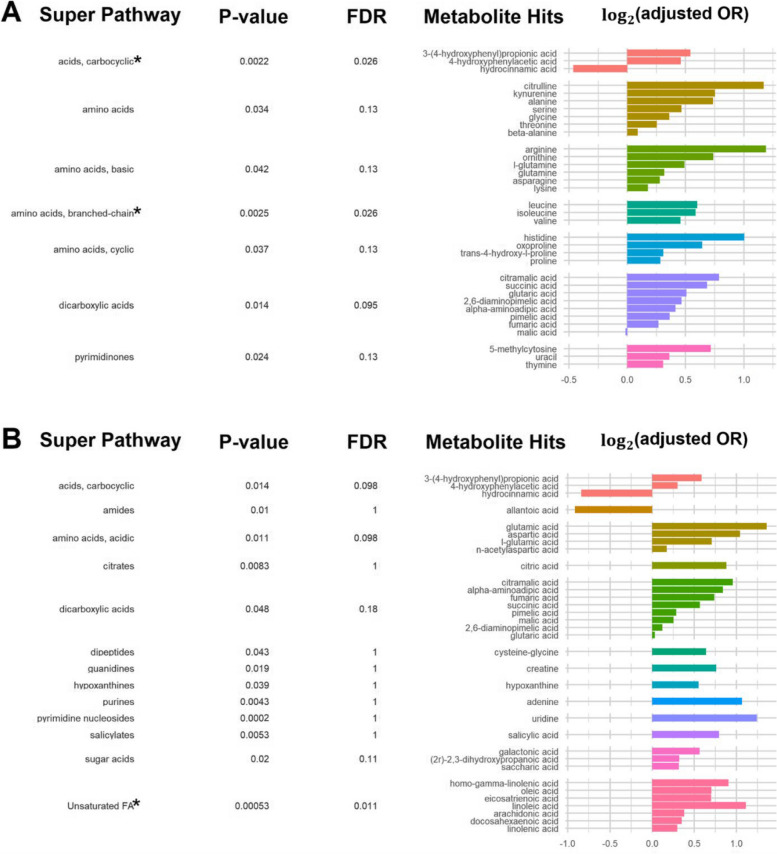
Among 1362 annotated compounds, we identified 140 of gut microbiome metabolism origin. Multivariate enrichment analysis illustrated that carbocyclic acids and branched-chain amino acid clusters at GW 10-13 and the unsaturated fatty acids cluster at GW 16-19 were positively associated with GDM risk (FDR < 0.05). At GW 10-13, the prediction model that combined conventional risk factors and LASSO-selected microbiome-derived metabolites significantly outperformed the model with only conventional risk factors including fasting glucose (discovery AUC: 0.884 vs. 0.691; validation 1: 0.945 vs. 0.731; validation 2: 0.987 vs. 0.717; all P < 0.01). At GW 16-19, similar results were observed (discovery AUC: 0.802 vs. 0.691, P < 0.01; validation 1: 0.826 vs. 0.780; P = 0.10).
Dysbiosis in microbiome-derived metabolites is present early in pregnancy among individuals progressing to GDM.
在非妊娠人群中,产前微生物组衍生代谢组的紊乱与糖尿病风险增加有关。然而,微生物组衍生代谢物(微生物代谢的终产物)在妊娠糖尿病(GDM)中的作用仍有待研究。我们在一个多样化的人群中研究了妊娠早期和中期微生物组衍生代谢物与 GDM 风险的前瞻性关联。
我们进行了一项前瞻性的发现和验证研究,包括多种族/族裔妊娠环境和生活方式研究(PETALS)中的病例对照样本 91 例 GDM 和 180 例非 GDM 个体作为发现组,PETALS 的随机样本(42 例 GDM,372 例非 GDM)作为验证组 1,以及妊娠体重增加和最佳健康随机对照试验的病例对照样本(35 例 GDM,70 例非 GDM)作为验证组 2。我们在妊娠 10-13 周和 16-19 周通过气相色谱/飞行时间质谱(TOF-MS)、液相色谱(LC)/四极杆 TOF-MS 和亲水相互作用 LC/四极杆 TOF-MS 测量了空腹血清代谢组学。GDM 使用 Carpenter-Coustan 标准在 GW 24-28 左右进行 3 小时、100g 口服葡萄糖耐量试验进行诊断。
在 1362 种注释化合物中,我们鉴定出 140 种来源于肠道微生物组代谢的化合物。多变量富集分析表明,GW 10-13 时的碳环酸和支链氨基酸簇以及 GW 16-19 时的不饱和脂肪酸簇与 GDM 风险呈正相关(FDR<0.05)。在 GW 10-13 时,结合常规危险因素和 LASSO 选择的微生物组衍生代谢物的预测模型明显优于仅包含常规危险因素的模型,包括空腹血糖(发现 AUC:0.884 与 0.691;验证 1:0.945 与 0.731;验证 2:0.987 与 0.717;均 P<0.01)。在 GW 16-19 时,观察到类似的结果(发现 AUC:0.802 与 0.691,P<0.01;验证 1:0.826 与 0.780;P=0.10)。
在进展为 GDM 的个体中,妊娠早期微生物组衍生代谢物的失调很早就存在了。