Faculty of Social Sciences, Centre of Excellence in Research on Ageing and Care, University of Helsinki, Helsinki, Finland.
Faculty of Social Sciences (Health Sciences) and Gerontology Research Center (GEREC), Tampere University, Tampere, Finland.
BMC Geriatr. 2024 Oct 11;24(1):817. doi: 10.1186/s12877-024-05404-4.
Prior studies on longevity often examine predictors in isolation and rely solely on baseline information, limiting our understanding of the most important predictors and their dynamic nature. In this study, we used an innovative regression tree model to explore the common characteristics of those who lived longer than their age and sex peers in 35-years follow-up. We identified different pathways leading to a long life, and examined to how changes in characteristics over 10 years (from 1979 to 1989) affect the findings on longevity predictors.
Data was obtained from the "Tampere Longitudinal Study on Ageing" (TamELSA) in Finland. Survey data was collected in 1979 from 1056 participants aged 60-89 years (49.8% men). In 1989, a second survey was conducted among 432 survivors from the 1979 cohort (40.2% men). Dates of death were provided by the Finnish Population Register until 2015. We employed an individual measure of longevity known as the realized probability of dying (RPD), which was calculated based on each participant's age and sex, utilizing population life tables. RPD is based on a comparison of the survival time of each individual of a specific age and sex with the survival time of his/her peers in the total population. A regression tree analysis was used to examine individual-based longevity with RPD as an outcome.
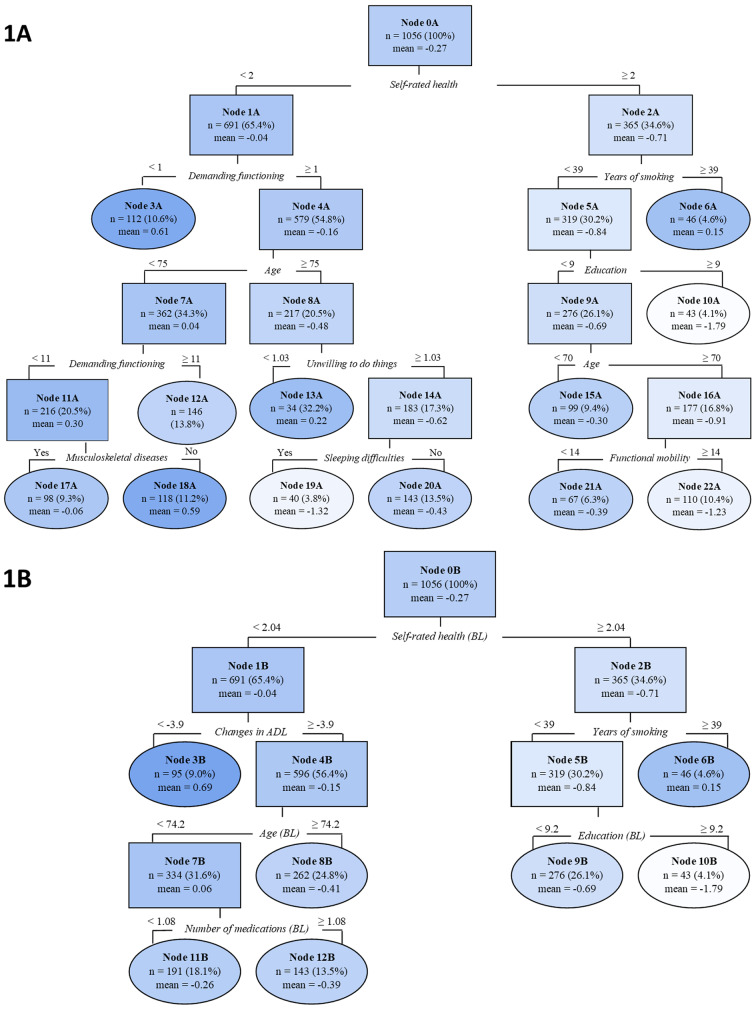
This relative measure of longevity (RPD) provided a complex regression tree where the most important characteristics were self-rated health, years of education, history of smoking, and functional ability. We identified several pathways leading to a long life such as individuals with (1) good self-rated health (SRH), short smoking history, and higher education, (2) good SRH, short smoking history, lower education, and excellent mobility, and (3) poor SRH but able to perform less demanding functions, aged 75 or older, willing to do things, and sleeping difficulties. Changes in the characteristics over time did not change the main results.
The simultaneous examination of a broad range of potential predictors revealed that longevity can be achieved under very different conditions and is achieved by heterogeneous groups of people.
先前关于长寿的研究通常单独检查预测因子,并仅依赖于基线信息,这限制了我们对最重要的预测因子及其动态性质的理解。在这项研究中,我们使用了一种创新的回归树模型来探索在 35 年随访中,那些比其年龄和性别同龄活得更长的人的共同特征。我们确定了通向长寿的不同途径,并研究了特征在 10 年内的变化(从 1979 年到 1989 年)如何影响长寿预测因子的发现。
数据来自芬兰的“坦佩雷老龄化纵向研究”(TamELSA)。1979 年,从 1056 名 60-89 岁的参与者(49.8%为男性)中收集了调查数据。1989 年,对 1979 年队列中的 432 名幸存者进行了第二次调查(40.2%为男性)。截至 2015 年,死亡日期由芬兰人口登记处提供。我们采用了一种称为已实现死亡率概率(RPD)的个体长寿衡量标准,该标准是根据每个参与者的年龄和性别,利用人口生命表计算得出的。RPD 是基于比较每个特定年龄和性别的个体的生存时间与总人群中同龄人的生存时间。回归树分析用于检查基于个体的长寿情况,RPD 作为结果。
这种相对长寿衡量标准(RPD)提供了一个复杂的回归树,其中最重要的特征是自我评估的健康状况、受教育年限、吸烟史和功能能力。我们确定了几种通向长寿的途径,例如:(1)自我评估的健康状况良好(SRH)、吸烟史短、受教育程度高的个体;(2)自我评估的健康状况良好(SRH)、吸烟史短、受教育程度低、活动能力强的个体;(3)自我评估的健康状况不佳(SRH)但能够完成要求较低的功能、年龄在 75 岁或以上、愿意做事和有睡眠困难的个体。随着时间的推移,特征的变化并没有改变主要结果。
同时检查广泛的潜在预测因子表明,长寿可以在非常不同的条件下实现,并且由不同的人群实现。