School of Public Health and the Second Affiliated Hospital, Zhejiang University School of Medicine, Hangzhou, Zhejiang, China.
Department of Epidemiology and Biostatistics, and Department of Respiratory Disease, Sir Run Run Shaw Hospital, Zhejiang University School of Medicine, Hangzhou, Zhejiang, China.
Alzheimers Res Ther. 2024 Oct 11;16(1):220. doi: 10.1186/s13195-024-01581-x.
The associations of different obesity and metabolic phenotypes during midlife with the risk of incident dementia remain unclear. This study aimed to investigate the associations between metabolic heterogeneity of obesity and long-term risk of dementia.
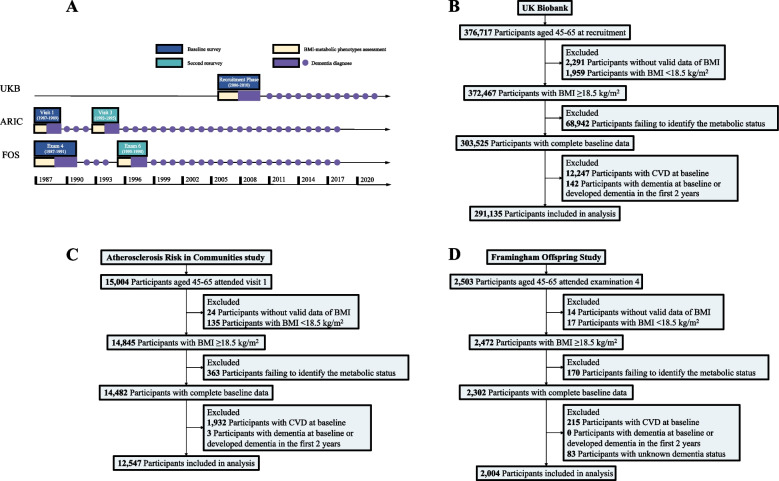
We conducted prospective analyses from three cohorts, including the UK Biobank (UKB), Atherosclerosis Risk in Communities (ARIC) study, and Framingham Offspring Study (FOS). Eligible participants were those aged 45-65 years with valid assessments of body mass index (BMI) and metabolic status at the study baseline. Obesity was defined as a BMI of ≥ 30.0 kg/m, while metabolic abnormality was defined as meeting ≥ 2 of the National Cholesterol Education Program-Adult Treatment Panel III (NCEP-ATP III) criteria. Metabolic heterogeneity of obesity was evaluated based on obesity and metabolic phenotypes and grouped as metabolically normal non-obesity (MNNO), metabolically abnormal non-obesity (MANO), metabolically normal obesity (MNO), and metabolically abnormal obesity (MAO).
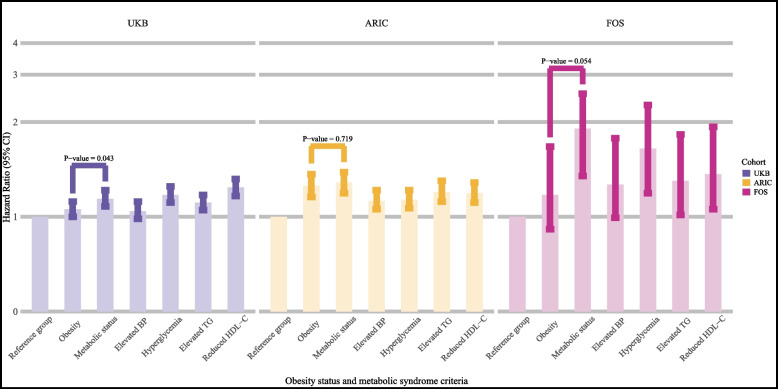
Included in this study were 295,823 participants aged 56.3 ± 5.9 years from the UKB, 12,547 participants aged 54.0 ± 5.7 years from the ARIC, and 2,004 participants aged 53.9 ± 5.9 years from the FOS. Over 4,348,208 person-years, a total of 6,190 participants (3,601 in the UKB, 2,405 in the ARIC, and 184 in the FOS) developed incident dementia. In the pooled analysis of three cohorts, metabolic abnormality was associated with a hazard ratio (HR) of 1.41 (95% confidence interval [CI]: 1.10-1.80) for dementia, while obesity was associated with an HR of 1.20 (1.03-1.41). Compared with MNNO, individuals with MANO and MAO had increased risks of dementia (pooled HR: 1.33, 95% CI: 1.04-1.71 for MANO and 1.48, 1.16-1.89 for MAO). However, there was no significant difference in the risk of dementia among MNO (pooled HR: 1.10, 95% CI: 0.98-1.24). In addition, participants who recovered from MANO to MNNO had a lower risk of dementia (pooled HR: 0.79, 95% CI: 0.64-0.97), as compared with stable MANO.
Metabolic abnormality has a stronger association with dementia than obesity. Metabolically abnormal non-obesity and obesity, but not metabolically normal obesity, are associated with higher risks of incident dementia as compared with metabolically normal non-obesity. Recovering from an abnormal metabolic status to normal reduces the risk of dementia in populations without obesity. Our findings highlight the important role of metabolic status in the development of dementia and recommend the stratified management of obesity based on metabolic status.
中年时期不同的肥胖和代谢表型与痴呆症发病风险的关联仍不清楚。本研究旨在探讨肥胖代谢异质性与痴呆症长期风险之间的关系。
我们进行了来自三个队列的前瞻性分析,包括英国生物库(UKB)、社区动脉粥样硬化风险(ARIC)研究和弗雷明汉后代研究(FOS)。合格的参与者是年龄在 45-65 岁之间的人群,在研究基线时具有有效的体重指数(BMI)和代谢状态评估。肥胖定义为 BMI 大于等于 30.0kg/m,而代谢异常定义为符合国家胆固醇教育计划-成人治疗小组 III(NCEP-ATP III)标准中的大于等于 2 项。肥胖的代谢异质性是根据肥胖和代谢表型进行评估的,并分为代谢正常非肥胖(MNNO)、代谢异常非肥胖(MANO)、代谢正常肥胖(MNO)和代谢异常肥胖(MAO)。
本研究纳入了来自 UKB 的 295823 名年龄为 56.3±5.9 岁的参与者、来自 ARIC 的 12547 名年龄为 54.0±5.7 岁的参与者和来自 FOS 的 2004 名年龄为 53.9±5.9 岁的参与者。在超过 4348208 人年的随访中,共有 6190 名参与者(UKB 中有 3601 名,ARIC 中有 2405 名,FOS 中有 184 名)发生了痴呆症。在三个队列的汇总分析中,代谢异常与痴呆的风险比(HR)为 1.41(95%置信区间 [CI]:1.10-1.80),而肥胖与痴呆的 HR 为 1.20(1.03-1.41)。与 MNNO 相比,MANO 和 MAO 个体发生痴呆症的风险增加(汇总 HR:1.33,95%CI:1.04-1.71 用于 MANO 和 1.48,1.16-1.89 用于 MAO)。然而,MNO 之间痴呆症的风险没有显著差异(汇总 HR:1.10,95%CI:0.98-1.24)。此外,与稳定的 MANO 相比,从 MANO 恢复为 MNNO 的参与者痴呆症的风险较低(汇总 HR:0.79,95%CI:0.64-0.97)。
代谢异常与痴呆的相关性强于肥胖。与代谢正常非肥胖相比,代谢异常非肥胖和肥胖与痴呆症的发病风险更高,而代谢正常肥胖则没有。从异常代谢状态恢复到正常可降低肥胖人群患痴呆症的风险。我们的研究结果强调了代谢状态在痴呆症发展中的重要作用,并建议根据代谢状态对肥胖进行分层管理。