Department of Endocrinology, Sanjay Gandhi Postgraduate Institute of Medical Sciences, Lucknow, India.
Endocrinol Metab (Seoul). 2024 Oct;39(5):686-692. doi: 10.3803/EnM.2024.2068. Epub 2024 Oct 14.
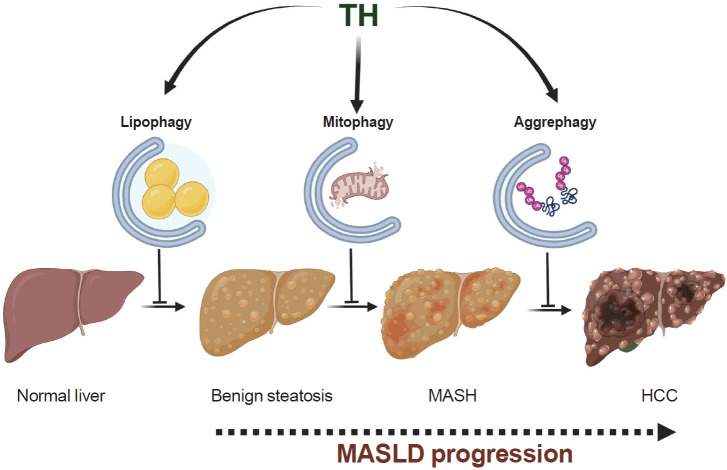
The influence of thyroid hormone (TH) on liver metabolism has attracted the attention of pharmacologists seeking new treatments for metabolic dysfunction-associated steatotic liver disease (MASLD), an increasingly common metabolic disorder. In this context, the selective induction of autophagy by TH in preclinical models has been identified as a promising mechanism. In this process, TH clears intrahepatic fat through lipophagy while protecting against inflammation and mitochondrial damage in hepatocytes via mitophagy. Furthermore, TH-induced aggrephagy may represent a protective mechanism to mitigate the development of MASLD-associated hepatocellular carcinoma. Considering the defects in autophagy observed during the progression of human MASLD, the induction of autophagy by TH, its metabolites, and its analogs represent a novel strategy to combat hepatic damage across the MASLD spectrum.
甲状腺激素 (TH) 对肝脏代谢的影响引起了药理学家的关注,他们正在寻找治疗代谢功能障碍相关脂肪性肝病 (MASLD) 的新方法,MASLD 是一种越来越常见的代谢紊乱。在这种情况下,TH 在临床前模型中选择性诱导自噬被确定为一种有前途的机制。在这个过程中,TH 通过脂噬清除肝内脂肪,同时通过线粒体自噬保护肝细胞免受炎症和线粒体损伤。此外,TH 诱导的聚集体自噬可能代表一种保护机制,可以减轻 MASLD 相关肝细胞癌的发展。鉴于在人类 MASLD 进展过程中观察到的自噬缺陷,TH、其代谢物及其类似物诱导自噬代表了一种新的策略,可以在 MASLD 谱范围内对抗肝损伤。