Department of Dermatology, Chongqing Traditional Chinese Medicine Hospital, Chongqing Clinical Research Center for Dermatology, Chongqing Key Laboratory of Integrative Dermatology Research, Chongqing, China.
The Second Affiliated Hospital, Guangzhou University of Chinese Medicine (Guangdong Provincial Hospital of Chinese Medicine), Guangzhou, China.
Mol Genet Genomic Med. 2024 Oct;12(10):e70022. doi: 10.1002/mgg3.70022.
Bullous pemphigoid (BP) and atopic dermatitis (AD) are currently thought to be tightly related, yet studies of the mechanisms of co-morbidities are lacking.
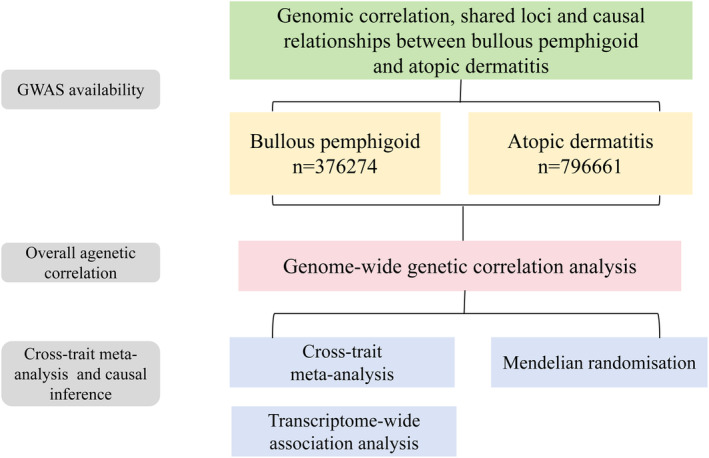
We obtained GWAS data for BP (N = 376,274) and AD (N = 796,661) from the Finnish Genetic Research Program dataset and the UK Biobank, separately. Then, the following four analyses were performed: (1) cross-trait linkage disequilibrium score regression (LDSC) to assess the genetic correlation between BP and AD, (2) cross-phenotype association analysis (CPASSOC) to identify multiple effector loci shared by BP and AD, (3) transcriptome-wide association study (TWAS) to determine whether their cross-organizational expression patterns share genes with a common biological mechanism of relevance, and (4) bidirectional Mendelian randomization (MR) analysis to assess bidirectional causal effects of BP and AD.
We found a positive genetic association between BP and AD (rg = 0.5476, p = 0.0495) as well as identified four pleiotropic loci and 59 common genes affecting BP and AD. Bidirectional MR analysis suggested that BP promotes the risk of AD.
We revealed a genetic link between BP and AD, which is associated with biological pleiotropy and causality. Awareness of the association between BP and AD helps dermatologists manage patients with these illnesses.
大疱性类天疱疮(BP)和特应性皮炎(AD)目前被认为密切相关,但对共病机制的研究尚缺乏。
我们从芬兰遗传研究计划数据集和英国生物库中分别获得了 BP(N=376274)和 AD(N=796661)的 GWAS 数据。然后,进行了以下四项分析:(1)跨性状连锁不平衡评分回归(LDSC)评估 BP 和 AD 之间的遗传相关性,(2)跨表型关联分析(CPASSOC)鉴定 BP 和 AD 共同的多个效应基因座,(3)全转录组关联研究(TWAS)确定它们的跨组织表达模式是否与具有共同生物学机制的基因共享,以及(4)双向孟德尔随机化(MR)分析评估 BP 和 AD 的双向因果效应。
我们发现 BP 和 AD 之间存在正的遗传关联(rg=0.5476,p=0.0495),并鉴定出四个多效性基因座和 59 个共同影响 BP 和 AD 的基因。双向 MR 分析表明 BP 促进 AD 的发病风险。
我们揭示了 BP 和 AD 之间的遗传联系,这与生物学的多效性和因果关系有关。对 BP 和 AD 之间关联的认识有助于皮肤科医生管理这些疾病的患者。