Hu Haishan, Zhou Qing, Ma Yanlin, Zhang Lingxiao
Department of Reproductive Medicine, The First Affiliated Hospital of Hainan Medical University, Haikou, 570102, China.
Hainan Provincial Key Laboratory for human reproductive medicine and Genetic Research&Key Laboratory of Reproductive Health Diseases Research and Translation, Ministry of Education&Hainan Provincial Clinical Research Center for Thalassemia, The First Affiliated Hospital of Hainan Medical University, Hainan Medical University, Haikou, 571101, China.
Basic Clin Androl. 2024 Oct 15;34(1):17. doi: 10.1186/s12610-024-00233-2.
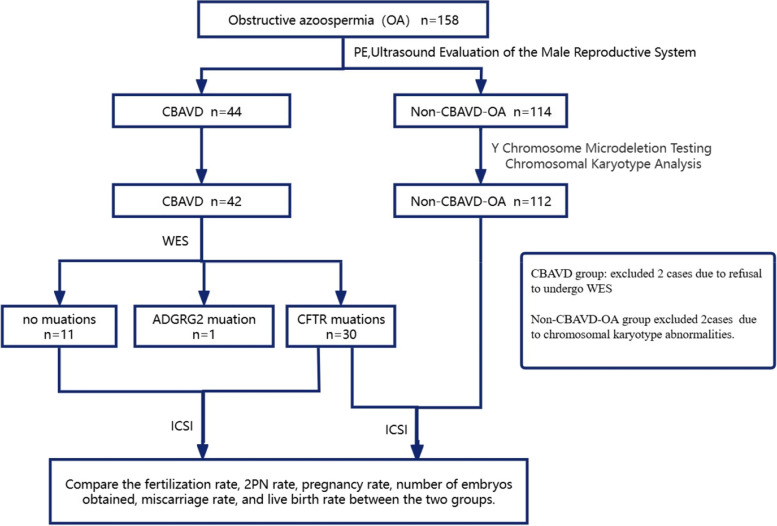
Obstructive azoospermia commonly is caused by CBAVD(Congenital Bilateral Aplasia of the Vas Deferens), mainly due to the cystic fibrosis transmembrane conductance regulator (CFTR) and adhesion G protein-coupled receptor G2(ADGRG2) mutations. The genetic landscape for Chinese CBAVD patients is unclear, leading to debates over genetic screening, counseling, and assisted reproduction strategies. This study investigates the prevalence of CFTR and ADGRG2 mutations in a southern Chinese cohort of CBAVD patients and evaluates the impact of CFTR mutations on intracytoplasmic sperm injection (ICSI) outcomes.
CFTR mutations were identified in 71.4% (30/42) of CBAVD patients, with a total of 36 CFTR mutation sites across 13 types identified, including two novel mutations. A novel ADGRG2 mutation was also detected. Betweenthe CFTR mutation-CBAVD group and the non-CBAVD OA group, a significant difference was observed only in the 2 Pronuclei(2PN) rate (79.5% vs 86.2%, P = 0.0065), while fertilization rates, pregnancy rates, miscarriage rates, and live birth rates showed no significant differences. Between the CFTR mutation-CBAVD group and the CBAVD group without CFTR mutation, there were no significant differences in fertilization rates, 2PN rates, pregnancy rates, miscarriage rates, or live birth rates.
Chinese CBAVD patients primarily exhibit mutations in the CFTR and ADGRG2 genes. Therefore, targeted gene testing for CFTR and ADGRG2 is more suitable compared to WES for CBAVD patients. Considering that the genetic factors of approximately 30% of CBAVD patients remain unknown, it is recommended to perform massive parallel sequencing for patients who test negative for CFTR and ADGRG2 gene screening. Despite these genetic factors, ICSI outcomes were not adversely affected, except for the 2PN rate. However, genetic counseling remains crucial for Chinese CBAVD patients before undergoing assisted reproduction.
梗阻性无精子症通常由先天性双侧输精管缺如(CBAVD)引起,主要归因于囊性纤维化跨膜传导调节因子(CFTR)和粘附G蛋白偶联受体G2(ADGRG2)突变。中国CBAVD患者的基因图谱尚不清楚,这导致了关于基因筛查、遗传咨询和辅助生殖策略的争论。本研究调查了中国南方CBAVD患者队列中CFTR和ADGRG2突变的发生率,并评估CFTR突变对卵胞浆内单精子注射(ICSI)结局的影响。
在71.4%(30/42)的CBAVD患者中鉴定出CFTR突变,共鉴定出13种类型的36个CFTR突变位点,包括两个新突变。还检测到一个新的ADGRG2突变。在CFTR突变-CBAVD组和非CBAVD梗阻性无精子症组之间,仅在双原核(2PN)率上观察到显著差异(79.5%对86.2%,P = 0.0065),而受精率、妊娠率、流产率和活产率无显著差异。在CFTR突变-CBAVD组和无CFTR突变的CBAVD组之间,受精率、2PN率、妊娠率、流产率或活产率均无显著差异。
中国CBAVD患者主要表现为CFTR和ADGRG2基因突变。因此,对于CBAVD患者,与全外显子测序(WES)相比,针对CFTR和ADGRG2的靶向基因检测更合适。鉴于约30%的CBAVD患者的遗传因素仍不清楚,建议对CFTR和ADGRG2基因筛查呈阴性的患者进行大规模平行测序。尽管存在这些遗传因素,但除2PN率外,ICSI结局未受到不利影响。然而,对于中国CBAVD患者,在接受辅助生殖之前,遗传咨询仍然至关重要。