Department of Cardiac Surgery, Beijing Anzhen Hospital, Beijing Institute of Heart Lung and Blood Vessel Diseases, Capital Medical University, Beijing, 100029, China.
Department of Emergency Medicine, Second Affiliated Hospital of Shenyang Medical College, Shenyang, 110001, China.
BMC Cardiovasc Disord. 2024 Oct 14;24(1):556. doi: 10.1186/s12872-024-04145-x.
This study aims to retrospectively analyze the clinical features of Stanford type A acute aortic dissection (TAAAD) based on Sun's modified classification, and to investigate whether the Sun's modified classification can be used to assess the risk of preoperative rupture.
Clinical data was collected between January 2018 and June 2019. Data included patient demographics, history of disease, type of dissection according to the Sun's modified classification, time of onset, biochemical tests, and preoperative rupture.
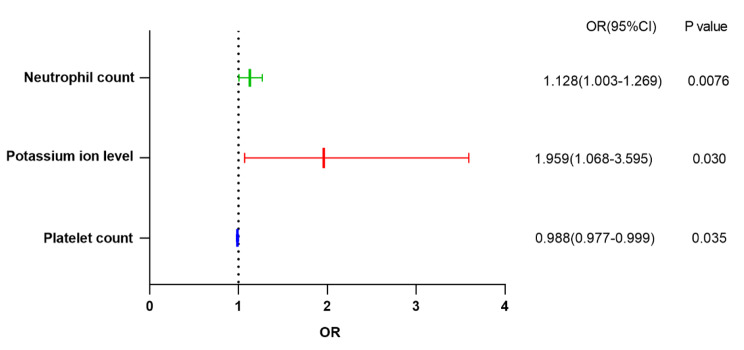
A total of 387 patients with TAAAD who met the inclusion criteria of Sun's modified classification were included. There were more complex types, with 75, 151 and 140 patients in the type A1C, A2C and A3C groups, respectively. The age of the entire group of patients was 51.46 ± 12.65 years and 283 (73.1%) were male. The time from onset to the emergency room was 25.37 ± 30.78 h. There were a few cases of TAAAD combined with stroke, pericardial effusion, pleural effusion, and lower extremity and organ ischemia in the complex type group. The white blood cell count (WBC), neutrophil count (NEC) and blood amylase differed significantly between the groups. Three independent risk factors for preoperative rupture were identified: neutrophil count, blood potassium ion level, and platelet count. Binary logistic regression analysis showed that the Sun's modified classification could not be used to assess the risk of preoperative rupture in TAAAD.
TAAAD was classified as the complex type in most patients. WBC, NEC and blood amylase were significantly different between the groups. NEC and serum potassium ion level were independent risk factors for preoperative rupture of TAAAD, while platelet count was its protective factor. More samples are needed to determine whether Sun's modified classification can be used to evaluate the risk of preoperative rupture.
本研究旨在回顾性分析基于孙逸仙改良分类的 Stanford 型 A 型急性主动脉夹层(TAAAD)的临床特征,并探讨孙逸仙改良分类是否可用于评估术前破裂的风险。
收集 2018 年 1 月至 2019 年 6 月间的临床资料。数据包括患者人口统计学资料、疾病史、根据孙逸仙改良分类的夹层类型、发病时间、生化检查和术前破裂情况。
共纳入 387 例符合孙逸仙改良分类纳入标准的 TAAAD 患者。复杂型较多,A1C、A2C 和 A3C 组分别有 75、151 和 140 例患者。所有患者的年龄为 51.46±12.65 岁,283 例(73.1%)为男性。从发病到急诊室的时间为 25.37±30.78 h。复杂型组中少数患者并发脑卒中、心包积液、胸腔积液及下肢和器官缺血。白细胞计数(WBC)、中性粒细胞计数(NEC)和血淀粉酶在各组间差异有统计学意义。术前破裂的 3 个独立危险因素为:中性粒细胞计数、血钾离子水平和血小板计数。二元逻辑回归分析显示,孙逸仙改良分类不能用于评估 TAAAD 术前破裂的风险。
大多数 TAAAD 患者的分类为复杂型。各组间 WBC、NEC 和血淀粉酶差异有统计学意义。NEC 和血清钾离子水平是 TAAAD 术前破裂的独立危险因素,而血小板计数是其保护因素。需要更多的样本以确定孙逸仙改良分类是否可用于评估术前破裂的风险。