Zou Xinrong, Nagino Ken, Yee Alan, Midorikawa-Inomata Akie, Eguchi Atsuko, Nakao Shintaro, Kobayashi Hiroyuki, Inomata Takenori
Juntendo University Graduate School of Medicine, Department of Ophthalmology, Tokyo, Japan.
Department of Ophthalmology, Fengcheng Hospital, Fengxian District, Shanghai, China.
Heliyon. 2024 Sep 28;10(19):e38674. doi: 10.1016/j.heliyon.2024.e38674. eCollection 2024 Oct 15.
BACKGROUND/OBJECTIVES: Dry eye disease (DED) and myopia are common ocular disorders. This systematic review and meta-analysis investigated the association between DED and myopia.
PubMed and EMBASE were searched for articles published between 1984 and 2022. Study quality was assessed using the Joanna Briggs Institute Critical Appraisal Checklist, and analysis was conducted using the DerSimonian-Laird random-effects model.
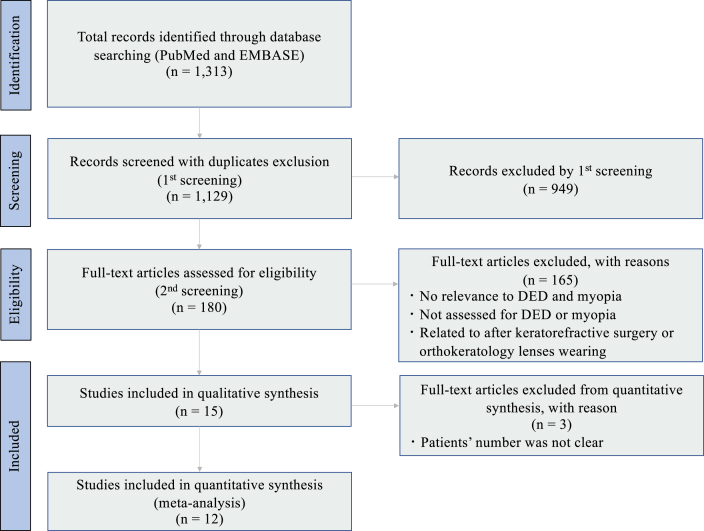
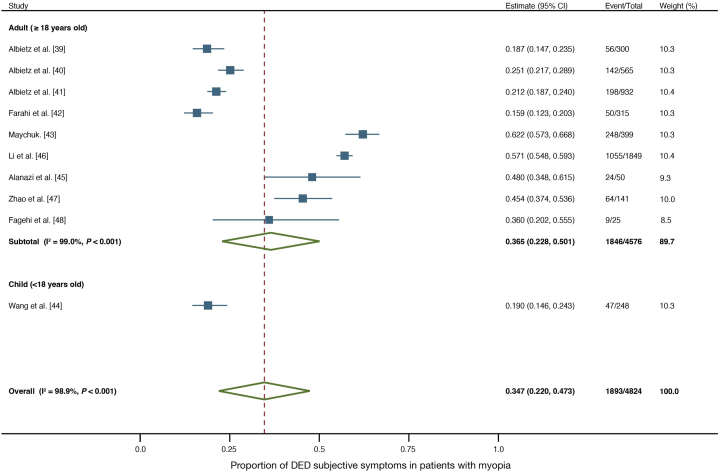
Of the 1,313 studies identified, 15 studies on DED and myopia were included. The meta-analysis revealed that the overall prevalence of subjective DED symptoms in the myopia population was 45.1 % (95 % confidence interval: 0.287-0.616). There was a significant association between DED and myopia. The myopia population had higher Ocular Surface Disease Index scores and shorter tear film breakup times than the non-myopia population. Additionally, the meta-regression analysis showed that spherical equivalent was significantly associated with the prevalence of DED symptoms in adults with myopia.
Interventions to prevent DED are required in the myopia population. Enhancing patient awareness and self-management for DED, in addition to early screening and detection, is especially critical for younger populations who are at a higher risk of developing myopia.
背景/目的:干眼疾病(DED)和近视是常见的眼部疾病。本系统评价和荟萃分析研究了DED与近视之间的关联。
检索了PubMed和EMBASE中1984年至2022年发表的文章。使用乔安娜·布里格斯研究所的批判性评价清单评估研究质量,并使用DerSimonian-Laird随机效应模型进行分析。
在检索到的1313项研究中,纳入了15项关于DED和近视的研究。荟萃分析显示,近视人群中主观DED症状的总体患病率为45.1%(95%置信区间:0.287 - 0.616)。DED与近视之间存在显著关联。近视人群的眼表疾病指数得分高于非近视人群,泪膜破裂时间短于非近视人群。此外,荟萃回归分析表明,等效球镜度与近视成年人中DED症状的患病率显著相关。
近视人群需要采取预防DED的干预措施。除了早期筛查和检测外,提高患者对DED的认识和自我管理能力,对于近视风险较高的年轻人群尤为关键。