Dr. Rajendra Prasad Centre for Ophthalmic Sciences, All India Institute of Medical Sciences, Delhi, India.
Indian J Ophthalmol. 2022 Aug;70(8):2800-2815. doi: 10.4103/ijo.IJO_2098_21.
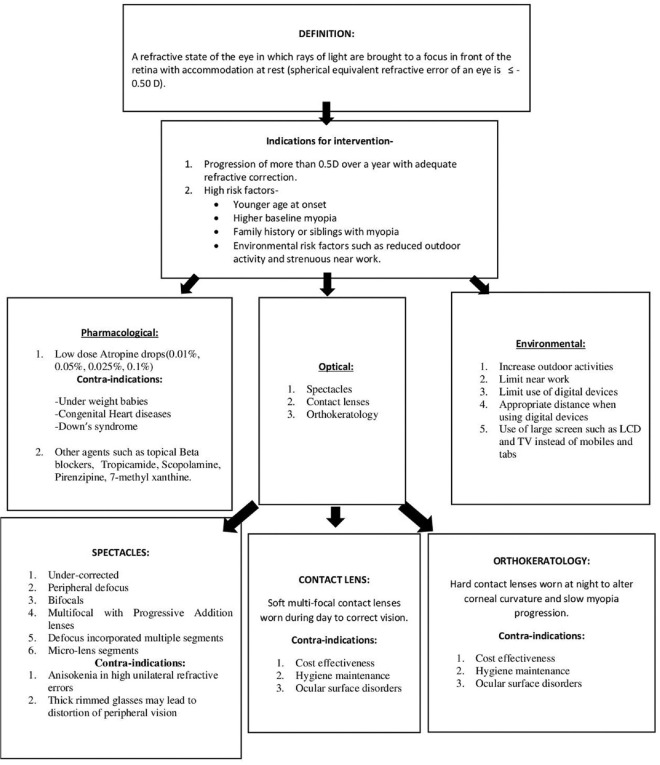
Myopia or short-sightedness is an emerging pandemic affecting more than 50% population in South-Asian countries. It is associated with several sight-threatening complications, such as retinal detachment and choroidal neovascularization, leading to an increased burden of visual impairment and blindness. The pathophysiology of myopia involves a complex interplay of numerous environmental and genetic factors leading to progressive axial elongation. Environmental factors such as decreased outdoor activity, reduced exposure to ambient light, strenuous near work, and role of family history of myopia have been implicated with increased prevalence of this refractive error. While multiple clinical trials have been undertaken to devise appropriate treatment strategies and target the modifiable risk factors, there is no single treatment modality with ideal results; therefore, formulating a comprehensive approach is required to control the myopia epidemic. This review article summarizes the epidemiology, dynamic concepts of pathophysiology, and evolution of the treatment modalities for myopia such as pharmacological (atropine and other agents) and optical methods (spectacles, contact lenses, and orthokeratology).
近视或短视是一种新兴的流行疾病,影响了南亚国家超过 50%的人口。它与许多威胁视力的并发症有关,如视网膜脱离和脉络膜新生血管形成,导致视力障碍和失明的负担增加。近视的病理生理学涉及许多环境和遗传因素的复杂相互作用,导致轴向伸长的进行性进展。环境因素,如户外活动减少、环境光线暴露减少、近距离工作强度增加以及近视家族史的作用,与这种屈光不正的患病率增加有关。虽然已经进行了多项临床试验来制定适当的治疗策略和针对可改变的危险因素,但没有一种单一的治疗方法能取得理想的效果;因此,需要制定综合的方法来控制近视的流行。本文综述了近视的流行病学、病理生理学的动态概念以及治疗方法的演变,如药物治疗(阿托品和其他药物)和光学方法(眼镜、隐形眼镜和角膜塑形术)。