Alcoceba-Herrero Irene, Coco-Martín María Begoña, Jiménez-Pérez José María, Leal-Vega Luis, Martín-Gutiérrez Adrián, Dueñas-Gutiérrez Carlos, Miramontes-González José Pablo, Corral-Gudino Luis, de Castro-Rodríguez Flor, Royuela-Ruiz Pablo, Arenillas-Lara Juan Francisco
Applied Clinical Neurosciences Research Group, Department of Medicine, Dermatology and Toxicology, University of Valladolid, 47005 Valladolid, Spain.
Department of Nursing, University of Valladolid, 47005 Valladolid, Spain.
J Clin Med. 2024 Oct 8;13(19):5974. doi: 10.3390/jcm13195974.
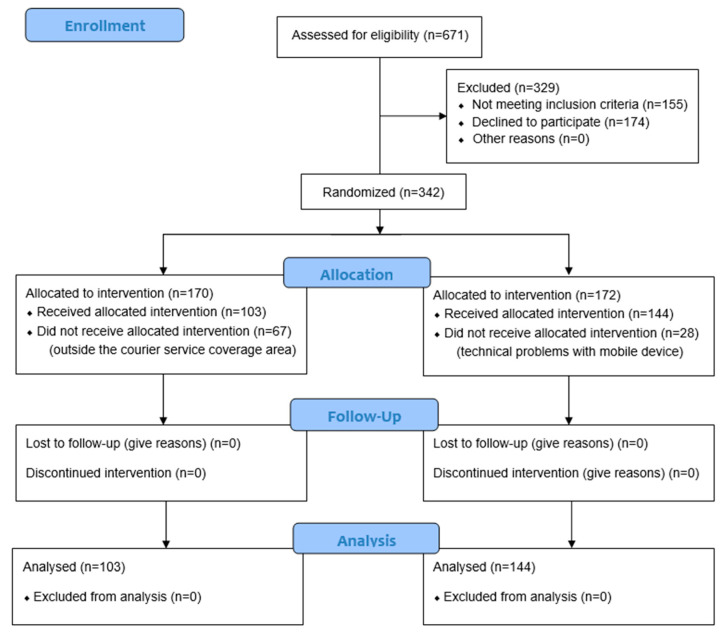
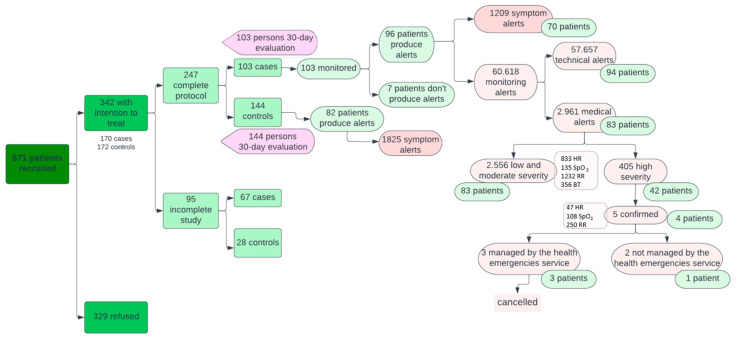
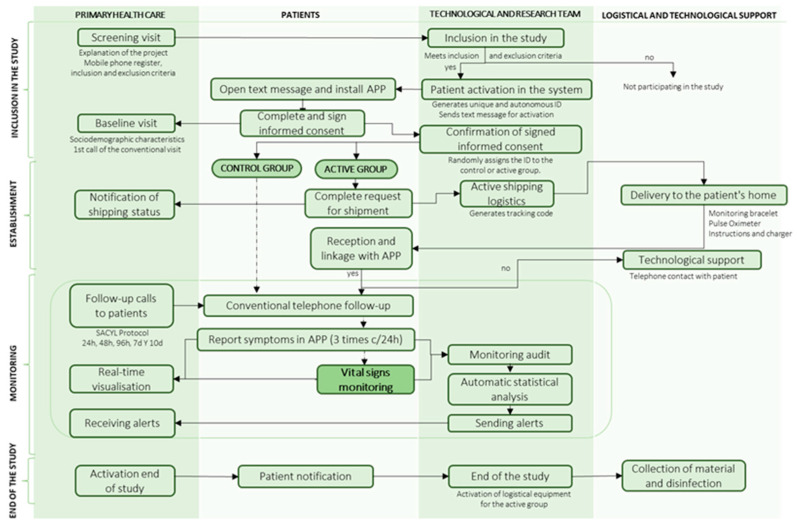
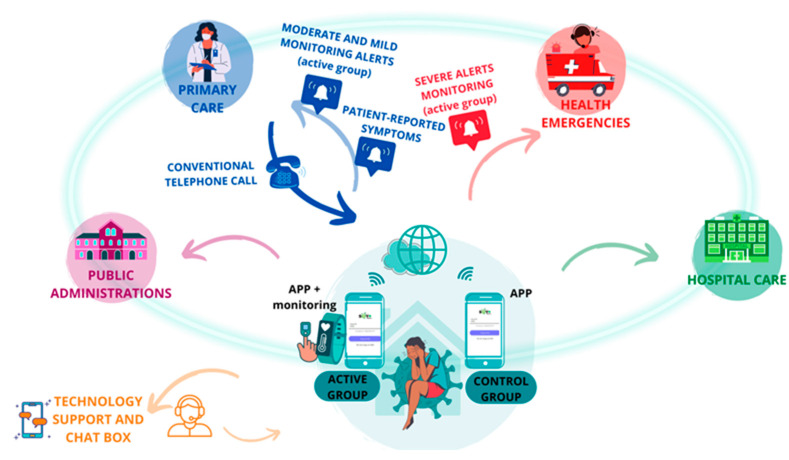
: Early identification of complications in chronic and infectious diseases can reduce clinical deterioration, lead to early therapeutic interventions and lower morbidity and mortality rates. Here, we aimed to assess the feasibility of a novel clinical decision support system (CDSS) based on the automatic generation of alerts through remote patient monitoring and to identify the patient profile associated with the likelihood of severe medical alerts. : A prospective, multicenter, open-label, randomized controlled trial was conducted. Patients with COVID-19 in home isolation were randomly assigned in a 1:1 ratio to receive either conventional primary care telephone follow-up plus access to a mobile app for self-reporting of symptoms (control group) or conventional primary care telephone follow-up plus access to the mobile app for self-reporting of symptoms and wearable devices for real-time telemonitoring of vital signs (case group). : A total of 342 patients were randomized, of whom 247 were included in the per-protocol analysis (103 cases and 144 controls). The case group received a more exhaustive follow-up, with a higher number of alerts (61,827 vs. 1825; < 0.05) but without overloading healthcare professionals thanks to automatic alert management through artificial intelligence. Baseline factors independently associated with the likelihood of a severe alert were having asthma (OR: 1.74, 95% CI: 1.22-2.48, = 0.002) and taking corticosteroids (OR: 2.28, 95% CI: 1.24-4.2, = 0.008). : The CDSS could be successfully implemented and enabled real-time telemonitoring of patients' clinical status, providing valuable information to physicians and public health agencies.
早期识别慢性疾病和传染病的并发症可减少临床病情恶化,实现早期治疗干预,并降低发病率和死亡率。在此,我们旨在评估一种基于通过远程患者监测自动生成警报的新型临床决策支持系统(CDSS)的可行性,并确定与严重医疗警报可能性相关的患者特征。
开展了一项前瞻性、多中心、开放标签、随机对照试验。居家隔离的新冠肺炎患者按1:1比例随机分组,分别接受常规初级保健电话随访并可使用用于自我报告症状的移动应用程序(对照组),或常规初级保健电话随访并可使用用于自我报告症状的移动应用程序以及用于实时远程监测生命体征的可穿戴设备(病例组)。
共有342例患者被随机分组,其中247例纳入符合方案分析(103例病例和144例对照)。病例组接受了更详尽的随访,警报数量更多(61827次对1825次;<0.05),但由于通过人工智能进行自动警报管理,并未使医护人员负担过重。与严重警报可能性独立相关的基线因素为患有哮喘(OR:1.74,95%CI:1.22 - 2.48, = 0.002)和服用皮质类固醇(OR:2.28,95%CI:1.24 - 4.2, = 0.008)。
CDSS能够成功实施,并实现对患者临床状态的实时远程监测,为医生和公共卫生机构提供有价值的信息。