
肺血栓栓塞症死亡率的炎症和代谢预测因素:聚焦甘油三酯-葡萄糖指数和全免疫炎症值
Inflammatory and Metabolic Predictors of Mortality in Pulmonary Thromboembolism: A Focus on the Triglyceride-Glucose Index and Pan-Immune Inflammation Value.
作者信息
Bilgin Murat, Akkaya Emre, Dokuyucu Recep
机构信息
Department of Cardiology, Private Aktif International Hospital, Yalova 77720, Turkey.
Department of Cardiology, Bossan Hospital, Gaziantep 27580, Turkey.
出版信息
J Clin Med. 2024 Oct 9;13(19):6008. doi: 10.3390/jcm13196008.
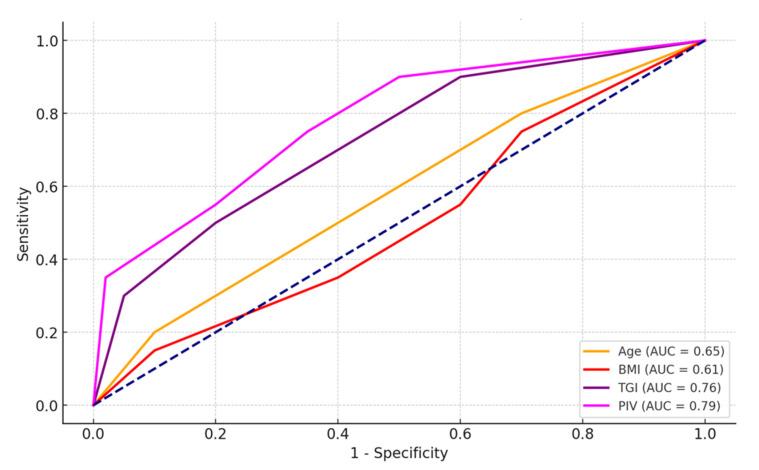
: We aimed to evaluate the importance of metabolic and inflammatory markers, specifically the Triglyceride-Glucose Index (TGI) and pan-immune inflammation value (PIV), in predicting mortality among patients diagnosed with pulmonary thromboembolism (PTE). : A total of 450 patients diagnosed with PTE between December 2018 and December 2023 were included in his study. The diagnosis of PTE was confirmed by clinical presentation, laboratory tests, and imaging studies such as computed tomography pulmonary angiography (CTPA). Data were obtained from medical records, including demographic information, medical history, laboratory results, and clinical outcomes. : In terms of age, non-survivors were older on average (66.1 ± 11.8 years) compared to survivors (58.3 ± 12.4 years) ( = 0.03). In terms of gender, 55% of non-survivors and 45% of survivors were male ( = 0.111). Non-survivors had higher BMIs (28.3 ± 5.1) than survivors (25.7 ± 4.5) ( = 0.04). In terms of hypertension, 40% of non-survivors and 30% of survivors had hypertension ( = 0.041). In terms of diabetes, 35% of those who did not survive and 20% of those who survived had diabetes ( = 0.001). In terms of smoking, 25% of non-survivors and 15% of survivors smoke ( = 0.022). In terms of TGI, non-survivors had higher TGI values (12.1 ± 1.5) than survivors (5.9 ± 1.2) ( < 0.001). In terms of PIV, non-survivors had significantly higher PIV (878.2 ± 85.4) than survivors (254.5 ± 61.1) ( < 0.001). The risk factors found to be significantly associated with differentiation in the multiple logistic regression analysis included age, BMI, TGI, and PIV ( = 0.005, = 0.002, = 0.013, and 0.022, respectively). As a result, according to ROC analysis for patients who are non-survivors, age, BMI, TGI, and PIV were significant prognostic factors. The cut-off points for these values were >60, >27, >10, and >500, respectively. : the TGI and PIV are strong markers for predicting mortality in PTE patients. The independent predictive value of age and BMI further demonstrates their role in risk stratification. We think that high TGI values and PIVs reflect underlying metabolic and inflammatory disorders that may contribute to worse outcomes in these patients.
我们旨在评估代谢和炎症标志物,特别是甘油三酯 - 葡萄糖指数(TGI)和全免疫炎症值(PIV),在预测肺血栓栓塞症(PTE)患者死亡率中的重要性。本研究纳入了2018年12月至2023年12月期间共450例诊断为PTE的患者。PTE的诊断通过临床表现、实验室检查以及计算机断层扫描肺动脉造影(CTPA)等影像学检查得以证实。数据取自病历,包括人口统计学信息、病史、实验室结果和临床结局。在年龄方面,非幸存者平均年龄(66.1±11.8岁)比幸存者(58.3±12.4岁)更大(P = 0.03)。在性别方面,55%的非幸存者和45%的幸存者为男性(P = 0.111)。非幸存者的体重指数(BMI)(28.3±5.1)高于幸存者(25.7±4.5)(P = 0.04)。在高血压方面,40%的非幸存者和30%的幸存者患有高血压(P = 0.041)。在糖尿病方面,未存活者中有35%患有糖尿病,存活者中有20%患有糖尿病(P = 0.001)。在吸烟方面,25%的非幸存者和15%的幸存者吸烟(P = 0.022)。在TGI方面,非幸存者的TGI值(12.1±1.5)高于幸存者(5.9±1.2)(P < 0.001)。在PIV方面,非幸存者的PIV显著高于幸存者(878.2±85.4)(254.5±61.1)(P < 0.001)。在多因素逻辑回归分析中发现与差异显著相关的危险因素包括年龄、BMI、TGI和PIV(分别为P = 0.005、P = 0.002、P = 0.013和P = 0.022)。结果,根据对非幸存者患者的ROC分析,年龄、BMI、TGI和PIV是显著的预后因素。这些值的截断点分别为>60、>27、>10和>500。TGI和PIV是预测PTE患者死亡率的强有力标志物。年龄和BMI的独立预测价值进一步证明了它们在风险分层中的作用。我们认为高TGI值和PIV反映了潜在的代谢和炎症紊乱,这可能导致这些患者的预后更差。
 Zotero 插件