Department of Urology, School of Medicine, University of Occupational and Environmental Health, Kitakyushu 807-8555, Japan.
Departments of Pathology & Laboratory Medicine and Urology, University of Rochester Medical Center, Rochester, NY 14642, USA.
Int J Mol Sci. 2024 Sep 26;25(19):10348. doi: 10.3390/ijms251910348.
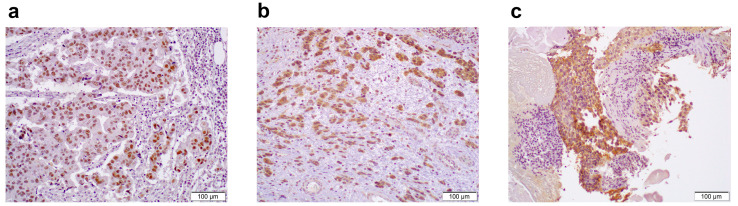
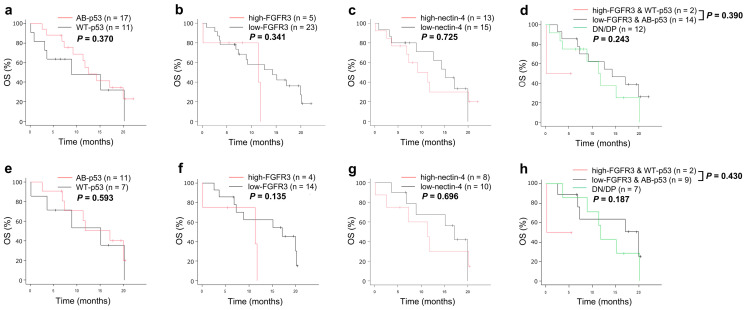
Locally advanced or metastatic urothelial carcinoma is a genomically and molecularly heterogeneous disease associated with various clinical outcomes. We aimed to evaluate the association between the status of p53/FGFR3 expression and the efficacy of enfortumab vedotin (EV) in metastatic urothelial carcinoma. We evaluated the association between p53 (abnormal vs. wild-type) or FGFR3 (high vs. low) expression determined by immunohistochemistry and response to EV in 28 patients with metastatic urothelial carcinoma. Overall, 60.7% showed abnormal p53, and 17.9% had high FGFR3 expression. The rates of objective response to EV were statistically higher in patients with abnormal p53 than in those with wild-type p53 ( = 0.038). Patients with pure urothelial carcinoma ( = 18) and low FGFR3 showed significantly better response to EV than those with high FGFR3. When the statuses of p53 and FGFR3 were combined, abnormal p53/low FGFR3 (vs. wild-type p53/high FGFR3) was strongly associated with favorable outcomes in both the entire cohort ( 0.002) and in cases of pure urothelial carcinoma only ( = 0.023). Immunohistochemically abnormal p53 tumors were found to respond well to EV, while high FGFR3 tumors had a poorer response. Thus, p53 and FGFR3 are potential biomarkers for predicting response to EV treatment in patients with urothelial carcinoma.
局部晚期或转移性尿路上皮癌是一种基因组和分子上具有异质性的疾病,与各种临床结局相关。我们旨在评估 p53/FGFR3 表达状态与转移性尿路上皮癌患者接受依维莫司(EV)治疗效果的关系。我们通过免疫组织化学评估了 28 例转移性尿路上皮癌患者中 p53(异常与野生型)或 FGFR3(高与低)表达状态与 EV 反应之间的关系。总体而言,60.7%的患者表现出 p53 异常,17.9%的患者 FGFR3 表达较高。p53 异常的患者对 EV 的客观反应率明显高于 p53 野生型患者( = 0.038)。纯尿路上皮癌( = 18)和 FGFR3 低表达的患者对 EV 的反应明显优于 FGFR3 高表达的患者。当 p53 和 FGFR3 的状态结合时,异常 p53/低 FGFR3(与野生型 p53/高 FGFR3 相比)在整个队列中( 0.002)和仅在纯尿路上皮癌病例中( = 0.023)与良好的结果密切相关。研究发现,免疫组织化学异常的 p53 肿瘤对 EV 反应良好,而 FGFR3 高表达的肿瘤反应较差。因此,p53 和 FGFR3 可能是预测尿路上皮癌患者对 EV 治疗反应的潜在生物标志物。