Almeida Catarina, Gervaso Lorenzo, Frigè Gianmaria, Spada Francesca, Benini Lavinia, Cella Chiara Alessandra, Mazzarella Luca, Fazio Nicola
Division of Gastrointestinal Medical Oncology and Neuroendocrine Tumors, European Institute of Oncology, IEO IRCCS, 20141 Milan, Italy.
Department of Medical Oncology, São João University Hospital Center, 4200-319 Porto, Portugal.
Cancers (Basel). 2024 Sep 30;16(19):3349. doi: 10.3390/cancers16193349.
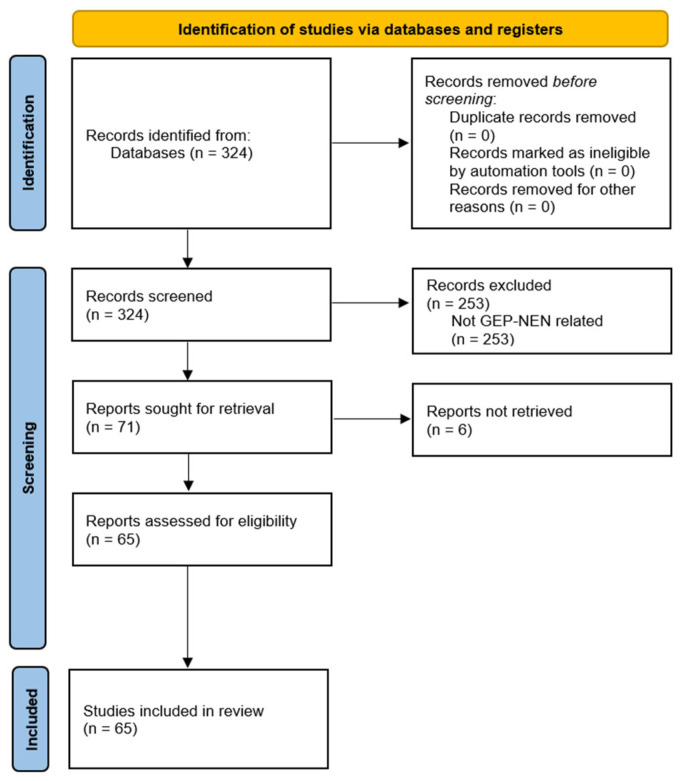
Neuroendocrine neoplasms incidence has been increasing, arising the need for precise and early diagnostic tools. Liquid biopsy (LB) offers a less invasive alternative to tissue biopsy, providing real-time molecular information from circulating tumour components in body fluids. The aim of this review is to analyse the current evidence concerning LB in NENs and its role in clinical practice. We conducted a systematic review in July 2024 focusing on LB applications in NENs, including circulating tumour cells (CTCs), circulating tumour DNA (ctDNA), micro RNA (miRNA), messenger RNA (mRNA) and extracellular vesicles. Sixty-five relevant articles were analysed. The LB showed potential in diagnosing and monitoring NENs. While CTCs face limitations due to low shedding, ctDNA provides valuable information on high-grade neoplasms. MiRNA and mRNA (e.g., the NETest) offer high sensitivity and specificity for diagnosis and prognosis, outperforming traditional markers like chromogranin A. The LB has significant potential for NEN diagnosis and monitoring but lacks widespread clinical integration due to limited prospective studies and guidelines, requiring further validation. Advances in sequencing technologies may enhance the clinical utility of LB in NENs. Future research should focus on refining LB methods, standardising protocols and exploring applications in high-grade NENs.
神经内分泌肿瘤的发病率一直在上升,因此需要精确的早期诊断工具。液体活检(LB)为组织活检提供了一种侵入性较小的替代方法,可从体液中的循环肿瘤成分中提供实时分子信息。本综述的目的是分析有关神经内分泌肿瘤中液体活检的现有证据及其在临床实践中的作用。我们在2024年7月进行了一项系统综述,重点关注液体活检在神经内分泌肿瘤中的应用,包括循环肿瘤细胞(CTC)、循环肿瘤DNA(ctDNA)、微小RNA(miRNA)、信使RNA(mRNA)和细胞外囊泡。分析了65篇相关文章。液体活检在神经内分泌肿瘤的诊断和监测中显示出潜力。虽然循环肿瘤细胞由于脱落率低而存在局限性,但循环肿瘤DNA为高级别肿瘤提供了有价值的信息。微小RNA和信使RNA(如NETest)在诊断和预后方面具有高灵敏度和特异性,优于嗜铬粒蛋白A等传统标志物。液体活检在神经内分泌肿瘤的诊断和监测方面具有巨大潜力,但由于前瞻性研究和指南有限,缺乏广泛的临床应用,需要进一步验证。测序技术的进步可能会提高液体活检在神经内分泌肿瘤中的临床应用价值。未来的研究应侧重于改进液体活检方法、规范方案并探索在高级别神经内分泌肿瘤中的应用。