R&D Department, Eone-Diagnomics Genome Center, Inc., 143 Gaetbeol-Ro, Yeonsu-Gu, Incheon, 21999, Republic of Korea.
Division of Pulmonary and Critical Care Medicine, Department of Medicine, Samsung Medical Center, Sungkyunkwan University School of Medicine, 81 Irwon-Ro, Gangnam-Gu, Seoul, 06351, Republic of Korea.
Sci Rep. 2023 Aug 19;13(1):13502. doi: 10.1038/s41598-023-40611-w.
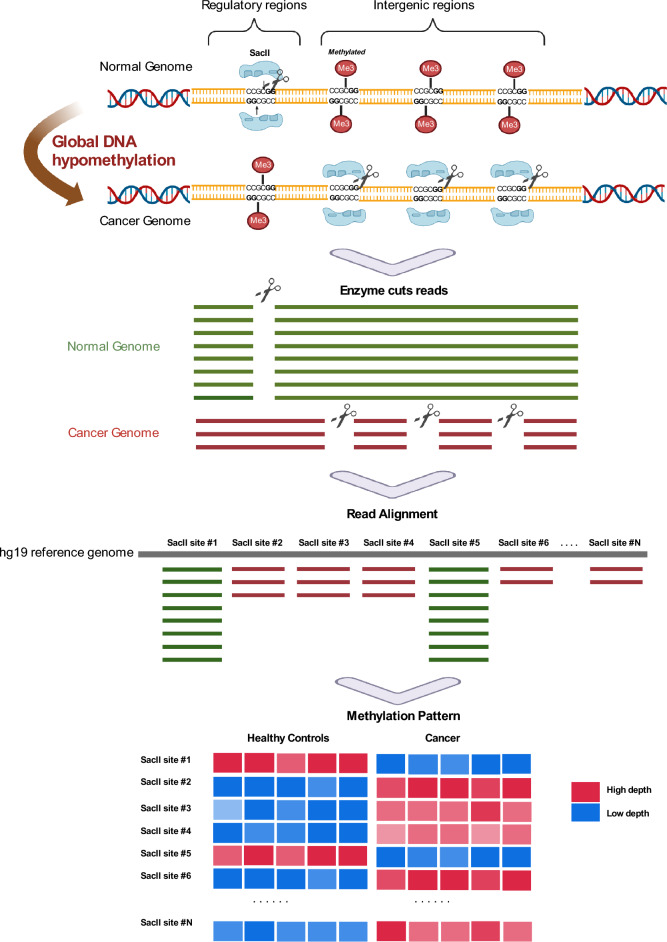
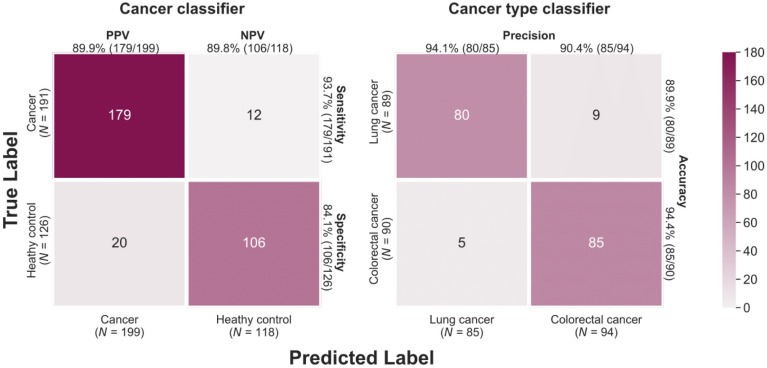
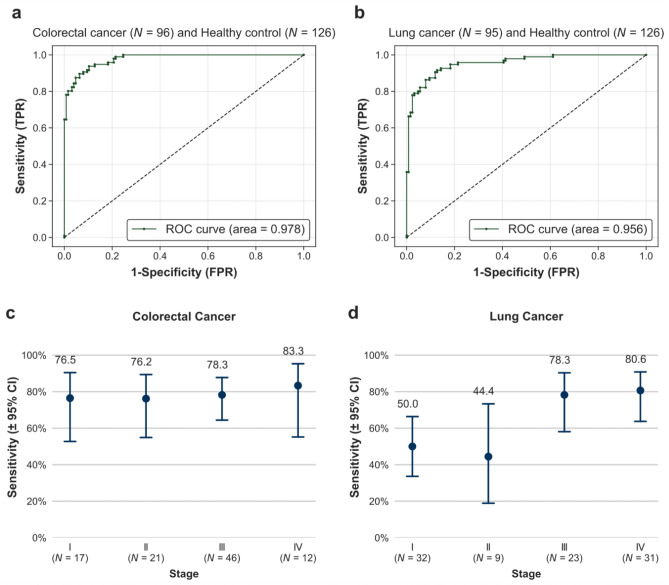
Methylation patterns in cell-free DNA (cfDNA) have emerged as a promising genomic feature for detecting the presence of cancer and determining its origin. The purpose of this study was to evaluate the diagnostic performance of methylation-sensitive restriction enzyme digestion followed by sequencing (MRE-Seq) using cfDNA, and to investigate the cancer signal origin (CSO) of the cancer using a deep neural network (DNN) analyses for liquid biopsy of colorectal and lung cancer. We developed a selective MRE-Seq method with DNN learning-based prediction model using demethylated-sequence-depth patterns from 63,266 CpG sites using SacII enzyme digestion. A total of 191 patients with stage I-IV cancers (95 lung cancers and 96 colorectal cancers) and 126 noncancer participants were enrolled in this study. Our study showed an area under the receiver operating characteristic curve (AUC) of 0.978 with a sensitivity of 78.1% for colorectal cancer, and an AUC of 0.956 with a sensitivity of 66.3% for lung cancer, both at a specificity of 99.2%. For colorectal cancer, sensitivities for stages I-IV ranged from 76.2 to 83.3% while for lung cancer, sensitivities for stages I-IV ranged from 44.4 to 78.9%, both again at a specificity of 99.2%. The CSO model's true-positive rates were 94.4% and 89.9% for colorectal and lung cancers, respectively. The MRE-Seq was found to be a useful method for detecting global hypomethylation patterns in liquid biopsy samples and accurately diagnosing colorectal and lung cancers, as well as determining CSO of the cancer using DNN analysis.Trial registration: This trial was registered at ClinicalTrials.gov (registration number: NCT04253509) for lung cancer on 5 February 2020, https://clinicaltrials.gov/ct2/show/NCT04253509 . Colorectal cancer samples were retrospectively registered at CRIS (Clinical Research Information Service, registration number: KCT0008037) on 23 December 2022, https://cris.nih.go.kr , https://who.init/ictrp . Healthy control samples were retrospectively registered.
游离 DNA(cfDNA)中的甲基化模式已成为检测癌症存在和确定其起源的有前途的基因组特征。本研究旨在评估使用 cfDNA 进行甲基化敏感限制性内切酶消化后测序(MRE-Seq)的诊断性能,并使用深度学习网络(DNN)分析对结直肠癌和肺癌的液体活检进行癌症信号源(CSO)的研究。我们使用来自 SacII 酶消化的 63,266 个 CpG 位点的去甲基化序列深度模式开发了一种基于 DNN 学习的选择性 MRE-Seq 方法,建立预测模型。本研究共纳入 191 名 I-IV 期癌症患者(95 例肺癌和 96 例结直肠癌)和 126 名非癌症参与者。我们的研究显示,结直肠癌的受试者工作特征曲线下面积(AUC)为 0.978,灵敏度为 78.1%,肺癌的 AUC 为 0.956,灵敏度为 66.3%,特异性均为 99.2%。对于结直肠癌,I-IV 期的灵敏度范围为 76.2%至 83.3%,而对于肺癌,I-IV 期的灵敏度范围为 44.4%至 78.9%,特异性均为 99.2%。CSO 模型的真阳性率分别为结直肠癌和肺癌的 94.4%和 89.9%。研究发现,MRE-Seq 是一种有用的方法,可用于检测液体活检样本中的全局低甲基化模式,并准确诊断结直肠癌和肺癌,以及使用 DNN 分析确定癌症的 CSO。试验注册:本试验于 2020 年 2 月 5 日在 ClinicalTrials.gov(注册号:NCT04253509)注册用于肺癌,网址为 https://clinicaltrials.gov/ct2/show/NCT04253509。结直肠癌样本于 2022 年 12 月 23 日在 CRIS(临床研究信息服务,注册号:KCT0008037)中进行了回顾性注册,网址为 https://cris.nih.go.kr,https://who.init/ictrp。健康对照组样本进行了回顾性注册。