Veselá Helena, Kameník Josef, Dušková Marta, Ježek František, Svobodová Hana
Department of Animal Origin Food & Gastronomic Sciences, Faculty of Veterinary Hygiene and Ecology, University of Veterinary Sciences Brno, 612 42 Brno-Královo Pole, Czech Republic.
Foods. 2024 Sep 25;13(19):3037. doi: 10.3390/foods13193037.
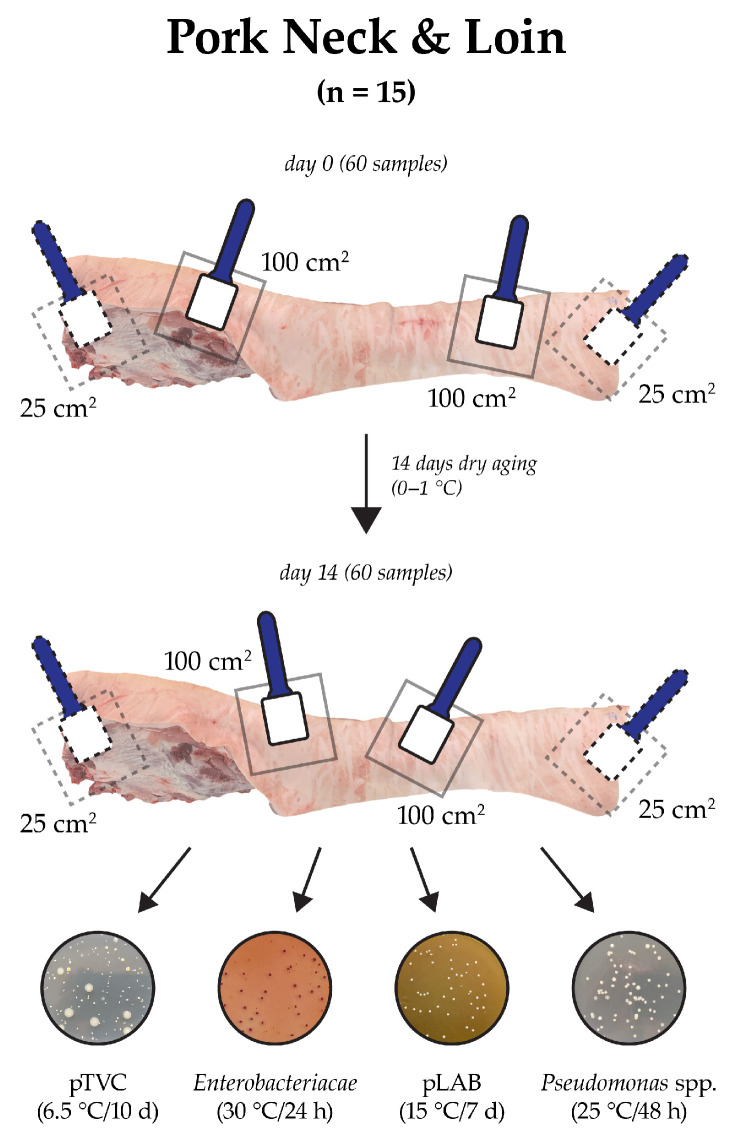
Meat aging is an important process that affects the quality of meat and is traditionally used mainly for beef. However, in recent years, there has been an increasing demand for pork products subjected to dry aging. The aim of this study was to compare selected parameters (microbiological quality, instrumental analyses of texture and color of meat, ) of pork neck and loin with bone and skin together subjected to dry aging for 14 days. The microbiological profile (total viable psychrotrophic count, , psychrotrophic lactic acid bacteria, spp.) on the surface of the meat with the skin and the lateral cutting surfaces without skin was compared on the first day after slaughter and after 14 days of dry aging. The results of this study demonstrated that dry aging did not significantly deteriorate the microbiological profile. Statistically significant es were observed after 14 days of aging. The dry aging of pork had no significant effect on lightness (L*), redness (a*), and shear force. Significant differences were observed for yellowness (b*) and meat hardness ( < 0.05).
肉类熟成是一个影响肉品质的重要过程,传统上主要用于牛肉。然而,近年来,对经过干腌熟成的猪肉产品的需求不断增加。本研究的目的是比较猪颈肉和带骨带皮里脊肉在干腌熟成14天后的选定参数(微生物质量、肉的质地和颜色的仪器分析)。在屠宰后第一天和干腌熟成14天后,比较了带皮猪肉表面和不带皮的侧面切割面的微生物概况(总嗜冷活菌数、嗜冷乳酸菌、 菌属)。本研究结果表明,干腌熟成不会显著恶化微生物概况。熟成14天后观察到具有统计学意义的变化。猪肉的干腌熟成对亮度(L*)、红色度(a*)和剪切力没有显著影响。在黄度(b*)和肉硬度方面观察到显著差异(<0.05)。