Chin Hsin-Hua, Tai Ying-Hsuan, Yep Rachel, Chang Yi-Hsuan, Hsu Chun-Hsien, Wang Chin-An
Eye-Tracking Laboratory, Shuang Ho Hospital, Taipei Medical University, New Taipei, Taiwan.
Department of Psychology, Chung Yuan Christian University, Taoyuan, Taiwan.
Front Neurosci. 2024 Oct 1;18:1412527. doi: 10.3389/fnins.2024.1412527. eCollection 2024.
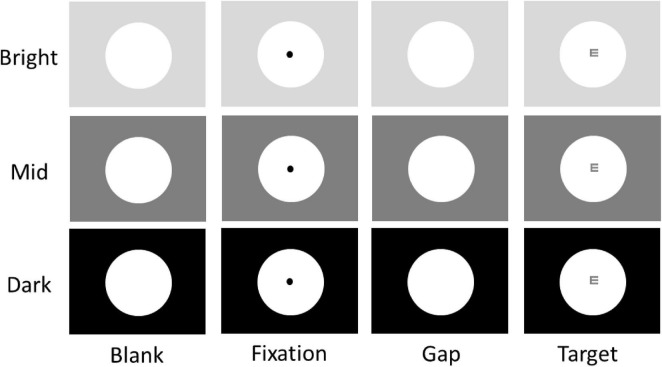
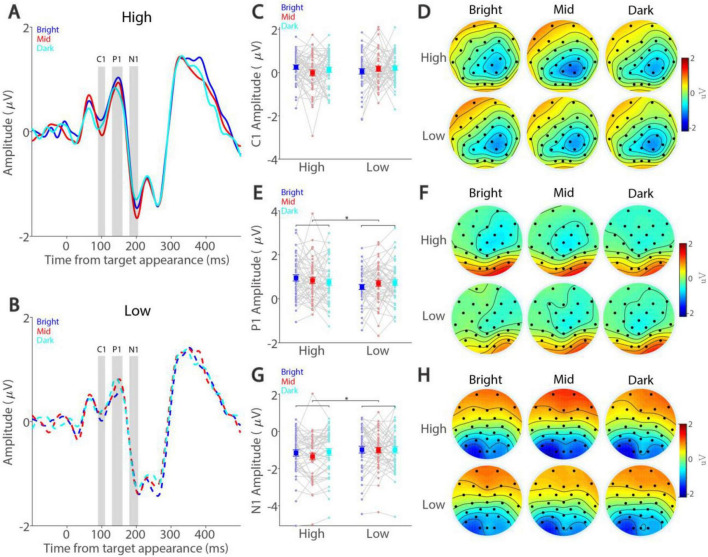
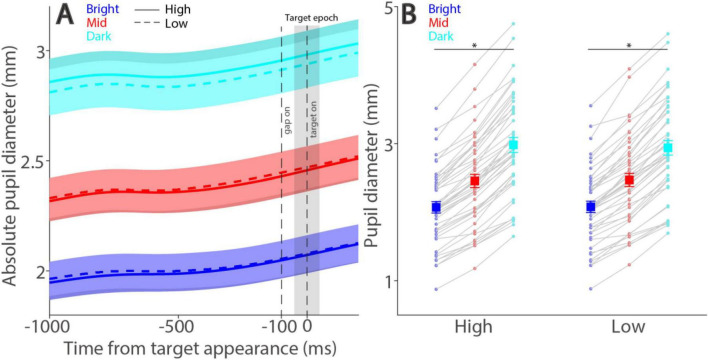
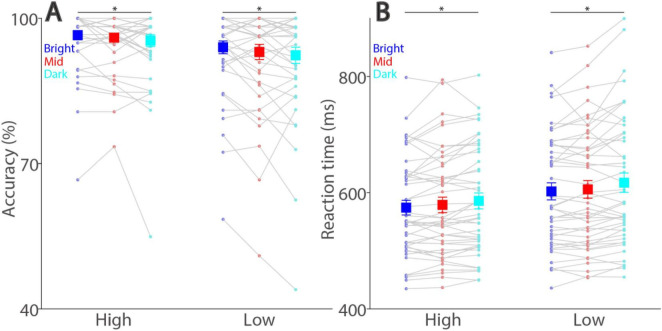
Pupil size primarily changes to regulate the amount of light entering the retina, optimizing the balance between visual acuity and sensitivity for effective visual processing. However, research directly examining the relationship between pupil size and visual processing has been limited. While a few studies have recorded pupil size and EEG signals to investigate the role of pupil size in visual processing, these studies have predominantly focused on the domain of visual sensitivity. Causal effects of pupil size on visual acuity, therefore, remain poorly understood. By manipulating peripheral background luminance levels and target stimulus contrast while simultaneously recording pupillometry and EEG signals, we examined how absolute pupil size affects visual discrimination and visually evoked potentials (VEP) in a task using optotype mimicking the Snellen eye chart, the most common assessment of visual acuity. Our findings indicate that both higher background luminance levels and higher target contrast were associated with improved target discrimination and faster correct reaction times. Moreover, while higher contrast visual stimuli evoked larger VEPs, the effects of pupil size on VEPs were not significant. Additionally, we did not observe inter-individual correlations between absolute pupil size and discrimination performance or VEP amplitude. Together, our results demonstrate that absolute pupil size, regulated by global luminance level, played a functional role in enhancing visual discrimination performance in an optotype discrimination task. The differential VEP effects of pupil size compared to those of stimulus contrast further suggested distinct neural mechanisms involved in facilitating visual acuity under small pupils.
瞳孔大小主要通过变化来调节进入视网膜的光量,优化视敏度和敏感度之间的平衡,以实现有效的视觉处理。然而,直接研究瞳孔大小与视觉处理之间关系的研究一直很有限。虽然有一些研究记录了瞳孔大小和脑电图信号,以探究瞳孔大小在视觉处理中的作用,但这些研究主要集中在视觉敏感度领域。因此,瞳孔大小对视敏度的因果效应仍知之甚少。通过操纵周边背景亮度水平和目标刺激对比度,同时记录瞳孔测量和脑电图信号,我们在一项使用模仿斯内伦视力表的视标(视敏度最常见的评估方法)的任务中,研究了绝对瞳孔大小如何影响视觉辨别和视觉诱发电位(VEP)。我们的研究结果表明,更高的背景亮度水平和更高的目标对比度都与目标辨别能力的提高和更快的正确反应时间相关。此外,虽然更高对比度的视觉刺激会诱发更大的VEP,但瞳孔大小对VEP的影响并不显著。此外,我们没有观察到绝对瞳孔大小与辨别性能或VEP振幅之间的个体间相关性。总之,我们的结果表明,由全局亮度水平调节的绝对瞳孔大小在视标辨别任务中对提高视觉辨别性能起到了功能性作用。与刺激对比度相比,瞳孔大小对VEP的不同影响进一步表明,在小瞳孔情况下促进视敏度涉及不同的神经机制。