Li Qian, Zhang Shujing, Zhou Qinghong, Gu Chenxi, Liu Yinghua, Zhang Jing, Zhang Jingshu
School of Public Health, Qilu Medical University, Shandong 255300, China.
Department of Toxicology, Tianjin Centers for Disease Control and Prevention, Tianjin 300011, China.
Curr Res Toxicol. 2024 Sep 26;7:100196. doi: 10.1016/j.crtox.2024.100196. eCollection 2024.
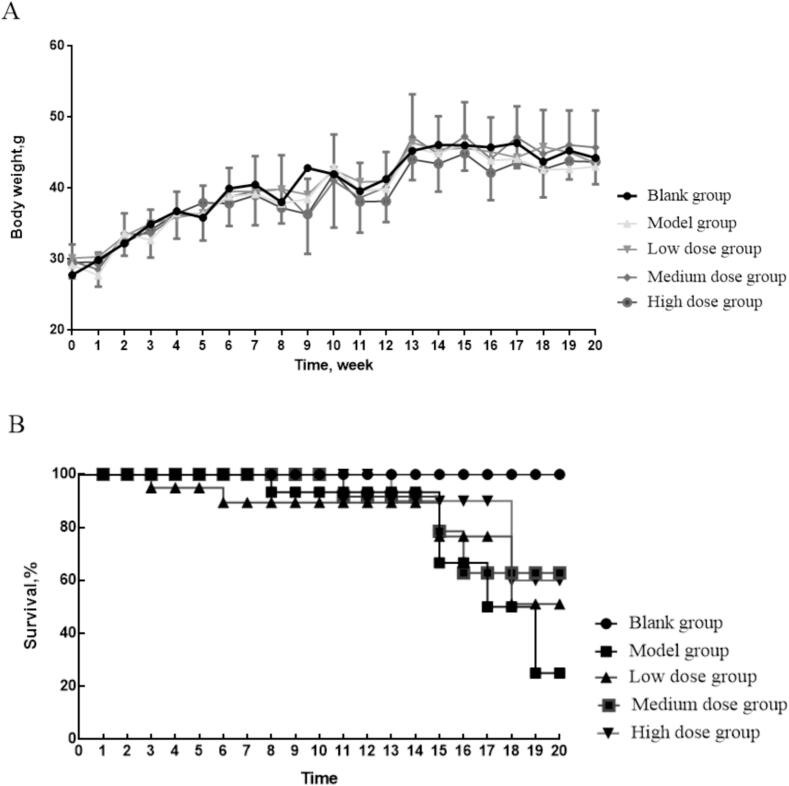
This study aimed to evaluate the preventive efficacy of tocotrienol in inhibiting the nuclear factor-kappa B (NF-κB) mediated inflammation pathways in colorectal cancer. We utilized the azoxymethane (AOM) and dextran sulfate sodium salt (DSS) to induce colitis-associated colorectal cancer (CAC) mice model. In generating a CAC model, mice were intraperitoneally injected with AOM at a concentration of 10 mg/kg body weight. Seven days after the AOM injection, mice drinking water containing 3 % DSS for 1 week, followed by a 2-week period of regular water. This cycle of DSS treatment (1-week 3 % DSS+2-week water) was repeated for two additional cycles. Mice were randomly divided into five groups (n = 20/group), including Blank group, Model group, three different dosages tocotrienol groups (Low dose group [50 mg/kg], Medium dose group [75 mg/kg], and High dose group [100 mg/kg]). The protective effects of tocotrienol were assessed using histological, flow cytometry, western blot and mouse Luminex assay. Compared with the blank group, expressions of toll-like receptor 4 (TLR4), myeloid differentiation protein 88 (MyD88), tumor necrosis factor receptor-associated factor 6 (TRAF-6), NF-κB, Interleukin (IL)-6 and tumor necrosis factor (TNF) -α were increased in model group, while IL-4 and IL-10 were decreased in model group (<0.05). Tocotrienol prevented carcinogenesis and decreased the IL-6, TNF-α, MyD88, TLR4, TRAF-6 and NF-κB expression levels, compared with the model group (<0.05). Compared with the model group, the expression of IL-10 was increased in medium dose group and high dose group (<0.05). The protective effects of tocotrienol may be related to the inhibition of TLR4 /MyD88 /NF-κB mediated inflammatory signaling pathways. Therefore, the use of tocotrienol can improve the abnormal expression of cytokines in a mouse model of colorectal cancer and inhibit the occurrence and development of colorectal cancer.
本研究旨在评估生育三烯酚在抑制结直肠癌中核因子-κB(NF-κB)介导的炎症通路方面的预防效果。我们利用氧化偶氮甲烷(AOM)和葡聚糖硫酸钠(DSS)诱导结肠炎相关结直肠癌(CAC)小鼠模型。在建立CAC模型时,给小鼠腹腔注射浓度为10毫克/千克体重的AOM。AOM注射7天后,让小鼠饮用含3% DSS的水1周,随后2周饮用常规水。将DSS处理的这个周期(1周3% DSS + 2周水)再重复两个周期。小鼠被随机分为五组(每组n = 20),包括空白组、模型组、三个不同剂量的生育三烯酚组(低剂量组[50毫克/千克]、中剂量组[75毫克/千克]和高剂量组[100毫克/千克])。使用组织学、流式细胞术、蛋白质免疫印迹和小鼠Luminex检测法评估生育三烯酚的保护作用。与空白组相比,模型组中Toll样受体4(TLR4)、髓样分化蛋白88(MyD88)、肿瘤坏死因子受体相关因子6(TRAF-6)、NF-κB、白细胞介素(IL)-6和肿瘤坏死因子(TNF)-α的表达增加,而模型组中IL-4和IL-10减少(<0.05)。与模型组相比,生育三烯酚可预防癌变并降低IL-6、TNF-α、MyD88、TLR4、TRAF-6和NF-κB的表达水平(<0.05)。与模型组相比,中剂量组和高剂量组中IL-10的表达增加(<0.05)。生育三烯酚的保护作用可能与抑制TLR4 / MyD88 / NF-κB介导的炎症信号通路有关。因此,使用生育三烯酚可改善结直肠癌小鼠模型中细胞因子的异常表达,并抑制结直肠癌的发生和发展。