Department of Physical Therapy, Faculty of Medical Science, Nagoya Women's University, 3-40 Shioji-cho, Mizuho-ku, Nagoya, Aichi, 467-8610, Japan.
Department of Cardiac Rehabilitation, Iwama Cardiovascular and Dental Clinic for Prevention and Care, 3rd Floor, Kamei Kousan Building, 2-7-23 Oji, Oji-cho, Kitakatsuragi-gun, Nara, 636-0002, Japan.
Sci Rep. 2024 Oct 16;14(1):24217. doi: 10.1038/s41598-024-75362-9.
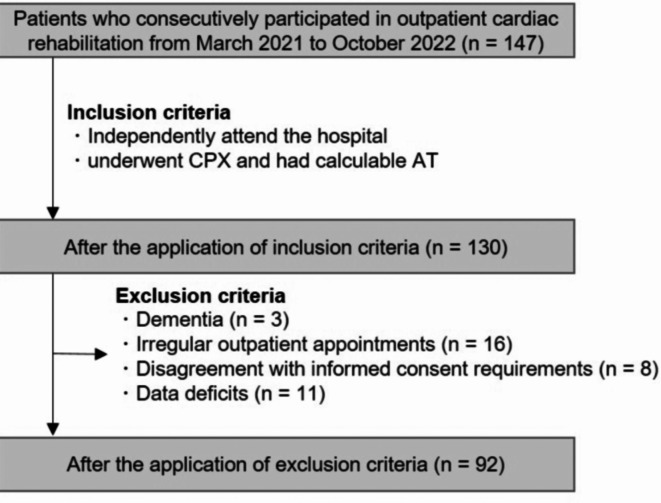
Cardiac rehabilitation is crucial for the secondary prevention of cardiovascular disease, the leading cause of death worldwide. In Japan, as hospitalization periods have been shortened due to advances in medical technology and government policies, outpatient rehabilitation focused on lifestyle and physical activity (PA) is becoming increasingly important as hospital stays shorten. This study was aimed to identify patient characteristics that define the different types of PA and sedentary behaviors, and patient factors in 92 Japanese outpatients by using accelerometers. The patients were found to spend considerable time being sedentary (663.7 ± 118.1 min/day) and very little time engaging in moderate-to-vigorous PA (MVPA, 25.6 (10.6-43.4) min/day). Regression analysis revealed that the daily duration of sedentary behavior was 64 min longer in men than in women (β = 64.2, 95% CI[12.9, 115], p = 0.015); furthermore, men engaged in 22% less light PA (β = -0.245, 95% CI[-0.388, -0.102], p = 0.001). Additionally, MVPA increased by 43% for every 1 metabolic equivalent (MET) task increase in the anaerobic threshold (AT) (β = 0.367, 95% CI[0.035, 0.698], p = 0.031) but decreased by 3% per year of age(β = -0.035, 95% CI[-0.056, -0.015], p < 0.001). The study also found that body mass index (BMI) was negatively correlated with walking time (β = -0.039, 95% CI[-0.075, -0.003], p = 0.036), while AT was positively correlated with MVPA (β = 0.367, 95% CI[0.035, 0.698], p = 0.031) but negatively correlated with time above the AT (β = -2.06, 95% CI[-2.53, -1.59], p < 0.001). These results emphasize the importance of customizing rehabilitation programs according to sex, age, BMI, and AT differences. Furthermore, monitoring home activities and providing individualized prescriptions may enhance the effectiveness of rehabilitation programs.
心脏康复对于心血管疾病的二级预防至关重要,心血管疾病是全球范围内的主要死亡原因。在日本,由于医疗技术的进步和政府政策的影响,住院时间已经缩短,因此以生活方式和身体活动(PA)为重点的门诊康复变得越来越重要。本研究旨在通过使用加速度计确定定义不同类型 PA 和久坐行为的患者特征,以及 92 名日本门诊患者的患者因素。研究发现,患者久坐时间相当长(663.7±118.1 分钟/天),而进行中高强度 PA(MVPA)的时间非常少(25.6(10.6-43.4)分钟/天)。回归分析显示,男性的久坐时间比女性长 64 分钟(β=64.2,95%CI[12.9,115],p=0.015);此外,男性进行的轻度 PA 减少了 22%(β=-0.245,95%CI[-0.388,-0.102],p=0.001)。此外,随着无氧阈(AT)每增加 1 个代谢当量(MET)任务,MVPA 增加 43%(β=0.367,95%CI[0.035,0.698],p=0.031),但每年年龄增加 3%(β=-0.035,95%CI[-0.056,-0.015],p<0.001)。研究还发现,身体质量指数(BMI)与步行时间呈负相关(β=-0.039,95%CI[-0.075,-0.003],p=0.036),而 AT 与 MVPA 呈正相关(β=0.367,95%CI[0.035,0.698],p=0.031),但与 AT 以上时间呈负相关(β=-2.06,95%CI[-2.53,-1.59],p<0.001)。这些结果强调了根据性别、年龄、BMI 和 AT 差异定制康复计划的重要性。此外,监测家庭活动并提供个性化的处方可能会提高康复计划的效果。