Department of Pediatric Neurology, French Reference Center for Neuromuscular Diseases, AP-HP, Hôpital Necker-Enfants Malades, 149 Rue de Sèvres, 75015, Paris, France.
Clinical Neurophysiology Department, AP-HP, Hôpital Necker Enfants Malades, Paris, France.
J Neuroeng Rehabil. 2024 Oct 17;21(1):183. doi: 10.1186/s12984-024-01477-9.
Onasemnogene abeparvovec gene replacement therapy (GT) has changed the prognosis of patients with spinal muscular atrophy (SMA) with variable outcome regarding motor development in symptomatic patients. This pilot study evaluates acceptability, validity and clinical relevance of Inertial Measurement Units (IMU) to monitor spontaneous movement recovery in early onset SMA patients after GT.
Clinical assessments including CHOPINTEND score (the gold standard motor score for infants with SMA) and IMU measurements were performed before (M0) and repeatedly after GT. Inertial data was recorded during a 25-min spontaneous movement task, the child lying on the back, without (10 min) and with a playset (15 min) wearing IMUs. Two commonly used parameters, norm acceleration 95th centile (||A||_95) and counts per minute (||A||_CPM) were computed for each wrist, elbow and foot sensors.
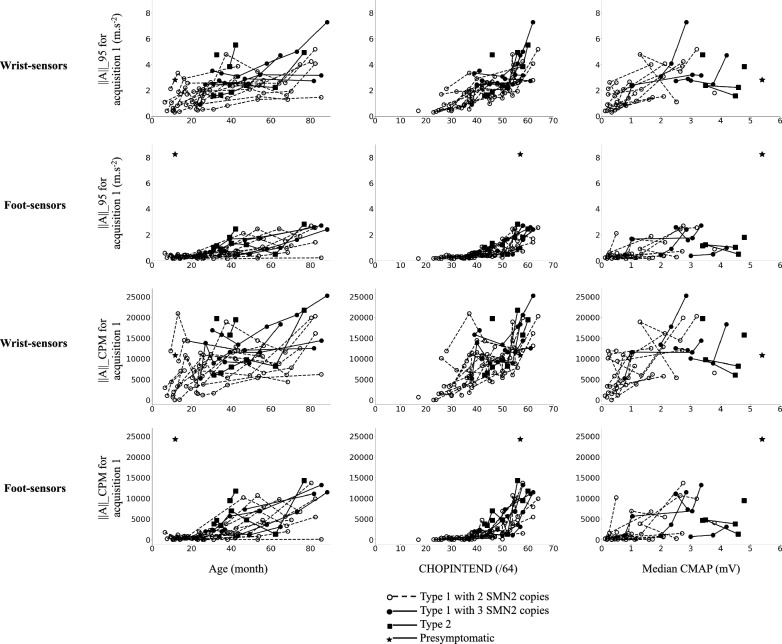
23 SMA-patients were included (mean age at diagnosis 8 months [min 2, max 20], 19 SMA type 1, three type 2 and one presymptomatic) and 104 IMU-measurements were performed, all well accepted by families and 84/104 with a good child participation (evaluated with Brazelton scale). ||A||_95 and ||A||_CPM showed high internal consistency (without versus with a playset) with interclass correlation coefficient for the wrist sensors of 0.88 and 0.85 respectively and for the foot sensors of 0.93 and 0.91 respectively. ||A||_95 and ||A||_CPM were strongly correlated with CHOPINTEND (r for wrist sensors 0.74 and 0.67 respectively and for foot sensors 0.61 and 0.68 respectively, p-values < 0.001). ||A||_95 for the foot, the wrist, the elbow sensors and ||A||_CPM for the foot, the wrist, the elbow sensors increased significantly between baseline and the 12 months follow-up visit (respective p-values: 0.004, < 0.001, < 0.001, 0.006, < 0.001, < 0.001).
IMUs were well accepted, consistent, concurrently valid, responsive and associated with unaided sitting acquisition especially for the elbow sensors. This study is the first reporting a large set of inertial sensor derived data after GT in SMA patients and paves the way for IMU-based follow-up of SMA patients after treatment.
Onasemnogene abeparvovec 基因替换疗法(GT)改变了脊髓性肌萎缩症(SMA)患者的预后,对于有症状的患者,运动发育的结果各不相同。本初步研究评估了惯性测量单元(IMU)在 GT 后监测早期发病 SMA 患者自发性运动恢复的可接受性、有效性和临床相关性。
在 GT 之前(M0)和之后重复进行临床评估,包括 CHOPINTEND 评分(SMA 婴儿的金标准运动评分)和 IMU 测量。在儿童仰卧、不戴(10 分钟)和戴游戏套装(15 分钟)的情况下,IMU 记录 25 分钟的自发性运动任务中的惯性数据。对于每个手腕、肘部和脚部传感器,计算了两个常用参数,即归一化加速度 95 百分位(||A||_95)和每分钟计数(||A||_CPM)。
共纳入 23 名 SMA 患者(诊断时的平均年龄为 8 个月[最小 2 岁,最大 20 岁],19 名 SMA 1 型,3 名 SMA 2 型,1 名无症状前 SMA 患者),共进行了 104 次 IMU 测量,均被家庭很好地接受,其中 84/104 次具有良好的儿童参与度(用 Brazelton 量表评估)。||A||_95 和 ||A||_CPM 显示出较高的内部一致性(有无游戏套装),手腕传感器的组内相关系数分别为 0.88 和 0.85,脚部传感器的组内相关系数分别为 0.93 和 0.91。||A||_95 和 ||A||_CPM 与 CHOPINTEND 高度相关(手腕传感器的相关系数分别为 0.74 和 0.67,脚部传感器的相关系数分别为 0.61 和 0.68,p 值均<0.001)。||A||_95 脚部、手腕、肘部传感器和 ||A||_CPM 脚部、手腕、肘部传感器在基线和 12 个月随访之间显著增加(各自的 p 值分别为 0.004、<0.001、<0.001、0.006、<0.001、<0.001)。
IMU 被很好地接受,具有一致性、同时有效性、反应性,并与无辅助坐立获取有关,特别是肘部传感器。本研究首次报道了 SMA 患者 GT 后大量惯性传感器衍生数据,并为 SMA 患者治疗后的基于 IMU 的随访铺平了道路。