Pediatric Neurology, Santobono-Pausilipon Children's Hospital, Naples, Italy.
Department of Pharmacy, Santobono-Pausilipon Children's Hospital, Naples, Italy.
Gene Ther. 2023 Aug;30(7-8):592-597. doi: 10.1038/s41434-022-00341-6. Epub 2022 May 24.
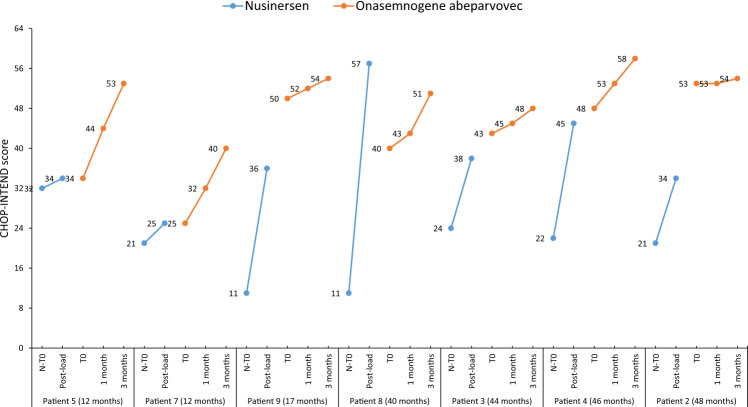
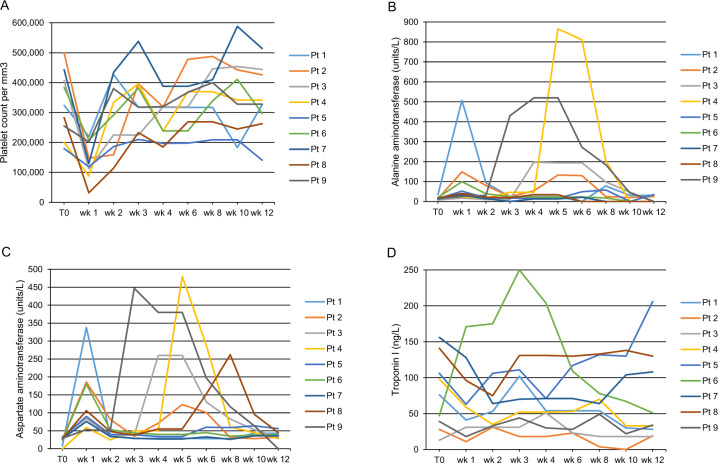
Spinal muscular atrophy (SMA) is a genetically inherited recessive neuromuscular disease that causes muscular atrophy and weakness. Onasemnogene abeparvovec (formerly AVXS-101, Zolgensma®, Novartis) is a targeted therapy approved to treat patients with SMA in >40 countries worldwide. This study describes the clinical efficacy and tolerability of gene replacement therapy with onasemnogene abeparvovec over a 3-month period in 9 SMA type 1 patients aged 1.7-48 months, with 7 patients on stable nusinersen (i.e., had received all four nusinersen loading doses before inclusion in this study). Liver function (alanine aminotransferase, aspartate aminotransferase, total bilirubin), troponin I, platelet counts, creatinine levels, and motor function (CHOP-INTEND) were monitored. For the seven patients on stable nusinersen, the median baseline CHOP-INTEND score increased significantly during nusinersen treatment (Wilcoxon signed-rank test p = 0.018) and at 3 months after switching to onasemnogene abeparvovec (Wilcoxon signed-rank test p = 0.0467). We also identified two patients who responded poorly to nusinersen but showed the largest increase in baseline CHOP-INTEND scores at 1 and 3 months after switching, which could suggest that poor responders to nusinersen may respond favorably to onasemnogene abeparvovec. No unknown adverse events occurred. One patient developed moderate/severe thrombocytopenia 1 week after onasemnogene abeparvovec administration that resolved after treatment. Our study suggests the possibility of a change in the dynamic of CHOP-INTEND for patients who respond poorly to nusinersen after switching therapy to onasemnogene abeparvovec. Alternatively, patient age at treatment initiation may impact the response to onasemnogene abeparvovec. Testing in larger patient populations must be undertaken to assess the plausibility of these hypotheses.
脊髓性肌萎缩症(SMA)是一种遗传性隐性神经肌肉疾病,可导致肌肉萎缩和无力。onasemnogene abeparvovec(前称 AVXS-101、Zolgensma®、诺华制药)是一种靶向疗法,已在全球 40 多个国家获得批准,用于治疗 SMA 患者。本研究描述了在 9 名年龄为 1.7-48 个月的 1 型 SMA 患者中,使用 onasemnogene abeparvovec 进行基因替代治疗 3 个月的临床疗效和耐受性,其中 7 名患者正在接受稳定剂量的 nusinersen(即,在纳入本研究前已接受了全部 4 次 nusinersen 负荷剂量)。监测了肝功能(丙氨酸氨基转移酶、天冬氨酸氨基转移酶、总胆红素)、肌钙蛋白 I、血小板计数、肌酐水平和运动功能(CHOP-INTEND)。对于正在接受稳定剂量 nusinersen 的 7 名患者,CHOP-INTEND 评分的中位数基线在 nusinersen 治疗期间显著升高(Wilcoxon 符号秩检验,p=0.018),在切换至 onasemnogene abeparvovec 后 3 个月时也显著升高(Wilcoxon 符号秩检验,p=0.0467)。我们还发现了两名对 nusinersen 反应不佳的患者,他们在切换后 1 个月和 3 个月时的基线 CHOP-INTEND 评分增加最大,这可能表明对 nusinersen 反应不佳的患者对 onasemnogene abeparvovec 可能有良好的反应。未发生新的未知不良事件。1 名患者在接受 onasemnogene abeparvovec 治疗后 1 周出现中度/重度血小板减少症,经治疗后缓解。我们的研究表明,在切换治疗方案至 onasemnogene abeparvovec 后,对 nusinersen 反应不佳的患者,CHOP-INTEND 的动态可能发生变化。或者,患者开始治疗时的年龄可能会影响对 onasemnogene abeparvovec 的反应。必须在更大的患者群体中进行测试,以评估这些假设的可能性。