Lu Yue, Walji Tezin, Pandey Pratima, Zhou Chuanli, Habela Christa W, Snapper Scott B, Li Rong, Chen Elizabeth H
Department of Molecular Biology, University of Texas Southwestern Medical Center, Dallas, TX, USA.
Department of Immunology, University of Texas Southwestern Medical Center, Dallas, TX, USA.
bioRxiv. 2024 Oct 8:2024.09.30.615960. doi: 10.1101/2024.09.30.615960.
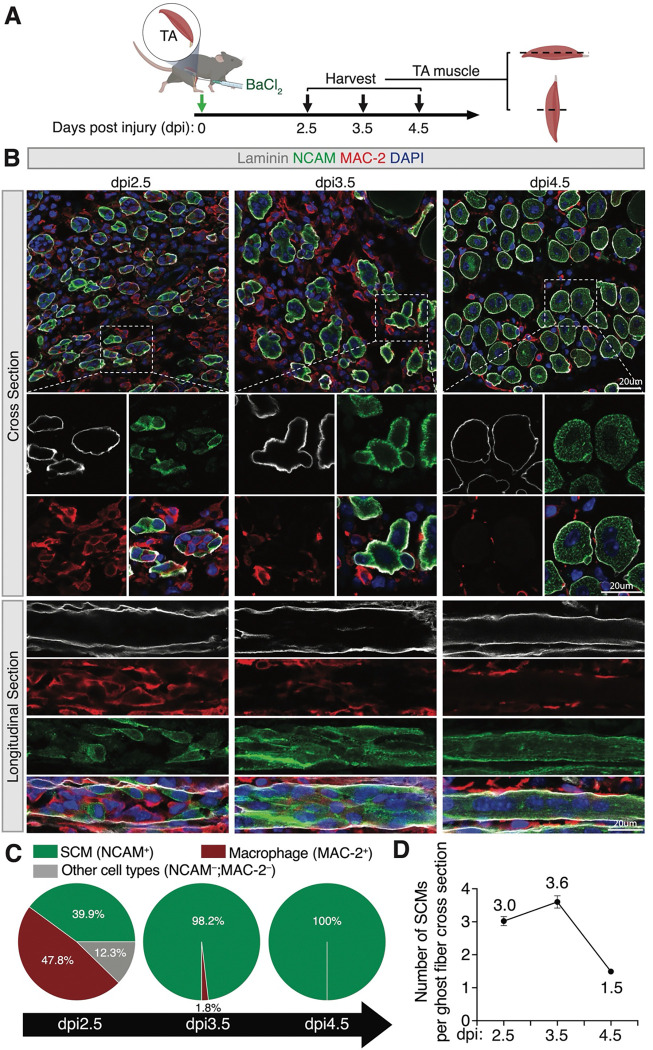
Skeletal muscle regeneration is a multistep process involving the activation, proliferation, differentiation, and fusion of muscle stem cells, known as satellite cells. The fusion of satellite cell-derived mononucleated muscle cells (SCMs) is indispensable for the generation of multinucleated, contractile myofibers during muscle repair. However, the molecular and cellular mechanisms underlying SCM fusion during muscle regeneration remain poorly understood. In this study, we uncovered an essential role for branched actin polymerization in SCM fusion. Using conditional knockouts of the Arp2/3 complex and its actin nucleation-promoting factors, N-WASP and WAVE, we demonstrated that branched actin polymerization is required for the SCM fusion, but not for satellite cell proliferation, differentiation, and migration. We showed that the N-WASP and WAVE complexes have partially redundant functions in regulating SCM fusion. Furthermore, we showed that branched actin polymerization is essential for generating invasive protrusions at the fusogenic synapses in SCMs. Taken together, our study has identified new components of the myoblast fusion machinery in skeletal muscle regeneration and demonstrated a critical role for branched actin-propelled invasive protrusions in this process.
骨骼肌再生是一个多步骤过程,涉及肌肉干细胞(即卫星细胞)的激活、增殖、分化和融合。卫星细胞衍生的单核肌细胞(SCMs)的融合对于肌肉修复过程中多核收缩性肌纤维的生成不可或缺。然而,肌肉再生期间SCM融合的分子和细胞机制仍知之甚少。在本研究中,我们发现了分支肌动蛋白聚合在SCM融合中的重要作用。通过条件性敲除Arp2/3复合体及其肌动蛋白成核促进因子N-WASP和WAVE,我们证明分支肌动蛋白聚合是SCM融合所必需的,但对于卫星细胞的增殖、分化和迁移并非必需。我们表明,N-WASP和WAVE复合体在调节SCM融合方面具有部分冗余功能。此外,我们表明分支肌动蛋白聚合对于在SCM的融合突触处产生侵袭性突起至关重要。综上所述,我们的研究确定了骨骼肌再生中成肌细胞融合机制的新成分,并证明了分支肌动蛋白推动的侵袭性突起在此过程中的关键作用。