Long Nicole, Sheets Kimberly, Thornton Erin Kennedy, Ross Ann H
Department of Biological Sciences, North Carolina State University, Raleigh, NC, USA.
Department of Anthropology, Washington State University, Pullman, WA, USA.
Forensic Sci Res. 2024 Jul 23;9(3):owae038. doi: 10.1093/fsr/owae038. eCollection 2024 Sep.
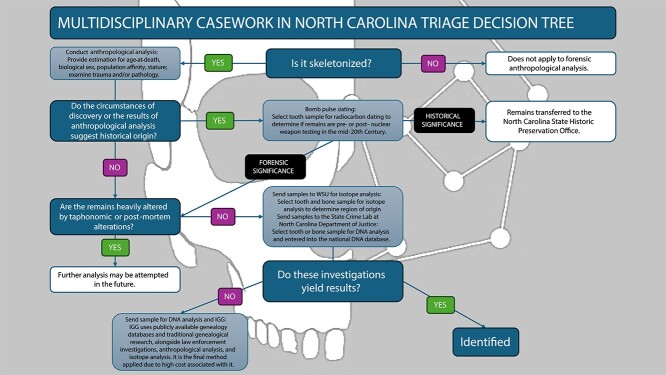
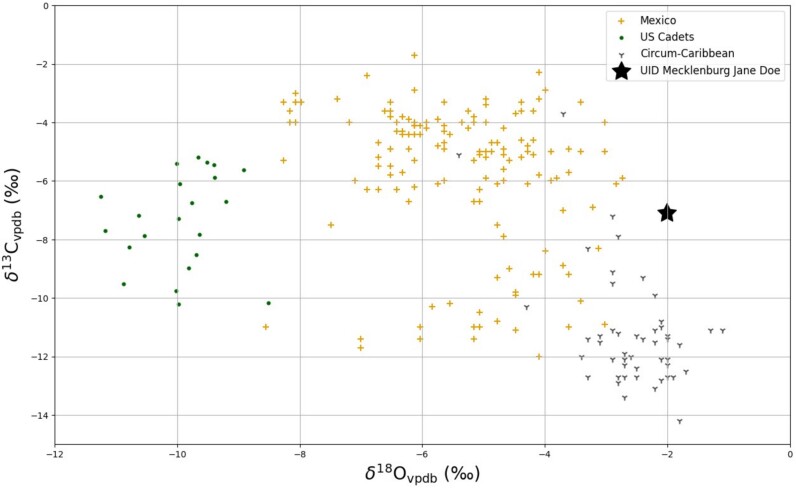
A multidisciplinary approach in the investigation of unidentified decedents employs the use of a variety of scientific approaches. This approach is applied in casework in North Carolina, USA and has led to successful identifications using anthropological analysis and population affinity estimation using 3D-ID, investigative genetic geneaology (IGG), and isotopic analyses. Results from one scientific approach can help to inform the others, providing more information about the decedent, and thus enhancing the investigation. This case report outlines three cases from North Carolina that combine each of these scientific approaches and serve as examples of collaboration in a multidisciplinary approach.
Anthropological analyses including population affinity using 3D-ID can be used in conjunction with isotopic analyses in estimating geographic origin.Results from anthropological and isotopic analyses can help to narrow down or direct IGG.Multidisciplinary collaboration in the investigation of unidentified decedents enhances the investigation.
对身份不明死者进行调查时采用的多学科方法运用了多种科学方法。这种方法在美国北卡罗来纳州的案件工作中得到应用,并通过人类学分析以及使用3D-ID进行人口亲缘关系估计、调查性遗传谱系学(IGG)和同位素分析成功实现了身份识别。一种科学方法的结果可以为其他方法提供信息,提供更多关于死者的信息,从而加强调查。本病例报告概述了北卡罗来纳州的三个案例,这些案例结合了上述每种科学方法,并作为多学科方法合作的示例。
包括使用3D-ID进行人口亲缘关系分析在内的人类学分析可与同位素分析结合用于估计地理来源。人类学和同位素分析的结果有助于缩小或指导IGG。对身份不明死者进行调查时的多学科合作可加强调查。