
双质粒相互作用刺激了金合欢烯在……中的积累。
Dual-plasmid interactions stimulate the accumulation of valencene in .
作者信息
Zhu Chaoyi, Cai Shengliang, Liu Peiling, Chen Dongying, Zhou Jingtao, Zhuo Min, Li Shuang
机构信息
School of Biology and Biological Engineering, South China University of Technology, Guangzhou, 510006, China.
出版信息
Biotechnol Notes. 2023 Dec 11;4:127-134. doi: 10.1016/j.biotno.2023.12.004. eCollection 2023.
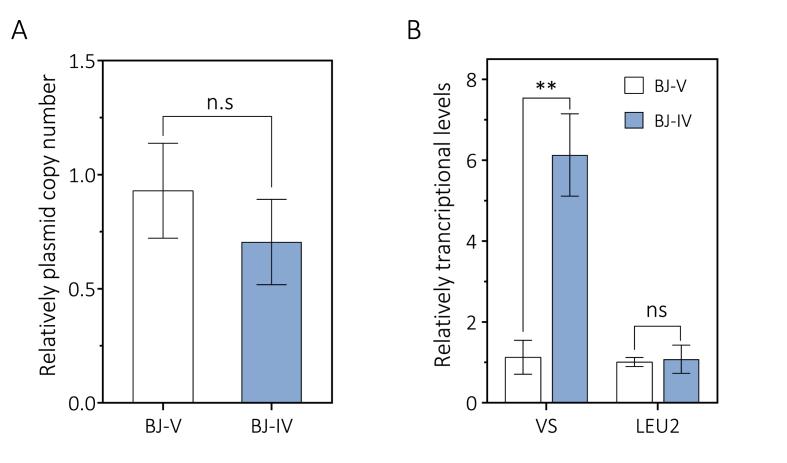
Plasmids are one of the most commonly used basic tools in the construction of microbial cell factories, the use of which individually or in pairs play an important role in the expression of exogenous gene modules. However, little attention has been paid to the interactions of plasmid-plasmid and plasmid-host in the widespread use of the double plasmid system. In this study, we demonstrated that dual-plasmid interactions facilitated to cell growth and product accumulation in . The strain containing both the expression plasmid pEV (a plasmid carrying the gene encoding valencene synthase) and the assistant plasmid pI (an empty plasmid expressing no extra gene) showed a significant improvement in relative growth rate, biomass and valencene production compared to the strain containing only the pEV plasmid. The transcriptional level analysis revealed an up-regulated expression of specific gene on the expression plasmid pEV stimulated by the assistant plasmid pI in the dual-plasmid interactions. Further investigations demonstrated the essential roles of the promoters of the expression plasmid pEV and the CEN/ARS element of the assistant plasmid pI in the dual-plasmid interactions. Combined with the results of predicted nucleosome occupancy, a response model of interaction based on the key T(n)C and CEN/ARS element was established. Moreover, the transformation order of the two plasmids significantly affected the response effect, implying the dominance of plasmid pI in the dual-plasmid interactions. Our finding first demonstrated that dual plasmids regulate the gene expression through spatial interactions at DNA sequences level, which provides a new perspective for the development of microbial cell factories in future.
质粒是构建微生物细胞工厂最常用的基础工具之一,单独或成对使用时,它们在外源基因模块的表达中发挥着重要作用。然而,在双质粒系统的广泛应用中,质粒-质粒和质粒-宿主之间的相互作用却很少受到关注。在本研究中,我们证明了双质粒相互作用促进了细胞生长和产物积累。与仅含有表达质粒pEV(携带编码瓦伦烯合酶基因的质粒)的菌株相比,同时含有表达质粒pEV和辅助质粒pI(不表达额外基因的空质粒)的菌株在相对生长速率、生物量和瓦伦烯产量方面均有显著提高。转录水平分析表明,在双质粒相互作用中,辅助质粒pI刺激了表达质粒pEV上特定基因的上调表达。进一步研究表明,表达质粒pEV的启动子和辅助质粒pI的CEN/ARS元件在双质粒相互作用中起着至关重要的作用。结合预测的核小体占有率结果,建立了基于关键T(n)C和CEN/ARS元件的相互作用响应模型。此外,两种质粒的转化顺序显著影响响应效果,这意味着质粒pI在双质粒相互作用中占主导地位。我们的发现首次证明了双质粒通过DNA序列水平的空间相互作用来调控基因表达,这为未来微生物细胞工厂的发展提供了新的视角。




 Zotero 插件