Cadiñanos Julen, Rodríguez-Centeno Javier, Montejano Rocío, Esteban-Cantos Andrés, Mena-Garay Beatriz, Jiménez-González María, Saiz-Medrano Gabriel, de Miguel Rosa, Rodríguez-Artalejo Fernando, Bernardino José I, Marcelo-Calvo Cristina, Gutierrez-García Lucía, Martínez-Martín Patricia, Díez Vidal Alejandro, de Gea Grela Alejandro, Ortolá Rosario, Rodés Berta, Arribas José R
Department of Internal Medicine, La Paz University Hospital-IdiPAZ, Madrid, Spain.
CIBER of Infectious Diseases, Madrid, Spain.
Open Forum Infect Dis. 2024 Sep 23;11(10):ofae550. doi: 10.1093/ofid/ofae550. eCollection 2024 Oct.
People with HIV-1 (PWH) age differently than the general population. Blood telomere length (BTL) attrition is a surrogate biomarker of immunosenescence and aging in PWH. BTL is reduced immediately after HIV-1 infection and recovers in PWH with long-term virologic suppression, but the extent of this recovery is unknown.
This prospective 6-year observational study assessed the evolution of BTL in PWH who were virologically suppressed. A cross-sectional analysis additionally compared BTL with age- and sex-matched blood donors and sex-matched persons older than 60 years from a general population cohort. DNA from whole blood was isolated, and relative BTL was determined by monochrome quantitative multiplex polymerase chain reaction assay and expressed as the ratio of telomere to single-copy gene (T/S).
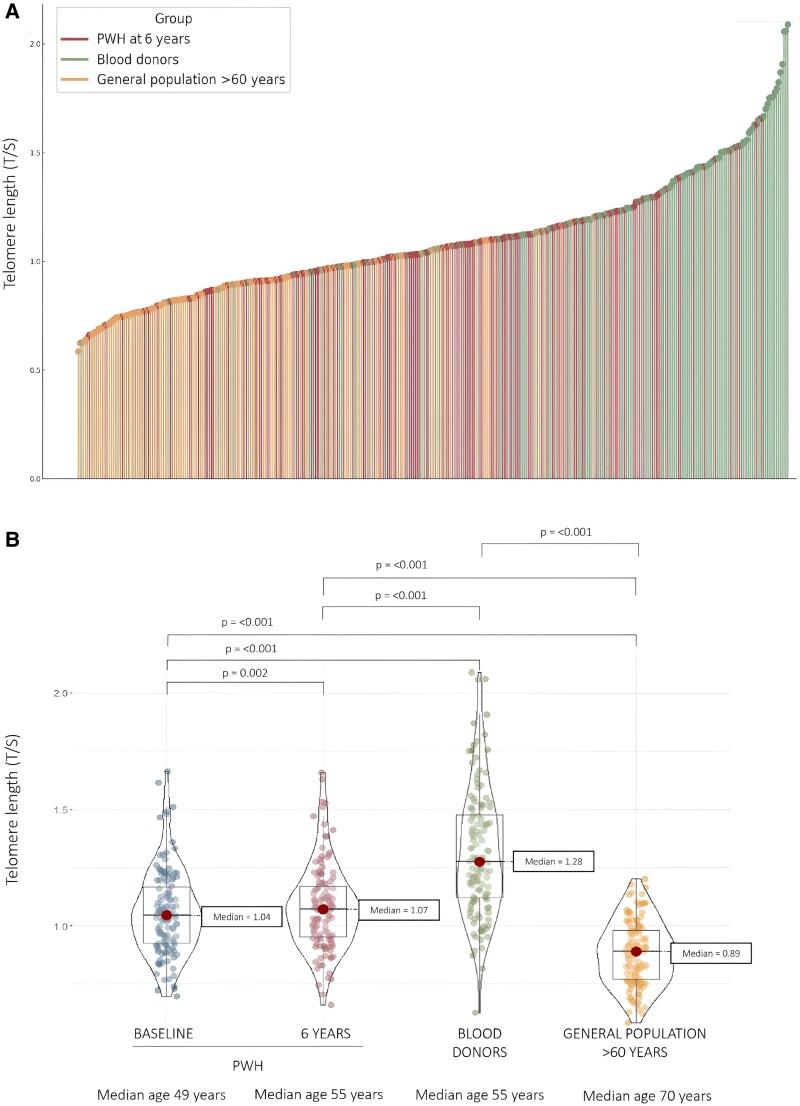
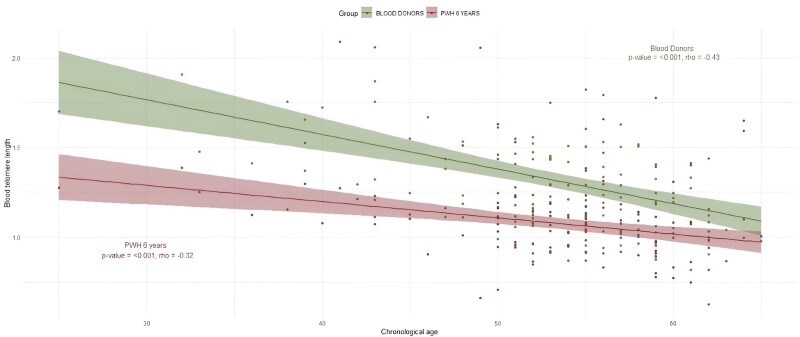
A total of 128 PWH were included in the prospective 6-year observational study. These same 128 PWH (median age, 55 years; 27.3% women) were compared cross-sectionally at 6-year follow-up with 128 age- and gender-matched blood donors (median age, 55 years) and 128 gender-matched individuals older than 60 years from a general population cohort (median age, 70 years). An inverse correlation between age and BTL was observed. The median BTL of PWH was shorter than their matched blood donors (T/S, 1.07 [IQR, 0.95-1.17] vs 1.28 [IQR, 1.12-1.48]; < .001) but longer than the elderly population (T/S, 0.89 [IQR, 0.77-0.98], < .001). PWH experienced a BTL increase at 6 years of 2.9% (T/S, 1.04 vs 1.07; = .002). In PWH, age was associated with a shorter BTL (coefficient, -0.007 45, SE = 0.002 04, = .002) and baseline lower CD4 count with a gain in BTL (coefficient, -0.000 06, SE = 0.000 02, = .004). Shorter baseline BTL (odds ratio, 0.91 [95% CI, .87-.94]; < .001) and higher glucose levels (odds ratio, 1.04 [95% CI, 1.02-1.07]; = .003) were associated with a greater similarity of BTL to the elderly population.
PWH with long-term virologic suppression experience a trend toward an increased BTL after 6 years of follow-up. Middle-aged people with long-term controlled HIV-1 have a shorter BTL than expected for their chronologic age but longer than that of people 15 years older in the general population.
HIV-1感染者(PWH)的衰老过程与普通人群不同。血液端粒长度(BTL)损耗是PWH免疫衰老和衰老的替代生物标志物。HIV-1感染后BTL立即缩短,在病毒得到长期抑制的PWH中会有所恢复,但恢复程度尚不清楚。
这项为期6年的前瞻性观察性研究评估了病毒得到抑制的PWH中BTL的变化情况。一项横断面分析还将BTL与年龄和性别匹配的献血者以及来自普通人群队列的60岁以上性别匹配者进行了比较。从全血中分离DNA,通过单色定量多重聚合酶链反应测定法确定相对BTL,并表示为端粒与单拷贝基因的比率(T/S)。
共有128名PWH纳入了这项为期6年的前瞻性观察性研究。在6年随访时,将这128名PWH(中位年龄55岁;27.3%为女性)与128名年龄和性别匹配的献血者(中位年龄55岁)以及128名来自普通人群队列的60岁以上性别匹配者(中位年龄70岁)进行了横断面比较。观察到年龄与BTL呈负相关。PWH的中位BTL短于其匹配的献血者(T/S,1.07[四分位间距,0.95 - 1.17]对1.28[四分位间距,1.12 - 1.48];P <.001),但长于老年人群(T/S,0.89[四分位间距,0.77 - 0.98],P <.001)。PWH在6年时BTL增加了2.9%(T/S,1.04对1.07;P =.002)。在PWH中,年龄与较短的BTL相关(系数,-0.007 45,标准误 = 0.002 04,P =.002),基线CD4计数较低与BTL增加相关(系数,-0.000 06,标准误 = 0.000 02,P =.004)。较短的基线BTL(比值比,0.91[95%置信区间,0.87 -.94];P <.001)和较高的血糖水平(比值比,1.04[95%置信区间,1.02 - 1.07];P =.003)与BTL与老年人群的更大相似性相关。
经过6年随访,病毒得到长期抑制的PWH的BTL有增加的趋势。长期HIV-1得到控制的中年人的BTL比其实际年龄预期的要短,但比普通人群中比他们大15岁的人的BTL要长。